Answering the need for clear water and safer aquariums, these UV-based solutions are ideal for hobbyists seeking algae control, reduced green water, and improved water quality. The best picks suit different tank sizes and setups, from small freshwater tanks to larger setups that include saltwater environments. This guide highlights five UV-focused products, who they’re best for, and practical buying tips so you can choose confidently.
Summary Table
| Product | Best For | Tank Size Range | Key Benefit |
|---|---|---|---|
| COODIA Internal Green Water Killer | Beginner to intermediate freshwater or saltwater setups | Up to 75 gallons | Turns green water clear in days |
| hygger U-V Light with Timer | Small to medium freshwater or saltwater tanks | 5-25 gallons | Safe with 360° shield, multiple timer modes |
| JAHEA Aquarium Clean Light | Budget-friendly small tanks | 3-30 gallons | Easy operation, quick disinfection |
| coospider-repta 200GPH U-V Filter | Mid-sized tanks with noise concerns | 20-75 gallons | 4-in-1 function, independent U-V switch |
| AquaMiracle SV-500 | Small to mid tanks needing combined filtration & UV | 10-30 gallons | Integrated filter sponge and U-V light with timer |
COODIA Internal Green Water Killer Aquarium Filter Tank U-V Pump

Best for: Beginners and hobbyists looking for a simple, all-in-one UV solution for up to 75 gallons. The unit claims rapid green water removal and broad compatibility with both saltwater and freshwater tanks. This makes it a solid choice for mixed setups or new aquariums starting with green-water concerns.
Why selected: It emphasizes a practical safety profile through straightforward operation and reliable disinfection for everyday tanks, helping maintain clearer water without complex installation.
Limitations: Exact performance can vary by water conditions and bio-load; consider a backup plan for heavy algae blooms or very large ecosystems.
hygger Aquarium U-V Light with Timer

Best for: Small to medium freshwater or marine setups that need a compact UV solution with automated timing. The 3W unit is designed for 5-25 gallon tanks and includes a 360° shield for safety.
Why selected: The 254nm UV-C approach targets algae growth while the timer modes (3H, 6H, 12H, 24H) offer flexible maintenance schedules. A memory function helps keep settings consistent.
Caution: Ensure electrical components stay dry and away from water splashes; install according to provided safety guidelines.
JAHEA Aquarium Clean Light

Best for: Budget-conscious hobbyists with small tanks who want quick disinfection and clear water. The unit is a 3W mini UV lamp intended for smaller environments like ponds, pools, and indoor tanks.
Why selected: Includes a test card to verify UV authenticity and a temperature strip for tank safety. It promises noticeable clearing within 30 minutes to optimize maintenance time.
Limitation: Requires careful handling to avoid direct exposure; follow safety instructions to prevent skin or eye contact with UV light.
coospider-repta 200GPH Aquarium Filter with U-V

Best for: Mid-sized tanks (20-75 gallons) needing a compact, quiet, 4-in-1 solution that combines filtration, deodorization, oxygenation, and water circulation with UV disinfection.
Why selected: Double filtration with a U-V lamp enhances green-water control more quickly than filtration alone. An independent switch allows running filtration without UV if preferred.
Caution: Monitor power usage and ensure water contact with electrical parts stays within safety guidelines; do not run UV light when the tank is empty.
AquaMiracle Aquarium Filter with U – V Light & Filter Sponge
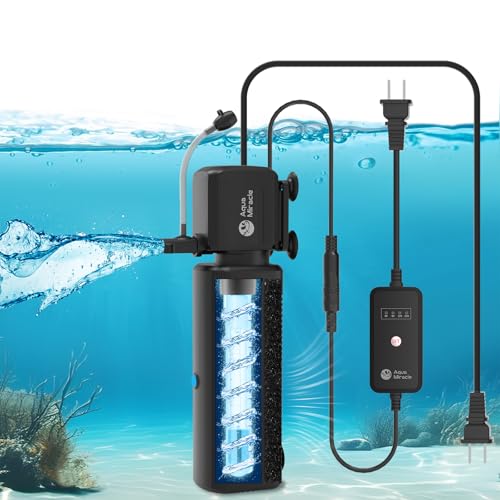
Best for: Small to mid tanks (10-30 gallons) needing a compact, integrated filtration and UV solution. The model combines a filter sponge with a U-V light and a timer for practical daily use.
Why selected: The integrated design reduces equipment clutter while providing both mechanical filtration and UV disinfection. The timer helps automate water treatment without extra steps.
Limitation: The unit is best suited for smaller tanks; very heavy bio-loads may require a larger or additional filtration system.
Buying Guide: UV For Fish Tanks
- Tank size and flow: Match UV units to your tank capacity. Larger tanks may require higher-output UV systems or multiple units for even disinfection.
- UV wavelength and effectiveness: Most consumer UV-A/B-C units use UV-C around 254 nm for disinfection. This helps reduce green water and algae but is not a substitute for regular water changes or proper filtration.
- System type: Consider integrated units (filter + UV) for space-saving setups versus standalone UV lamps that require separate filtration.
- Safety and installation: Look for 360° shields, splash-safe housings, and clear safety instructions. Never expose skin or eyes to UV light, and keep electrical components away from water.
- Maintenance schedule: Timers and memory features simplify consistent use. Track cleaning intervals for the filter media and check UV sleeves or bulbs as directed by the manufacturer.
- Compatibility with saltwater or freshwater: Some units are designed specifically for freshwater, others handle both. Confirm compatibility with your aquarium type.
- Replacement parts availability: Consider brands with easy access to bulbs or replacement sleeves to avoid long downtime.
Frequently Asked Questions
- Do UV lights kill beneficial bacteria? UV disinfection primarily targets free-floating algae and microorganisms in the water column. It can reduce some bacteria but does not replace the biological filtration established by your tank’s beneficial bacteria.
- How long should UV light run each day? Many products offer multiple timer options. Typical schedules range from a few hours per day to continuous cycles, depending on algae levels and tank size.
- Can UV light harm fish? When used as directed, UV-C exposure is contained within the housing. Risk occurs if bulbs break or if exposure occurs to exposed skin or eyes during maintenance.
- Is UV effective for all algae types? UV helps primarily with green water and certain algal blooms. Some algae in biofilms or filamentous forms may require additional mechanical or chemical controls.
- How do I choose the right wattage? Higher gallons-per-hour systems and larger tanks typically need stronger UV output. Start with a unit rated for your tank size and scale up if algae persists.