Looking for an automatic fish feeder that reliably dispenses pellets and keeps foods dry while you’re away? This guide highlights five top options suited for different setups—small tanks, large aquariums, or homes with limited power access. Each product is evaluated on ease of use, feeding accuracy, and moisture resistance to prevent clumping. The buyer profiles below show who each feeder is best for, such as frequent travelers, households with multiple tanks, or beginners seeking simple operation. A quick summary table follows to help compare at-a-glance.
Summary table of chosen products:
- DXOPHIEX Automatic Fish Feeder — Ideal for standard tanks; flexible power options.
- Petbank Automatic Fish Feeder (Moisture-Proof) — Best for moisture-prone environments and varied food types.
- FISHNOSH Automatic Fish Feeder (New Generation) — Great for small to mid-sized tanks; straightforward setup.
- Aoyar Automatic Fish Feeder — Good large-capacity, moisture-resistant option with easy intervals.
- Ycozy WiFi Automatic Fish Feeder — Best for remote control via app and power stability.
DXOPHIEX Automatic Fish Feeder For Aquariums

Best for: hobbyists with standard freshwater or tropical tanks who want reliable multi-time feeding and flexible power options. This feeder supports automatic feeds every 8, 12, or 24 hours, plus manual feeding. It offers two power sources—two AA batteries (not included) or USB power, with a 6.6-foot cable included. A notable advantage is the dual power setup that reduces downtime during outages. The design accommodates edge-molted tanks or hooded tanks with two fixed methods. Caution: battery replacement is required over time, and USB power is the default setting.
Petbank Automatic Fish Feeder (Moisture-Proof)

Best for: users who need precise portioning and a moisture-resistant design in humid environments. This feeder provides 16 grids for up to 15 meals and uses separate compartments to reduce moisture exposure. Each grid holds about 2g for accurate dosing. It offers two installation methods—adjustable clamp base or suction cup—so it fits most tanks. The device supports various foods, including pellets and powders, but is not suitable for shrimp or flakes. Consider: ensure the food type matches the device’s capacity and moisture control limits.
FISHNOSH Automatic Fish Feeder (New Generation)

Best for: small to large aquariums where straightforward setup and reliable timing matter. This new generation model supports a timer with up to nine feedings per day and allows three rounds per feeding, enabling a flexible schedule. It emphasizes simple operation with a user-friendly design—refills can be done without removing the unit. Limitation: it does not include a display screen, so advanced customization may require trial and error. Overall, choose this for an uncomplicated, dependable routine.
Aoyar Automatic Fish Feeder

Best for: hobbyists needing a large-capacity and moisture-resistant feeder for longer trips. Aoyar offers a 200ml cup with three fixed intervals (8, 12, 24 hours) plus manual feeding. It emphasizes upgraded moisture-proof lid technology to reduce humidity and prevent food clumping. This model suits households with reliable WiFi or stable power for more advanced users who want a simple, clear interval setup. Caution: designed for pellets and small foods; check compatibility with your specific fish diet.
Ycozy WiFi Automatic Fish Feeder
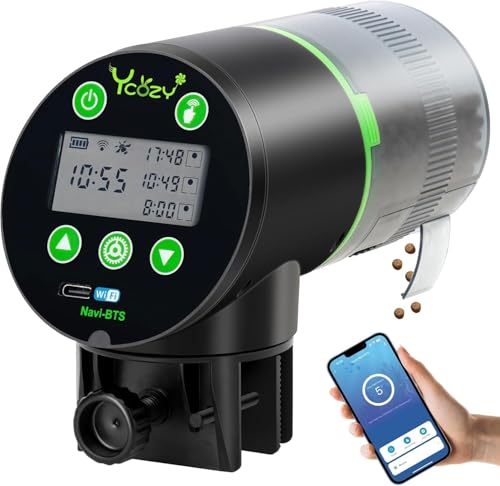
Best for: tech-friendly households needing remote operation and monitoring. This feeder connects via WiFi and app, allowing remote scheduling, history logs, and offline notifications during outages. It uses a USB-C power setup with 5V 1A input. The app synchronizes all settings with the feeder and provides automatic reconnection after power restoration. A potential limitation is the need for a stable 2.4GHz WiFi network and proximity to the router for reliable connection. Ideal for busy families who want to verify feeding remotely.
Buying Guide
Key purchase considerations help distinguish features that matter for different setups:
- Power source: Choose between battery, USB, or WiFi-powered models depending on your power reliability and tank location.
- Feeding capacity: Larger tanks with multiple fish benefit from higher capacity and multiple feedings per day.
- Moisture resistance: Look for moisture-proof lids or sealed compartments to prevent clumping in humid rooms or near water splashes.
- Portion control: Accurate dosing reduces overfeeding and water pollution. Check whether the device uses fixed grids or adjustable sliders.
- Installation: Some feeders work best on tank edges, others on hoods or curved surfaces. Ensure compatibility with your tank type.
- User interface: Simple one-button operation suits beginners; app-based controls offer advanced customization for tech-savvy users.
- Food compatibility: Verify the unit supports your pellet size, flakes, powders, or sticks. Some designs exclude certain food types.
Frequently Asked Questions
- What is the typical feeding interval for automatic fish feeders?
– Most models offer 8, 12, or 24-hour intervals, with some supporting multiple meals per day. - Can these feeders work during a power outage?
– Battery-backed models can continue, and some units switch to a built-in power source automatically. - Are moisture-proof feeders worth it for humid rooms?
– Yes, moisture-proof lids help prevent clumping and jammed mechanisms, improving reliability. - Is remote control necessary for vacation feeding?
– Not necessary, but WiFi-enabled models provide monitoring and adjustments from anywhere. - Can I use different food types with these feeders?
– Most support pellets and granules; check each product’s compatibility for flakes or powders. - How do I choose the best feeder for my tank size?
– Consider tank volume, number of fish, feeding frequency, and whether you need manual feeding as a backup.