Looking for a quiet aquarium filter that keeps water crystal clear without creating a noisy distraction? This guide highlights top, low-noise filters ideal for nano to mid-sized tanks. The picks emphasize quiet operation, reliable filtration, and ease of use for beginners and experienced hobbyists alike. Best for small tanks, such as 5–10 gallons, or mid-sized setups up to 45 gallons, these filters balance sound at low decibels with effective mechanical, chemical, and biological filtration.
Buyer focus snapshot:
- Best for nano tanks and shrimp or betta habitats: NICREW Slim Aquarium Filter (up to 5 gallons).
- Better for small to medium freshwaters with LED visibility: Aqueon QuietFlow 30 LED PRO (up to 45 gallons).
- Choose this if you want a compact in-tank option with auto restart: Aqueon QuietFlow 10 E (up to 10 gallons).
- Best for larger small-to-medium tanks seeking ultra-quiet operation: Tetra Whisper IQ Power Filter 20/45 Gallon.
- Consider for budget-friendly, quiet performance with multi-stage filtration: AQUA-TECH Ultra Quiet Power Filter (20–40 gallons).
Tetra Whisper IQ Power Filter 20 Gallons

Best for small tanks up to 20 gallons with a compact footprint. Features Stay Clean technology and a sound shield to keep noise below 40 dB, plus a submerged motor that auto-starts after power interruptions. This filter is ideal for aquariums where minimal noise is crucial, such as bedrooms or study setups. The self-priming design reduces maintenance effort.
Who it’s best for: hobbyists with 10–20 gallon tanks needing quiet operation and reliable priming. Why selected: combines quiet performance with practical 130 GPH flow suitable for small community tanks. Limitation: best suited for up to 20 gallons; larger tanks may require higher-capacity units.
Tetra Whisper IQ Power Filter 45 Gallons

Best for mid-sized displays up to 45 gallons with higher flow. Stay Clean technology and a quiet design keep noise under 40 dB, while a submerged motor provides easy setup and maintenance. This model supports larger habitats or community tanks that require stronger filtration without added noise.
Who it’s best for: aquarists with 20–45 gallon tanks seeking higher water turnover. Why selected: 215 GPH helps manage heavier bioloads while maintaining a quiet environment. Limitation: larger footprint than the 20-gallon variant; might not fit compact stands or cabinetry.
NICREW Slim Aquarium Filter

Best for nano and pico tanks up to 5 gallons, with a slim, unobtrusive profile. It offers adjustable flow, quiet operation, and a self-contained priming system along with auto-restart after power interruptions. Great for shrimp habitats or betta tanks where space is at a premium.
Who it’s best for: small, densely planted tanks or shrimp tanks under 5 gallons. Why selected: minimal footprint plus auto-restart adds reliability in low-maintenance setups. Limitation: lower flow (42 GPH) may be insufficient for higher bioload tanks.
Aqueon QuietFlow 30 LED PRO

Best for larger quiet filtration up to 45 gallons with enhanced visibility via LED. It provides mechanical, chemical, and biological filtration, plus optional specialty filter pads for tailored media. Self-priming and designed for consistent circulation support fish health.
Who it’s best for: hobbyists needing robust filtration in a 30–45 gallon setup with a focus on low noise and simple maintenance. Why selected: balanced filtration trio and self-priming reduce downtime. Limitation: LED features add complexity and cost relative to basic models.
AQUA-TECH Ultra Quiet Power Filter
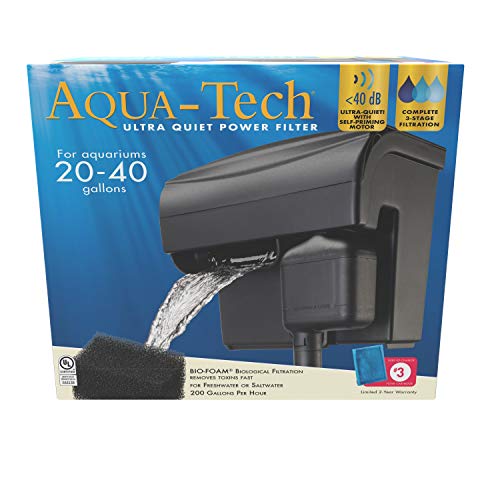
Best for mid-sized tanks ranging 20–40 gallons needing quiet, multi-stage filtration. Includes cartridge with activated carbon and biological filtration media. Decoupled motor and dampeners help keep noise below 40 dB, supporting peaceful viewing in living spaces.
Who it’s best for: aquarists seeking a budget-friendly option for moderate tanks with quiet operation. Why selected: good balance of mechanical and biological filtration at a lower price point. Limitation: may require extra media purchases for customized filtration needs.
Buying Guide: Key Purchase Considerations
- Tank size alignment: Match filter capacity to your aquarium volume. Overkill can be unnecessary noise, under-sizing risks poor water quality.
- Filtration type: Most setups benefit from a combination of mechanical, chemical, and biological filtration. Consider media options and upgrade paths.
- Noise level: Look for explicit dB ratings or phrases like “quiet,” “sound shield,” or “dampeners.” In-wall or external filters may differ in sound output from in-tank units.
- Priming and startup: Self-priming models simplify maintenance and reduce startup friction after power interruptions or cleaning.
- Media compatibility and upkeep: Ensure you can readily obtain replacement cartridges or media and that the unit supports your preferred filtration media.
- Installation footprint: Check dimensions and mounting options (in-tank, hang-on-back, or external) to fit your tank stand and space.
- Flow control: Adjustable flow helps tailor filtration to bioload and tank inhabitants; avoid excessive flow for delicate species.
Buying Considerations by Tank Type
- Nano and shrimp tanks (up to 5 gallons): prioritize compact, quiet, auto-restart features (e.g., NICREW Slim).
- Small community tanks (5–20 gallons): look for 40–130 GPH range and quiet operation (e.g., Tetra Whisper IQ 20, 30–40 dB).
- Medium planted or bioloaded tanks (20–45 gallons): prefer multi-stage filtration and reliable priming (e.g., Aqueon QuietFlow 30 LED PRO or Tetra Whisper IQ 45).
- Budget-conscious setups with easy maintenance: consider AQUA-TECH Ultra Quiet or similar economy models.
FAQ
- What is a quiet aquarium filter?
It is a filtration unit designed to minimize operational noise, often featuring sound shields, dampeners, or submerged motors to reduce sound emitted into the room.
- How do I choose the right filter capacity?
Match the filter’s flow rate (GPH) to your tank size and bioload. A general guideline is 4–6 air changes per hour, but higher turnover may be needed for heavily stocked tanks.
- Do I need a self-priming filter?
Self-priming filters simplify startup after cleaning or power loss, reducing manual priming steps and ensuring faster return to operation.
- Should I choose a hang-on-back or in-tank model for quiet operation?
Both can be quiet; in-tank models hide the unit and reduce splash noise, while hang-on-back options can be equally quiet if well manufactured and properly positioned.
- Can I use any filter media with these units?
Check media compatibility with each model. Some use standard media like activated carbon and bio-filtration pads; others rely on compatible cartridge systems.
- Is higher GPH always better?
No. Higher flow increases turnover but can create stress for small or delicate inhabitants. Balance flow with tank inhabitants and plant layout.