Looking for the right buffer and pH management for a saltwater aquarium? This guide highlights five effective buffers that stabilize pH and alkalinity, tailored for reef and mixed systems. Each product is best for different setups, from reef tanks needing precise calcium and carbonate balance to freshwater-style buffers adapted for marine environments. The following selections help minimize pH swings, promote aragonite stability, and support coral and fish health. Use the table below to compare core details at a glance.
| Product | Best For | Key Benefit |
|---|---|---|
| Brightwell Alkalin8.3 250 ml | Small to mid-size reef tanks | Elevates alkalinity and sets pH to 8.3 |
| Brightwell Alkalin8.3 500 ml | Medium to large reef tanks | Stable buffering with higher volume support |
| API PROPER pH 8.2 | Freshwater-adjacent setups and mixed tanks | Stabilizes pH to 8.2, suitable for saltwater and cichlids |
| Brightwell pH+ Alkalinity Booster | Reef tanks needing pH and alkalinity boost | Raises pH and alkalinity to support corals |
| Continuum Reef Basis KH Buffer | Professional-level reef environments | Multi-component buffering with pH automatic regulation |
Brightwell Alkalin8.3 Reef Buffer 250 ml

Best for small reef systems or shadow tanks that require precise KH and pH maintenance. Alkalin8.3 is a multi-component buffer designed to elevate alkalinity and adjust pH to 8.3, delivering a more stable environment. It also provides a carbonate source essential for aragonite skeletons in reef-building organisms, while remaining free of phosphates, silicate, and unwanted organics. This product helps reduce pH and KH fluctuations caused by inconsistent salt mixes. Use when you need targeted alkalinity support without introducing other minerals.
Who it’s best for: hobbyists with compact reef setups prioritizing stability and aragonite-related skeletal health. Limitation: suited for 8.3 pH targets; significant deviation from this range may require additional adjustments.
Brightwell Alkalin8.3 Reef Buffer 500 ml

Better for medium to larger reef tanks needing extended buffering capacity. The 500 ml version offers the same automatic pH regulation and carbonate source as the smaller bottle, with more volume to maintain stable KH and pH in bigger systems. It helps combat instability from salt mixes and environment shifts, promoting a consistent habitat for corals and invertebrates. Choose this if you maintain multiple SPS/LPS corals or run a higher-bioload system.
Best for: larger reefs or setups with frequent water changes where extended buffering is beneficial. Caution: follow dosing directions to avoid overshooting pH in sensitive tanks.
API PROPER pH 8.2 Freshwater Aquarium Stabilizer

Although widely marketed for freshwater, this product also suits mixed tanks that benefit from a stable pH around 8.2 and general stabilization. It’s practical when you want a straightforward, single-component approach to limit pH swings and maintain color and vitality in fish. It’s particularly useful in saltwater setups that tolerate a near-neutral to slightly alkaline pH target. Best for: hobbyists seeking a simple, predictable pH anchor and for tanks without heavy coral demands. Limitation: not designed to provide reef-specific buffering or high carbonate supplementation.
Brightwell Florin pH- Buffer for Water Conditioning

Designed to lower pH in freshwater, marine, and planted aquariums, Florin pH- can be used to simulate acidic conditions or to establish low-pH biotopes. In reef contexts, use with caution—this is most suitable when a deliberate, gradual pH decrease is desired rather than to raise pH. Best for: tanks showing signs that lower pH benefits species behavior or spawning. Limitation: not a general pH increaser for reef systems and may disrupt alcalinity if used improperly.
Brightwell pH+ Alkalinity Booster for Reef Aquariums
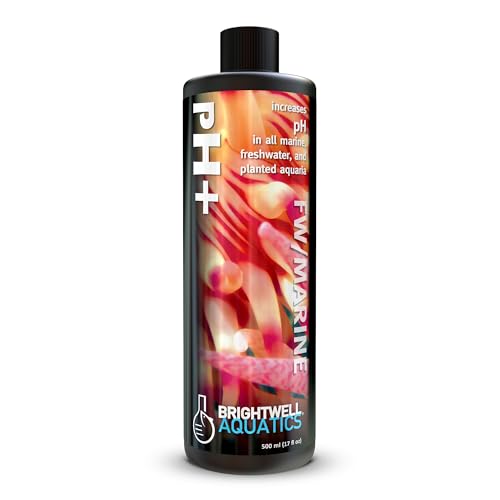
Specifically formulated to raise both pH and alkalinity in reef systems, pH+ supports stable parameters essential for stony corals and reef-building organisms. It’s a two-component approach that enhances buffering capacity and helps maintain consistent carbonate chemistry. Best for: reef aquariums needing a robust pH and alkalinity increase. Limitation: should be dosed with attention to existing alkalinity levels to avoid overshoot.
Continuum Reef Basis KH Buffer

Reef Basis KH Buffer is a professional-grade, multi-component buffering system designed to raise alkalinity and automatically regulate pH. It’s built to hold pH stable across a wide range of conditions, supporting safe and healthy reef environments. Best for: serious reef tanks that require a balanced, ongoing buffering strategy. Limitation: formulated for multi-component use; follow mixing and dosing guidance to maintain target parameters accurately.
Buying Guide: What to Look For When Choosing a Buffer
- Target pH range: Reef tanks often target 8.2–8.4; choose buffers designed to reach and hold the desired pH.
- Alkalinity support: If you need stable KH, prefer products that explicitly address carbonate buffering alongside pH.
- System size and volume: Larger tanks require buffers with higher dosing capacity or multi-pack options.
- Calcium balance: Some reef buffers are paired with calcium management; select items that align with your calcium strategy.
- Single vs. multi-component: Multi-component buffers can simplify dosing but require careful adherence to instructions.
- Tank type: Reef, mixed, or freshwater-adjacent saltwater setups have distinct needs; match product intent accordingly.
Frequently Asked Questions
- What is the difference between pH and KH buffering?
– pH buffering stabilizes hydrogen ion concentration, while KH buffering raises carbonate hardness to resist pH swings. - Can I mix different buffer products?
– It’s generally best to avoid mixing buffers unless specified by the manufacturer to prevent unexpected chemistry changes. - Which buffer is best for a small reef tank?
– A 250 ml Alkalin8.3 product is often suitable for small to mid-size tanks needing precise pH to 8.3 and stable KH. - Should I use a buffer that also supplies calcium?
– If you maintain corals, consider a buffer that supports both pH/ALK and calcium balance, such as Reef Code B with paired components. - How often should buffering be dosed?
– Dosing frequency depends on tank bioload, water change schedule, and testing results; follow product directions and test regularly. - Is a buffer necessary if I perform regular water changes?
– Water changes help stabilize chemistry, but buffers provide ongoing stabilization between changes, especially in stable reef systems.