If you’re shopping for a compact heater that won’t crowd a tiny aquarium, a 5-gallon or smaller tank is the target. This guide identifies five dependable, compact heaters designed for nano and small tanks, focusing on ease of use, reliable temperature control, and safety features. Best for beginners building a simple betta setup, best for ultra-small nano tanks, or best for continuous temperature stability, these picks balance size with performance. Below is a quick comparison to help you decide at a glance.
| Product | Tank Type & Size Focus | Wattage | Notable Feature |
|---|---|---|---|
| AQUANEAT Aquarium Heater, 25W | Betta and small tanks (3–5 gallons) | 25W | Preset 78°F with red/green indicator |
| hygger Small Aquarium Betta Heater | Freshwater/marine, up to 5 gallons | 10W / 25W / 50W / 100W options | LED digital display; multiple protection features |
| DaToo Mini Aquarium Heater 25W | Betta and small tanks (1–5 gallons) | 25W | Auto-maintains 78°F; smallest 25W option |
| YOFOTHS Adjustable Mini Aquarium Heater | Small tanks (0.5–3 gallons) | 10W / 20W / 30W | Digital display; memory and safety protections |
| AquaMiracle Mini Aquarium Heater | Nano to 1 gallon tanks | 10W | USB powered; memory function with dry-run protection |
Note: Each option emphasizes compact dimensions, simple preset temperatures, or digital telemetry to suit very small displays or nano tanks. The following sections detail five top choices with practical buying considerations and usage tips.
AQUANEAT 25W Mini Betta Heater

- Best for: Betta tanks in 3–5 gallon setups where space is at a premium.
- Why selected: Ultra-compact 4.5” length, ready-to-use with a preset 78°F, and a simple red/green indicator for quick status checks.
- Limitation: Preset temperature cannot be adjusted beyond 78°F, which may not suit all species or seasonal needs.
hygger Small Betta Heater

- Best for: Small freshwater or marine nano tanks that need precise control and multiple wattage options.
- Why selected: LED digital display and multiple wattage choices (10W/25W/50W/100W) with robust quartz construction and dry-run protection.
- Limitation: The right wattage must match tank size to avoid overheating in tiny volumes; mis-sizing could reduce efficiency or safety.
DaToo Mini 25W Heater with Free Thermometer
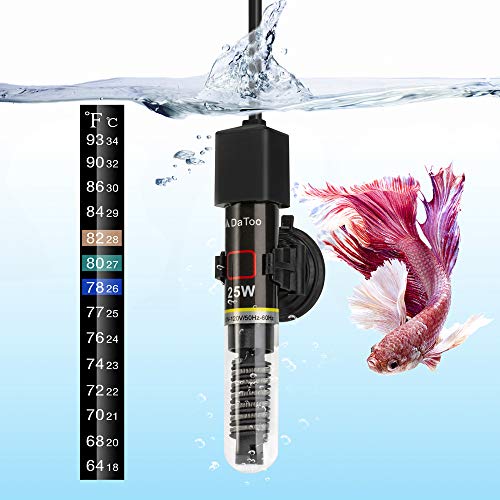
- Best for: Betta tanks that need a reliable, constant 78°F environment without extra setup.
- Why selected: Automatic 78°F maintenance with red/green indicators, and one of the smallest 25W options on the market (about 0.2 inches in profile).
- Limitation: Fixed at 78°F; not adjustable for other species or seasonal variations.
YOFOTHS Adjustable Mini Aquarium Heater

- Best for: Very small tanks (0.5–3 gallons) where precise temperature control is essential.
- Why selected: Compact 2.36 inch body, intelligent memory function, and overheating protection with clear error codes.
- Limitation: Lower wattage options may not provide rapid heating in colder rooms or larger micro-tanks.
AquaMiracle USB Mini Heater

- Best for: Nano tanks up to 1 gallon where USB power is convenient or preferred.
- Why selected: 5V/2A USB power option with a digital display showing current and set temperatures; compact thumb-sized form factor.
- Limitation: Requires USB power source; not ideal for non-USB setups or larger tanks.
Buying Guide: Smallest Fish Tank Heaters for Tiny Setups
What size should I choose?
For tanks 1–5 gallons, select the smallest heater that provides stable heating without oversizing. Overheating risk is higher in tiny volumes, so match wattage to tank volume and consider a model with auto shutoff or dry-run protection.
Do I need adjustable temperature?
If you keep species with strict temperature needs beyond a fixed 78°F, choose a model with an adjustable thermostat or a digital display that shows current versus target temperatures. This helps adapt to seasonal room changes or different fish.
Safety features to look for
Look for dry-run protection, overheat protection, and robust housing (quartz or ceramic). For USB-powered models, ensure the power source is safe and compatible with your setup to reduce electrical risk in small, humid environments.
Which features improve reliability?
Digital displays, memory functions after power interruption, and clear visual indicators (red/green) help maintain consistent temperatures with minimal monitoring. A compact form factor also reduces water disruption during maintenance.
Installation tips
- Place heaters on opposite ends if you use more than one device, to balance heat distribution.
- Avoid placing heaters where they can be easily knocked or partially blocked by substrate or decor.
- Regularly verify that readings align with aquarium thermometers, especially in ultra-small volumes where fluctuations appear faster.
FAQ
- Q: Are these heaters safe for automatic betta tanks? A: Yes, many are designed for betta care with small footprints and simple preset temperatures, though always monitor for tank-specific needs.
- Q: Can I use a 25W heater in a 10-gallon tank? A: Not recommended; larger tanks require higher wattage to maintain warmth reliably and avoid uneven heating.
- Q: Do all models come with temperature readouts? A: Most listed options provide a digital display or indicator lights; verify the product page for exact features.
- Q: Is USB power a safe option for fish tanks? A: USB-powered heaters are safe when used with appropriate power sources and splash protection; ensure compatibility with your setup.
- Q: What is dry-run protection? A: It prevents heater operation when water level is too low, reducing the risk of overheating and equipment damage.
- Q: How do I choose the right wattage? A: For 1–5 gallon tanks, 10–25W is common; larger nano setups may require higher wattage. Always match to tank volume and room temperature conditions.