Answering the question of which aquarium silicone to choose for fish tanks, this guide highlights five reliable options designed for safety, strong adhesion, and ease of use. Ideal for hobbyists building, repairing, or maintaining glass or acrylic tanks, these sealants are suitable for freshwater and saltwater setups. Each product is evaluated for fish safety, curing behavior, and practical limitations. The buyer will learn which sealant best fits beginners, experienced hobbyists, or professional aquarium builders.
| Product | Best For | Key Benefit | Limitations |
|---|---|---|---|
| SELSIL Aquarium Silicone Clear Sealant (2-Pack) | New tanks and minor repairs | 100% silicone, safe for fish, ISO-compliant | Explicitly indicates generic use; verify surface compatibility for complex substrates |
| DaToo Aquarium Silicone Sealant Clear | First-time hobbyists | VOC-free, solvent-free, strong adhesion | Ready-to-use; curing time varies with conditions |
| 4 Pack Aquarium Silicone Clear Sealant – LISRUX | Bulk repairs and multiple projects | Fast curing, non-toxic, high elasticity | Contains multiple tubes; uniform application required |
| 1 Pack Aquarium Silicone Clear Sealant – LISRUX | Single project or touch-ups | Same safety profile, quick cure | May require practice to apply evenly |
| Aquarium Safe Silicone – LANGXINST | Underwater bonding and maintenance | Underwater curing and strong adhesion | Limited data on long-term performance in extreme conditions |
Below are five product sections that explain who each item is best for, why it was selected, and practical considerations to help you compare options quickly.
SELSIL Aquarium Silicone Clear Sealant

Best for hobbyists who need a transparent, highly elastic bond on glass without primer. The product is formulated from 100% silicone polymer and complies with ISO 11600 –F&G–25 LM standards, making it suitable for both freshwater and saltwater aquariums. The silicone remains flexible across temperature changes and resists ozone and UV exposure. Use it for sealing corners, joins, or repairs on glass tanks. Caution: ensure the sealant cures fully in a well-ventilated area; odor or curing variability can occur in tight spaces.
Why chosen: Safety-first profile, clear finish, and robust elasticity support reliable water-tight bonds. Best for long-term sealing where fish safety is a priority.
DaToo Aquarium Silicone Sealant Clear Type
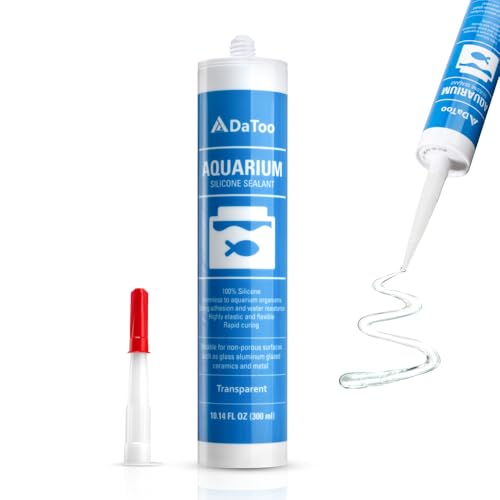
Best for beginners building their first fish tank or making simple repairs. DaToo silicone sealant emphasizes 100% pure silicone, with no solvents or harmful chemicals. It offers strong adhesion to glass without primer and is suitable for both fresh and saltwater environments. Fast curing supports quicker projects, though full cure may take longer under cooler or more humid conditions. Caution: avoid using in high-heat environments where extended curing times may occur.
Why chosen: User-friendly for newcomers, with clear safety claims and straightforward application. It supports reliable water resistance with minimal steps.
4 Pack Aquarium Silicone Clear Sealant – LISRUX

Best for bulk projects and ongoing maintenance. This non-toxic, solvent-free, acid-cured silicone forms a permanently soft seal with fast curing and high elasticity. It remains effective across a broad temperature range, making it suitable for both tropical and colder environments. It adheres well to glass without primer and resists water immersion after curing. Caution: ensure even bead distribution to prevent gaps that could attract air pockets.
Why chosen: Great value for multi-project users and shop-ready kits, offering consistent performance across applications.
1 Pack Aquarium Silicone Clear Sealant – LISRUX

Best for a single project or repairs where a compact quantity is preferred. This product offers the same non-toxic, solvent-free formulation and fast curing as the 4-pack variant, with straightforward application. It provides strong adhesion and broad temperature tolerance. Caution: shorter supply may require careful planning to complete larger jobs or multiple tanks.
Why chosen: A convenient option for small jobs or individual tank maintenance without committing to multiple tubes.
Aquarium Safe Silicone – LANGXINST

Best for underwater bonding and ongoing maintenance. LANGXINST silicone is described as safe for aquatic life and capable of curing underwater, enabling repairs without draining water. It adheres well to glass and is designed for underwater applications. Caution: reliability specifics may vary with water chemistry or tank size; test on a small area before full use.
Why chosen: Underwater curing expands options for live tanks or maintenance without disruption to aquatic life.
Buying Guide: Key Purchase Considerations
- Safety for fish and aquatic life: Look for silicone that’s 100% silicone polymer, solvent-free, and explicitly labeled safe for aquarium use.
- Curing behavior: Consider whether you need quick set times or longer work windows. Temperature and humidity affect cure time; plan accordingly.
- Adhesion on glass vs. other surfaces: Some products bond well to glass without primers; others state compatibility with aluminum or ceramic as well.
- Water exposure: For freshwater or saltwater tanks, ensure the sealant resists immersion and remains elastic after cure.
- Underwater bonding: If you need to seal parts without draining water, prefer products that advertise underwater curing capability.
- Elasticity and temperature range: High elasticity helps prevent cracks and gaps due to movement or temperature shifts.
- Quantity needs: For multiple tanks or frequent repairs, a multi-pack option may reduce cost and waste.
Frequently Asked Questions
- Q: Can aquarium silicone cure underwater? A: Some products advertise underwater curing, which can help seal repairs without draining the tank.
- Q: Is silicone safe for fish? A: Yes, look for 100% silicone polymer formulas that are solvent-free and ISO-compliant for aquarium use.
- Q: Do I need a primer for glass bonding? A: Many aquarium silicones bond well to glass without primers, but always check the product guidelines to be sure.
- Q: How long does curing take? A: Cure times vary by product and conditions; some sealants dry to touch in 30 minutes, with full cure in 24–48 hours or longer depending on temperature and humidity.
- Q: Can I use regular silicone around fish tanks? A: Only use products specifically labeled for aquarium use; regular household silicones may contain fillers or solvents harmful to aquatic life.
- Q: What is the best choice for a beginner? A: A ready-to-use, VOC-free, solvent-free silicone with clear guidance and straightforward application is ideal for newcomers.