Looking for the right pump to power a sponge filter? This guide highlights five reliable, compact pumps and kits ideal for 3–60 gallon tanks, focusing on user-friendly setups, quiet operation, and effective aeration. Each option suits different buyers: new hobbyists need simple plug-and-play solutions; space-conscious owners want compact designs; and aquarists seeking steady oxygenation can rely on adjustable flow. The following picks balance performance and practicality, helping you choose the best pump for sponge filtration in a variety of small-to-medium aquariums.
Product summary table
| Product | Best For | Key Benefit |
|---|---|---|
| Pawfly Aquarium Air Pump with Nano Bio Sponge Filter Kit | Small tanks (3–10 gal) | Dense bubbles for oxygenation |
| Pawfly Aquarium 15-40 GPH Compact Pump | Space-limited setups (5–20 gal) | Quiet operation, steady output |
| Pawfly Mini Aquarium Air Pump 15 GPH | Nano tanks and buckets (3–20 gal) | Very quiet, wall-mount friendly |
| AQUANEAT Aquarium Electric Sponge Filter | Medium tanks up to 40 gal | Integrated filter with extra media |
| Pawfly 50 GPH Aquarium Air Pump | Heavier aeration (up to 60 gal) | Rotatable flow control, low noise |
Pawfly Aquarium Air Pump With Nano Bio Sponge Filter Kit
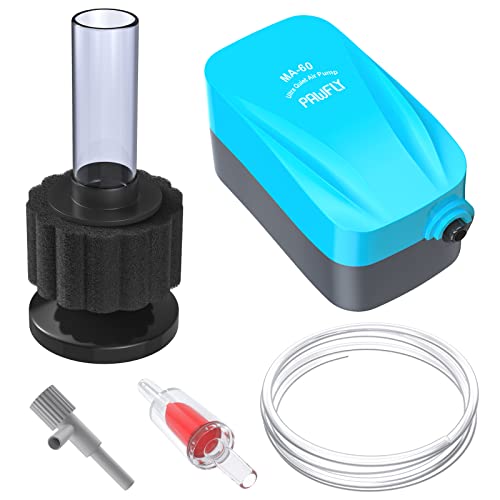
Best for very small tanks, including 3–10 gallon setups. This kit pairs a 40 GPH air pump with a sponge filter that produces dense bubbles to boost dissolved oxygen. The included air control valve lets you fine-tune flow, enabling safer environments for delicate fish or fry. The compact dimensions help fit tight spaces behind or beside tanks. Ideal for beginners prioritizing straightforward assembly and reliable basic filtration.
Best for: Small freshwater tanks with limited space and users who want a complete, ready-to-run package. Limitations: The maximum flow may be insufficient for larger or heavily stocked tanks; upgrading to a higher GPH unit is recommended as stocking levels rise.
Pawfly Compact Air Pump 15-40 GPH
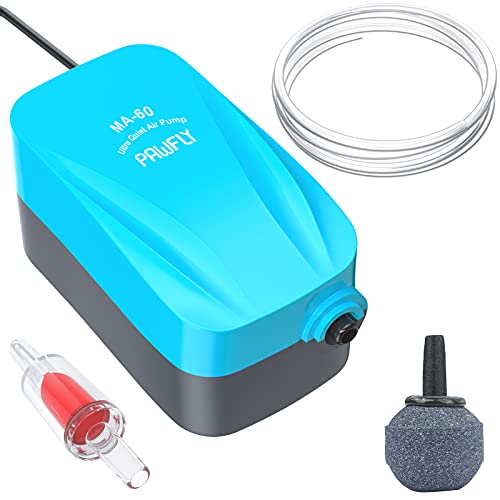
Best for tight spaces where a small footprint matters and you need dependable, quiet performance. This unit is designed for 5–20 gallon tanks with steady output up to 30 GPH. It emphasizes low noise (<45 dB) and vibration due to diaphragms and rubber feet, making it suitable for bedrooms or home offices near the aquarium. Choose this if you want a compact, unobtrusive aerator with consistent air flow.
Best for: Medium-small tanks where space is a premium and quiet operation is important. Limitation: Lower maximum flow may not keep up with large or heavily stocked systems.
Pawfly Mini Aquarium Air Pump With Bracket

Best for nano tanks and simple DWC buckets, offering an easy installation with a wall clip and stable output at 15 GPH. Its low noise (under 35 dB) and soft bracket base minimize vibrations, making it suitable for quiet rooms. This pump is a strong pick for 3–20 gallon setups where you want straightforward installation and dependable aeration without extra accessories.
Best for: Nano tanks, small buckets, or DIY systems needing a compact, whisper-quiet pump. Limitation: The smallest model provides modest airflow, so consider larger options if you need stronger aeration.
AQUANEAT Electric Sponge Filter for Fish Tank

Best for tanks up to 40 gallons needing both mechanical and bio filtration without relying on a separate air pump. This electric sponge filter integrates a filter motor with a sponge and bio media, and it features a 360° adjustable water outlet. The design supports oxygenation by infusing micro-bubbles, providing a compact all-in-one solution for moderate tanks and beginner setups seeking a single-unit filtration approach.
Best for: Medium tanks where a combined filter and oxygenation setup reduces equipment clutter. Limitation: Some aquarists may prefer external power options if upgrading to larger systems.
Pawfly 50 GPH Aquarium Air Pump

Best for larger or busier tanks within the 10–60 gallon range. This pump delivers up to 50 GPH with adjustable flow and a low noise profile under 30 dB. Its rotatable control helps tailor aeration to plant roots, fry, or heavier bio-loads. Use this when you need more robust oxygenation without expanding the equipment footprint significantly.
Best for: Tanks requiring stronger air flow and longer-term reliability. Caution: Higher GPH means greater flow than some nano systems, so match to tank size and stock levels.
Buying Guide: Key Considerations For Choosing A Sponge Filter Pump
- Tank size and stocking: Match pump GPH to tank volume and bioload. Smaller tanks benefit from modest, quiet pumps; larger or heavily stocked tanks may need higher output.
- Noise and vibration: Look for diaphagm-driven pumps with rubber feet or soft brackets to minimize noise, especially in bedrooms or living spaces.
- Filtration needs: Choose between integrated sponge-filter kits and separate pumps with sponge filters if you prefer modularity or future upgrades.
- Space and installation: Compact dimensions and wall-mount options help fit pumps in tight spaces and behind tanks.
- Adjustability: Pumps with adjustable flow let you tailor aeration to plant roots, fry, or delicate fish, balancing oxygenation with reduced surface agitation where needed.
- Durability and media compatibility: If using media beyond sponge (ceramic media, bio balls), verify compatibility and ease of media changes for long-term performance.
FAQ
- What is a sponge filter, and why pair it with a pump?
A sponge filter provides mechanical and biological filtration, while an air pump drives water through the sponge, enhancing oxygenation and water turnover. - Can I use any air pump with a sponge filter?
Most small sponge filters pair with inline air pumps; check the GPH rating and tubing size for compatibility with your setup. - Which pump is best for a 10-gallon tank?
A compact 15–30 GPH pump with a nano bio sponge kit is typically suitable, but consider tank inhabitants and stocking levels. - Is noise a concern with sponge-filter pumps?
Many models are designed for quiet operation; look for units with rubber feet and diaphragms to minimize sound. - Do sponge filters require air stones?
Not always; some kits include bio sponge filters with integrated aeration. If you use a separate aerator, ensure compatible tubing and fittings. - When should I upgrade the pump or filter?
If water remains cloudy, oxygen levels seem low, or filters clog quickly after cleaning, consider a higher-capacity or more efficient unit.