Battery operated gravel vacuums make aquarium upkeep faster and safer by eliminating messy siphons and cords. This guide highlights five top options for American hobbyists, focusing on cordless convenience, strong suction, and simple operation. Each product is evaluated for who it’s best for, along with practical limitations to help you choose confidently.
Summary table of selected products
- VILLNO Battery Aquarium Vacuum: Best for small to mid-size tanks, cordless operation, flexible length.
- hygger Battery Powered Vacuum: Best for deep tanks, high flow, 6-in-1 functionality.
- HACPUT Cordless Cleaner: Best for hands-off cleanup, long run-time, strong suction.
- HiTauing 6-in-1 Cleaner: Best for DeWalt 20V users, versatile modes, cordless freedom.
- EHEIM Quick Vac Pro: Best for quick maintenance, automatic cleaning, fully submersible.
VILLNO Aquarium Vacuum Gravel Cleaner

Best for: Small to mid-sized freshwater tanks where cordless convenience matters. This model emphasizes quick debris removal, with a battery-powered motor that reduces setup complexity. It’s chosen for users who want to avoid manual siphoning and enjoy easier water changes.
Why selected: It combines efficient gravel cleaning with a compact form and battery operation, enabling cleaner substrate without being tethered to a power outlet. It’s notably suitable for regular maintenance in smaller aquariums or terrariums where reach is a consideration.
Limitation: The battery life may limit very long cleaning sessions; plan for multiple passes for large tanks.
hygger Battery Powered Aquarium Vacuum
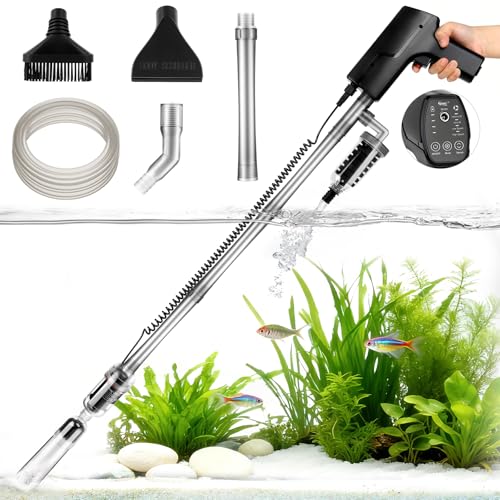
Best for: Aquariums needing sustained, high-power cleaning with a clear battery-driven operation. The built-in 2600mAh battery supports extended use, and the 6-in-1 design handles water changes, sand washing, debris removal, filtration, circulation, and more.
Why selected: It offers a long run time per charge and a robust flow rate, making it ideal for moderate to large tanks where frequent cleaning is required. The 6-in-1 approach reduces tool switching during maintenance.
Limitation: Heavier build due to the battery and motor, which may be less comfortable for very small tanks or delicate sump setups.
HACPUT Cordless Aquarium Vacuum

Best for: Tank owners seeking a flexible, cordless tool with strong suction for quick water changes and debris removal. The 36W motor provides solid cleaning power without cords, suitable for mid to larger tanks.
Why selected: The device’s cordless operation and 6-in-1 capability reduce clutter while offering efficient, fast cleaning. It is a practical option for frequent maintenance tasks across various tank sizes.
Limitation: Availability and battery compatibility may vary by region; ensure your battery platform is supported if you plan to use it with other tools.
HiTauing Aquarium Gravel Cleaner

Best for: Dewalt 20V battery users who want a versatile, cordless 6-in-1 cleaner. It supports multiple modes and adjustable suction, making it suitable for diverse tank setups including freshwater and saltwater.
Why selected: The dual-mode power option and adjustable flow help tailor cleaning to substrate type and tank depth. The compatibility with a popular battery system adds convenience for users with existing tools.
Limitation: Compatibility depends on having the correct battery platform; not all users may have a compatible battery on hand.
EHEIM Quick Vac Pro Automatic Gravel Cleaner

Best for: Aquarists seeking an automatic, submersible gravel cleaner that reduces water changes’ workload. Fully submersible up to 3 feet, designed for straightforward use in multiple tank sizes.
Why selected: It simplifies maintenance by automating some of the gravel cleaning steps and extends intervals between water changes, appealing to busy hobbyists with moderate tank sizes.
Limitation: Not explicitly battery powered; may rely on a plug-in operation. If cordless operation is a priority, consider alternative models in this guide.
Buying Guide: Battery Powered Gravel Vacuum Essentials
- Power source: Decide between fully cordless (battery) and corded models. Battery-operated units offer mobility but vary in run time. Consider tanks’ cleaning frequency to estimate needed battery life.
- Tank compatibility: Check the maximum recommended tank size and the cleaning reach. Some models extend up to several feet, others are best for small to mid-sized tanks.
- Flow rate and suction: Look for adjustable flow control to prevent substrate disturbance in delicate setups. Higher flow speeds are useful in larger tanks but may stir fine sand.
- Multi-function features: 6-in-1 systems combine water changes, sand washing, debris removal, filtration, circulation, and showering. They reduce tool swaps and save time.
- Maintenance and durability: Battery lifespan and motor heat influence long-term costs. Prefer options with easy cleaning and accessible replacement parts.
- Ease of use: Features like automatic modes, simple on/off controls, and clear status indicators help new hobbyists manage routine maintenance.
- Safety and compatibility: Ensure the device operates safely with your tank’s inhabitants and substrate. Anti-clog designs and filter nets help protect fish and gravel.
Frequently Asked Questions
- What is a battery-operated gravel vacuum best for?
– Best for cordless convenience in smaller to mid-sized tanks where mobility and reduced clutter matter most. - Can battery vacuums handle large tanks?
– Some models offer high flow and long run times, but many are optimized for smaller systems. Check the product’s tank size recommendations. - Do these vacuums require special batteries?
– Some models use standard battery platforms (like certain 20V systems). Verify battery compatibility before purchase. - Is a cordless vacuum as powerful as a corded one?
– Modern cordless vacuums can match power for routine cleaning, but very deep setups or heavy debris may require a higher-capacity pack or a corded backup. - What maintenance is needed after cleaning?
– Rinse filters, remove trapped debris, and check seals periodically to maintain suction efficiency and extend battery life. - Are there safety considerations for fish and substrate?
– Use adjustable flow and avoid overly aggressive suction near delicate substrates to minimize disruption to beneficial bacteria and fish.