When choosing an aquarium air pump with multiple outlets, the goal is steady, quiet airflow that can run several devices at once—without disturbing fish or plants. This guide highlights top multi-outlet models suited for larger tanks, hydroponics, and small ponds. Each option is evaluated for air volume, noise, and durability to help buyers pick the right pump for up to several tanks or zones. The selections favor pumps with 4 or more outlets, easy airflow adjustment, and solid build quality.
| Product | Air Outlets | Max Air Volume | Best For |
|---|---|---|---|
| HITOP 10W Powerful Aquarium Air Pump | 4 | 320 GPH | Four-tank aeration or large hydroponic setups |
| AQUANEAT Aquarium Air Pump 300GPH | 4 | 300 GPH | Running multiple filters or air stones |
| FEDOUR 4W/5W/8W Aquarium Air Pump | 4 | 96–256 GPH | Medium to large tanks with multiple devices |
| VIVOSUN Commercial Air Pump 634GPH | 6 | 634 GPH | High-output systems with several outlets |
| AQQA Powerful Aquarium Air Pump | 4 | 237–356 GPH | Large tanks or ponds needing strong, adjustable air |
HITOP 10W 4-Outlets Aquarium Air Pump
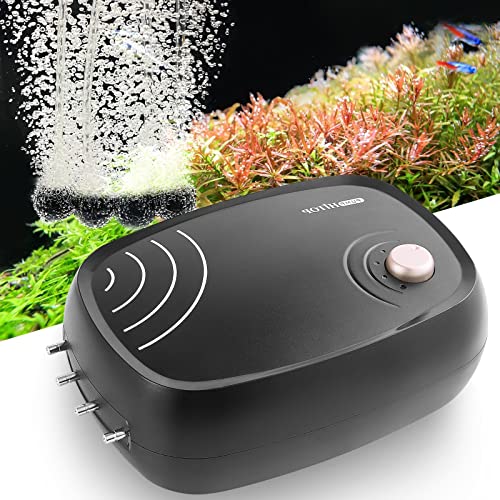
The HITOP 10W 4-outlet air pump offers a robust 320 GPH output and four separate outlets, making it suitable for aerating up to four tanks in parallel, or driving bubbler walls and hydroponic systems. It provides a high air pressure of 22 kPa and features an adjustable knob to tailor airflow to tank size. This model is best for buyers who need four independent aeration points with strong airflow for mid-size tanks or combined hydroponic setups. A potential limitation is that higher-output settings may necessitate outlet balancing to minimize pressure variance across lines.
AQUANEAT 300GPH Aquarium Air Pump

The AQUANEAT pump delivers 300 GPH across four outlets, ideal for running multiple sponge filters, air stones, and bubblers in larger tanks or hydroponic systems. It includes a control knob for adjustable airflow and a compact footprint designed for quiet operation. Best for buyers who want reliable multi-outlet performance with straightforward airflow control. Consider this option if you have several devices in a single large tank or a small-scale hydro setup where stability matters more than ultra-quiet operation.
INCLY 7W 4-Outlet Silent Air Pump

The INCLY 7W model provides 245 GPH with four adjustable outlets and a focus on ultra-quiet operation. It’s designed to keep noise low while the Hi/Low speed switch allows flexible use in living spaces. Best for buyers prioritizing near-silent performance in larger tanks or rooms where noise must be minimized. A caveat is that maximum airflow at all outlets may require careful balancing to maintain even aeration across zones.
FEDOUR 4-Outlet Aquarium Air Pump

The FEDOUR pump offers four outlets with adjustable airflow up to 256 GPH, designed for use in large tanks, hydroponics, and small ponds. It emphasizes low noise through sealed shells and soft silicone feet to reduce vibration. Choose this when you need a sturdy, moderately quiet option with a stable air supply across multiple lines. A limitation is that the device’s performance may vary with extreme tubing layouts or heavy concurrent use of all outlets.
AQQA 10W/15W 4-Outlet Air Pump

AQQA’s 4-outlet line includes 10W and 15W variants delivering 237 GPH (10W) or 356 GPH (15W) with 0.026–0.03 MPa air pressure. This pump is well-suited for large aquariums or ponds and is designed for stable airflow with a copper motor and rubber cup construction. It also supports per-outlet flow adjustment, making it easier to balance aeration across multiple zones. Best for buyers needing higher pressure and adjustable outlets in sizable systems. Note that higher power units may require more space and power capacity.
Buying Guide: Key Considerations For Multi-Outlet Pumps
- What size tank or system will the pump support? Look at total GPH and ensure it matches your total aeration needs across all outlets.
- How many devices will run off outlets? If you plan multiple filters or air stones, ensure the pump has enough outlets and stable flow.
- Noise tolerance and placement. Many models advertise quiet operation, but placement behind furniture or in cabinets can still influence perceived noise.
- Flow adjustment. Prefer models with per-outlet adjustment or a reliable central control to balance airflow.
- Power reliability. Higher-output pumps consume more energy; verify electrical compatibility and consider ambient temperature effects on efficiency.
- Maintenance and durability. Look for solid housings, vibration dampening, and easy access to replaceable parts like diaphragms or seals.
How To Choose By Use Case
- Multiple tanks: Choose pumps with four or more outlets, high total GPH, and consistent performance across outlets.
- Hydroponics: Prioritize higher pressure (MPa) and adjustable per-outlet flow for precise root-zone oxygenation.
- Large ponds: Opt for higher GPH or multi-outlet designs to support aeration across larger water volumes with stable air supply.
Installation Tips
- Keep pumps above water level or follow manufacturer guidance to prevent backflow.
- Place on vibration-dampening pads to minimize noise transfer.
- Use tubing and fittings rated for the expected pressure to avoid leaks.
- Regularly check and replace tubing to maintain airflow efficiency.
FAQ
- Do multi-outlet pumps increase noise? Some models may, but many offer quiet operation with proper placement and vibration dampening.
- Can I run a single pump with multiple devices? Yes, if the outlets and flow management support it; balance flow to prevent under- or over-aeration in any outlet.
- Is higher GPH always better? Not necessarily. Match GPH to your total system needs and consider noise and space.
- What maintenance is required? Regular checks for tubing wear, valve seals, and diaphragm condition; clean or replace components as needed.
- Can these pumps be used outdoors? Most are designed for indoor use; verify manufacturer recommendations and weather protection for outdoor setups.
- Are these pumps energy efficient? Efficiency varies by model; compare wattage with GPH to estimate energy consumption for your setup.