Answering the common buyer question: which zooplankton products best support reef tank corals, planktivorous fish, and other invertebrates? The following selections are designed for reliability, ease of use, and nutrient content. They suit hobbyists building a diverse reef system and seeking steady food sources for plankton eaters. The table below highlights five strong options with their primary strengths and who benefits most.
| Product | Best For | Notes |
|---|---|---|
| Seachem Reef Zooplankton 250 ml | New reef setups; beginners needing easy dosing | Value and US-made |
| Seachem Reef Zooplankton 500 ml | Growing tanks; established systems needing more volume | Easy to use; good value |
| Seachem Reef ZooPlankton 2 L | Medium to large reefs; higher nutrient demand | Concentrated blend; broad particle sizes |
| Brightwell Aquatics Zooplanktos-M 250 ml | Planktivores and filter feeders; color and growth focus | High-nutrient blend; supports coloration |
| Brightwell Aquatics ZooPlanktos S 125 ml | Invertebrates and juvenile fishes; small target organisms | Soothing for small corals and larvae |
Seachem Reef Zooplankton 250 ml

Seachem Reef Zooplankton 250 ml offers an easy-to-use solution designed to support reef inhabitants that feed on zooplankton. Best for new or small-to-medium tanks seeking a straightforward feeding supplement. It helps sustain corals, filter feeders, and plankton-eating invertebrates. A caveat: dosing frequency should align with tank bioload to avoid overfeeding.
Seachem Reef Zooplankton 500 ml

This 500 ml version suits growing systems with higher zooplankton needs or larger planktivorous populations. It is easy to use and provides good value per milliliter, making it a sensible upgrade for established tanks that require more substantial feeding support without frequent dosing. Best for more mature reefs or systems expanding coral and invertebrate diversity.
Seachem Reef ZooPlankton 2 L
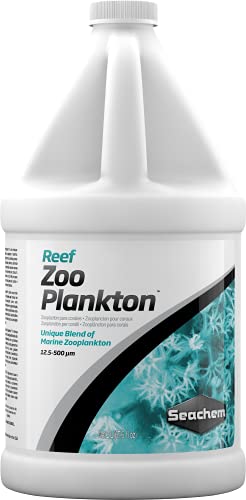
Reef ZooPlankton 2 L is a concentrated blend designed for higher nutrient needs. It covers a broad size range (12.5-500 μm) and is enhanced to increase nutrient bioavailability, benefiting corals, fish, and invertebrates that rely on planktonic foods. Choose this if your system houses multiple planktonivores and you want fewer dosing sessions. Caution: concentrated products may require careful dosing to avoid excess nutrients in the display aquarium.
Seachem Reef Zooplankton, 4 L

Note: This 4 L option belongs to the same family and is designed to provide a lengthy supply for robust systems needing ongoing zooplankton support. It is best for established, high-demand tanks with active coral growth and multiple planktivores. Best for experienced hobbyists who can manage larger volume handling. If your tank is smaller, start with the 250–500 ml options to gauge system response.
Brightwell Aquatics Zooplanktos-M 250 ml

Zooplanktos-M 250 ml offers a high-nutrient blend with amino acids, omega-3s, and carotenoids, designed for reef aquariums housing corals and filter feeders. It supports coloration, growth, and recovery. Best for planktonivores and predators that rely on nutritionally rich zooplankton. Limitation: smaller bottle size may require more frequent dosing in busy displays.
Brightwell Aquatics Zooplanktos-M 500 ml

The 500 ml version provides a higher-volume option with the same high-nutrient profile, making it suitable for larger reefs or systems with significant plankton-feeding activity. Best for experienced aquarists seeking fewer replenishment events and consistent nutrient delivery. Use caution to avoid overloading sensitive corals with rapid nutrient increases.
Brightwell Aquatics ZooPlanktos S 125 ml

ZooPlanktos S 125 ml provides small, fully-digestible zooplankton and unhatched eggs sized 50–300 μm, with an amino acid supplement to promote coloration and health in invertebrates and fishes. Best for many small polyp corals, clams, and juvenile fish. Ideal as a maintenance product for microfauna-focused setups. Limitation: smaller sizes may require more frequent dosing in fast-growing or densely stocked tanks.
Buying Guide: Key Purchase Considerations
Scope and tank size: Start with smaller volumes for beginners or modest tanks, and move to larger bottles for established systems with higher demand.
Particle size and diversity: Look for products that cover a broad size range to feed multiple species within the reef ecosystem.
Nutrient density: Higher nutrient blends support rapid coloration and growth but require careful dosing to avoid excessive nutrients.
Ease of use: Ready-to-use formulations with clear dosing guidelines reduce guesswork and improve consistency.
Source and preservation: US-made products can offer consistent quality; verify storage requirements and shelf life.
Frequently Asked Questions
- What is zooplankton used for in a reef tank? Zooplankton serves as a natural food source for plankton-eating corals, juvenile fishes, and filter feeders, promoting growth and coloration.
- How often should I dose zooplankton? Dosing frequency depends on tank bioload and the number of planktonivores; follow product guidelines and adjust based on observed feeding activity.
- Can zooplankton cause nutrient spikes? Yes, overfeeding can raise nutrient levels; monitor-tank and adjust dosing to maintain water quality.
- Is concentrated zooplankton better than liquid forms? Concentrated blends reduce dosing frequency but may require careful measurement to prevent overfeeding; liquid forms offer easier, consistent dosing for small tanks.
- Which product is best for beginners? A smaller, easy-to-use option, such as Seachem Reef Zooplankton 250 ml, is typically best for beginners to establish a routine.
- Should I mix zooplankton with other foods? Yes, complementary feeds (coral foods and microfauna) support a balanced nutrition profile, but avoid overloading the system with multiple high-nutrient products at once.