Finding the best underwater filter for a fish tank hinges on tank size, noise tolerance, and filtration needs. This guide highlights five reliable internal or submersible filters ideal for different setups—from small Betta tanks to larger community tanks. Each option is described with who it’s best for, why it’s chosen, and any limitations to consider. Whether you need powerful bio-filtration with minimal noise or a compact option for a 5–20 gallon tank, you’ll find practical, comparison-friendly details here.
Summary table of chosen products:
| Product | Tank Range | Key Benefit | Best For |
|---|---|---|---|
| TARARIUM Aquarium Filter | 55-150 gal | 4-in-1 function: filtration, air supply, water wave making, and pump | Large tanks needing multi-feature efficiency |
| Tetra Whisper Internal Filter 5-10 gal | 5-10 gal | Integrated filter and water pump with debris catching mesh | Small community or single-species tanks |
| NICREW Internal Filter | 5-10 gal | Biological and chemical filtration with carbon and foam | Low to moderate bioload setups |
| Vehipa 40-70 gal System | 40-70 gal | Three-stage filtration with isolation chamber | Mid-sized display tanks needing easy maintenance |
| VILLNO 10W 130GPH Filter | 10-35 gal | 3-in-1 filtration with oxygenation and adjustable flow | Versatile option for mid-small tanks |
TARARIUM Aquarium Filter For Large Tanks

The TARARIUM filter is designed for large systems (55-150 gallons) and combines multiple functions in one unit: a biochemical filtration sponge, air supply, water pumping, and wave-making action. Best for hobbyists who want to reduce equipment clutter while maintaining clear water and active surface agitation. The unit emphasizes low noise with silicone cushioning and a quiet operation profile, suitable for living spaces where quiet operation matters. A caution: ensure correct installation for optimal air/water circulation and periodic sponge rinsing to maintain flow.
Tetra Whisper Internal Power Filter 5-10 Gallons
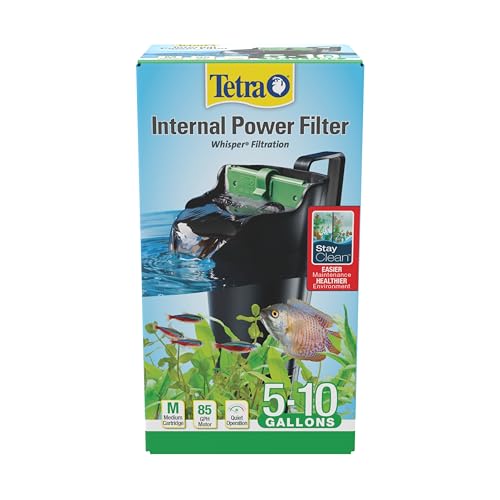
The Tetra Whisper 5-10 gallon internal filter blends filtration with a compact footprint. It mounts inside the tank with a clip and features dense dual-sided mesh to catch debris and waste. This option is best for small to medium community tanks or fry rearing setups where minimal external equipment is preferred. Limitation: best suited for light to moderate bioload; it may require more frequent maintenance in higher waste scenarios.
NICREW Internal Filter Submersible

The NICREW internal filter offers biological and chemical filtration for 5-10 gallon tanks, utilizing activated carbon and fine foam to trap debris and odors. It also produces moderate water flow and bubbles, contributing to oxygen exchange. Best for small planted or community tanks seeking reliable filtration without a high price. Caution: verify compatibility with your tank’s size and ensure the intake does not pull in small fry or delicate plants.
Vehipa All-in-One Filter For 40-70 Gallons

The Vehipa system is designed for mid-sized tanks (40-70 gallons) and emphasizes an all-in-one filtration approach with a 225 GPH flow rate. It includes a three-stage filtration process, an isolation chamber to reduce clogging, and ease of maintenance. Best for hobbyists who want solid filtration and simpler cleaning routines. Limitation: larger units may require a stable mounting setup to prevent vibration or wobble on taller tanks.
VILLNO 10W 130GPH Filter

The VILLNO filter offers a compact 10W pump with 130 GPH flow, designed for 10-35 gallon tanks. It supports three modes—filtration, water circulation, and oxygenation—through a simple, submersible design. Best for small to mid-sized habitats where combined filtration and aeration are advantageous. Choose this if you want adjustable flow and a versatile 3-in-1 setup; avoid if your tank exceeds the upper end of its suggested range for peak efficiency.
Buying Guide: Choosing The Right Underwater Filter
- Match filter capacity to your tank’s gallon rating and the fish load. Larger tanks need higher GPH and robust bio-filtration; smaller tanks benefit from compact units to minimize disturbance.
- Filtration stages Three-stage systems (mechanical, chemical, biological) typically offer balanced water quality. Consider units with carbon or foam media for odor control and debris removal.
- Noise and vibration Look for internal filters with silicone cushions or designs marketed as quiet. A quieter filter improves living space comfort, especially in bedrooms or offices near the tank.
- Maintenance and accessibility Ease of cleaning media, rinsing bioballs, and replacing sponges reduces downtime. Isolation chambers or clear housings can simplify upkeep.
- Installation options In-tank or submersible styles suit different aesthetics and space constraints. Verify compatibility with your tank dimensions and lid design.
- Oxygenation and circulation Filters that promote surface agitation and water movement help with gas exchange—useful in densely stocked tanks or low-oxygen environments.
FAQ
- What size filter do I need for a 20-gallon tank? Choose a filter rated near or slightly above 200 GPH for good turnover, with robust mechanical and biological filtration.
- Are internal filters better than hang-on-back for small tanks? Internal filters are space-saving and quiet; for very small tanks, a compact internal unit can be ideal, while HOB can provide higher flow in deeper setups.
- Do I need a filter with an aeration feature? Aeration improves oxygenation, especially in densely populated tanks or when using more surface-depressing fish; many filters deliver some aeration via surface agitation.
- Can I use multiple small filters in one tank? Yes, but ensure even flow distribution to avoid dead zones and excessive current in some areas.
- How often should I replace filter media? Replace or rinse mechanical media regularly (every 2–4 weeks generally) and replace carbon according to manufacturer guidance to maintain odor control.
- Is a larger filter better for fish health? Bigger filters provide more stable water quality and higher biological filtration capacity, but they may be unnecessary for small tanks and can create excessive flow if not adjustable.