Finding the right thermometer for a tropical fish tank helps maintain stable water temperatures, reducing stress for fish and other aquatic life. This guide highlights five top options that are easy to read, accurately track changes, and suit various tank setups. Best for hobbyists seeking external displays, floating sensors, or submersible probes, these picks cover diverse needs from LED-readouts to wireless controls. The table below summarizes each pick to aid quick comparison.
| Product | Best For | Reading Style | Notes |
|---|---|---|---|
| PAIZOO Fish Tank Digital Thermometer | External-display lovers | LED display, external probe | Accurate to ±0.9°F, cordless |
| Penn-Plax Therma-Temp Floating Thermometer | Simple placement, flexible mounting | Floating with optional suction | Mercury-free, bright color scale |
| QZQ Fish Tank Thermometer | Compact, modern setups | LED digital, wireless touch | Quiet, minimal tubing |
| AQUANEAT Aquarium Thermometer (1 Pack) | Large readouts, easy setup | Digital LCD, suction probe | Wide range, simple power |
| Dreyoo Floating Thermometers (2 Pcs) | Budget-friendly redundancy | Floating glass with suction | Two units, 0-43°C/32-110°F |
PAIZOO Fish Tank Digital Thermometer

Best for: Aquarists who prefer an external display and a cordless setup. PAIZOO uses a probe that senses water temperature while the display stays outside the tank, reducing wires inside the water. The LED readout is easy to view day or night, and the device refreshes quickly for near real-time readings. This model is especially suitable for small to mid-sized tanks where a clean, minimal-in-water solution is preferred.
Why chosen: The cordless design eliminates cable clutter, and the wide 0-140 °F range covers most tropical setups. Its accuracy to ±0.9 °F provides reliable monitoring to help maintain stable conditions for tropical species sensitive to temperature shifts. The touch-activation feature allows quick checks without constant power drains.
Caution: Ensure the adhesive remains sealed against humidity; re-apply if the display or probe shows signs of loosening. For very large or heavily planted tanks, consider supplementary thermometers to verify consistency across the aquarium.
Penn-Plax Therma-Temp Floating Aquarium Thermometer

Best for: Beginners and hobbyists who want a straightforward, reliable thermometer that floats and can be fixed with a suction cup. This model is mercury-free and suitable for both freshwater and saltwater tanks, making it versatile for mixed setups.
Why chosen: The floating design provides a quick glance reading, with a color-coded scale that highlights temperature changes instantly. It’s easy to place and read from outside the tank, reducing disruption to aquatic life during checks.
Caution: Floating thermometers can drift if the tank is overcrowded or if water movement is strong. Check placement periodically to ensure visibility and accurate readings.
QZQ Fish Tank Thermometer

Best for: Aquarists who want a compact, modern option with touch-activated display. The digital LED readout is clear in low light, and the device is designed to minimize wiring inside the tank.
Why chosen: The wireless touch design allows quick readability without fumbling with buttons inside the water, and the external placement reduces potential hazards for fish. It’s suitable for varied tank sizes and types, including terrarium-adjacent setups.
Caution: While the device is compact, ensure the probe and wiring do not intrude on filters or decorations to prevent snagging or accidental dislodging.
AQUANEAT Aquarium Thermometer (1 Pack)

Best for: Viewers who want a simple, highly legible digital display with a built-in probe. The large LCD makes quick temperature checks easy in busy tanks or classrooms.
Why chosen: This thermometer uses a built-in probe, keeping the outside of the tank clean while offering a broad 14°F to 122°F (-10°C to 50°C) range with ±1°C accuracy. Its straightforward operation suits both newcomers and experienced hobbyists seeking dependable monitoring.
Caution: Do not submerge the entire thermometer in water; only submerge the probe as directed to avoid damage to the device.
Dreyoo Floating Thermometers (2 Pcs)
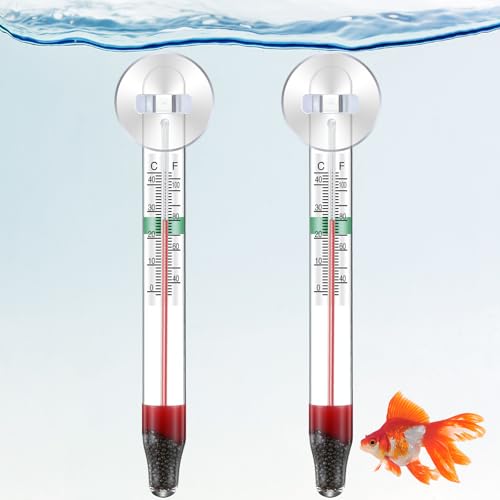
Best for: Budget-conscious buyers seeking redundancy or a backup pair. The two-piece set is ideal for larger tanks where a single unit may not cover the entire display area.
Why chosen: These floating thermometers provide readings in both Celsius and Fahrenheit, with clear markings from 0-43°C/32-110°F. The dual-pack design supports easier cross-checks and consistent monitoring across larger aquariums.
Caution: Floating glass thermometers can break if bumped by decor or rocks. Handle with care and replace any cracked units promptly.
Buying Guide: Key Considerations for Tropical Fish Tank Thermometers
- Reading method: Choose external displays for minimal water contact, floating options for easy viewing, or submersible probes for a clean look. Each method affects how easily you read the temperature and where the device sits.
- Readability: Look for large LCD or LED displays with high contrast and backlighting for nighttime visibility. Color-coded scales help identify safe ranges at a glance.
- Accuracy and range: Tropical tanks typically require readings within a narrow range. Prioritize devices with clear stated accuracy and a wide enough range to cover seasonal changes.
- Durability and placement: Consider whether your tank is freshwater, saltwater, or a terrarium-adjacent setup. Ensure the device can withstand humidity and avoid submerging non-submersible units.
- Installation method: Adhesive strips, suction cups, or removable mounts affect how easily you reposition or remove the thermometer for cleaning.
- Redundancy: For larger tanks or critical systems, using two thermometers provides cross-checks and minimizes the risk of drifting readings.
Frequently Asked Questions
Q: Do I need more than one thermometer for a tropical tank?
A: For larger tanks or tanks with diverse microhabitats, using two thermometers helps verify readings and avoid blind spots. Redundancy reduces the risk of undetected temperature shifts.
Q: Can thermometers affect water quality?
A: Most modern thermometers are designed to be safe; however, ensure any adhesive, suction cup, or probe materials are aquarium-safe and mounted outside the main water path when possible to minimize contaminants.
Q: Which thermometer is best for beginners?
A: Floating thermometers or external-display models with clear readouts and simple placement are ideal for beginners while still offering accurate measurements.
Q: How often should I check tank temperature?
A: Regular checks—ideally daily or every few days—help detect slow drift and ensure a stable environment for tropical fish and other inhabitants.
Q: Are digital thermometers better than analog ones?
A: Digital thermometers offer quicker, easier readings and often greater accuracy, especially with modern LED/LCD displays. Analog options can work, but digital models simplify monitoring in busy tanks.