Answering the needs of marine hobbyists, this guide highlights top saltwater products that simplify building and maintaining a sea water fish tank. The list targets both beginners and seasoned aquarists, with each product chosen for reliability, ease of use, and clear benefits to a marine environment. The top picks include salt mixes for reef and general marine tanks, water conditioners, and practical cleaning tools. Whether you’re stocking a small desktop reef or a larger display, these items help achieve stable chemistry, clean water, and vibrant life.
Buyer-friendly overview: the following table summarizes the five selected products, including what they’re best for, and a quick note on ideal use cases.
| Product | Best For | Why It Stands Out |
|---|---|---|
| Instant Ocean Sea Salt 50 Gallons | General marine tanks and beginners | Fast-dissolving formula with major, minor and trace elements; helps reach ideal pH quickly. |
| Instant Ocean Reef Crystals | Reef tanks with corals | Higher calcium and trace elements to support coral and coralline growth. |
| Fluval Flex 32.5 Marine Salt Water Kit | Medium to large marine setups | Integrated kit with lighting, filtration, and a compact footprint; flexible for diverse species. |
| Imagitarium Pacific Ocean Water | Quick-fill water source for setups | Pre-filtered, sanitized, and pH balanced for immediate use; low phosphate and nitrate. |
| API Tap Water Conditioner | Water preparation and safe acclimation | Neutralizes chlorine and chloramines to protect gills and tissues when using tap water. |
Instant Ocean Sea Salt 50 Gallons
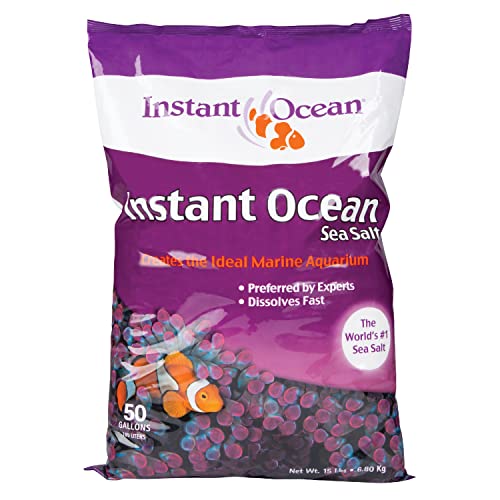
Best for: beginners setting up a new marine tank or those who do routine water changes with standard saltwater. This salt mix dissolves quickly and provides essential elements needed by most marine fish and invertebrates. It’s a solid baseline choice when first establishing salinity and pH conditions.
Why selected: the product emphasizes fast dissolution and ideal pH maintenance, reducing downtime between mixing and use. It supports a clean, ready-to-use solution in minutes, which is helpful for hobbyists who manage regular water changes or new tank cycles.
Caution: while versatile, this mix may differ slightly from reef-specific formulas; if you keep sensitive corals, consider reef salts designed for higher calcium and alkalinity.
Instant Ocean Reef Crystals

Best for: reef aquariums and tanks housing corals, where elevated calcium and trace elements support skeletal growth and coloration. This is a top pick for hobbyists prioritizing reef health alongside fish care.
Why selected: formulated with higher reef-relevant elements in concentrations greater than natural seawater, it aims to bolster calcium levels and trace nutrients essential for corals and coralline algae.
Limitation: reef buffers and calcium levels can be sensitive to dosing and water changes; consistent testing supports stable results.
Fluval Flex 32.5 Marine Salt Water Kit

Best for: intermediate to experienced hobbyists seeking an all-in-one system with a stylish design and built-in filtration. Suitable for tanks up to about 32.5 gallons with diverse inhabitants.
Why selected: the kit features a modern curved front, adjustable LED lighting, and a 3-stage filtration system, which helps maintain water quality while providing flexible lighting for fish, corals, and live rock.
Limitation: the integrated setup may require an initial learning curve to balance lighting and filtration settings for particular species.
Imagitarium Pacific Ocean Water 5 Gallons

Best for: quick-start setups, small tanks, or refresh needs where immediate access to sea-like water is desirable. Ideal for hobbyists who want a ready-to-pour marine water source without mixing.
Why selected: it’s pre-filtered, sanitized, and pH balanced with low phosphate and nitrate, reducing pre-mixing steps. This helps maintain consistency for those who want a straightforward water source.
Limitation: it is a pre-made water product, so long-term accuracy depends on maintaining tank parameters through testing and adjustments as needed for coral or sensitive species.
API Tap Water Conditioner

Best for: aquarists using tap water who need to neutralize chlorine and chloramines before introducing fish or reef inhabitants. It is also useful during acclimation processes.
Why selected: makes municipal water safer for marine life by neutralizing harmful chemicals that can irritate gills and tissues, reducing acclimation stress.
Limitation: conditioner addresses chemical contaminants but does not replace the need for proper salinity, alkalinity, and calcium management in a sea water system.
Buying Guide
What to consider when choosing sea water supplies
- Tank size and purpose: Reef tanks require different chemistry (calcium and alkalinity) than fish-only systems. Choose salts accordingly.
- Calcium and alkalinity needs: Reef-salt mixes typically provide higher calcium; plan dosing or water changes to maintain stable levels.
- Ease of use: For beginners, pre-mixed water or simple salt blends with clear instructions reduce setup time and mistakes.
- Filtration and lighting: All-in-one kits simplify setup, especially for small to mid-size tanks. For larger systems, modular filtration offers flexibility.
- Water source readiness: Tap water conditioners are helpful if you use municipal water; otherwise, purified or RO/DI water is ideal for ballast-free operation.
- Testing routine: Regular testing of salinity, pH, ammonia, nitrite, nitrate, and phosphate helps catch issues early and informs dosing decisions.
Frequently Asked Questions
- What salt should I use for a reef tank?
– Reef salts typically provide higher calcium and alkalinity, supporting corals and calcareous organisms. Choose based on your inhabitants and testing plan. - How often should I change saltwater in a marine tank?
– Regular water changes help maintain stable parameters. Frequency depends on tank size, bioload, and testing results. - Can I use regular tap water for marine tanks?
– If using tap water, treat it with a conditioner and test for chlorine, chloramines, and ammonia. Consider RO/DI water for best results. - Is pre-mixed ocean water adequate for all setups?
– It’s convenient for quick starts, but monitor parameters closely, since not all tanks will stay in equilibrium without adjustments. - Do I need calcium supplementation if I use reef salts?
– Not always. Monitor calcium and alkalinity; reef salts usually cover these but some tanks require additional dosing for optimal coral growth. - What is the best way to acclimate new fish or corals?
– Use a drip acclimation method and compare water chemistry between display and quarantine tanks to minimize shock.