Anyone maintaining a saltwater aquarium needs reliable pH testing and salinity checks. This guide highlights five top products that deliver clear readings, support saltwater care, and help prevent invisible water problems that stress or harm marine life. The picks are suitable for reef tanks, reef-keepers, and hobbyists dialing in precise salinity and pH levels. Read on to compare each option’s strengths, ideal user, and any practical limitations.
| Product | Best For | Key Benefit |
|---|---|---|
| API High Range pH Test Kit | Saltwater hobbyists seeking accurate pH in higher ranges | Precise pH readout 7.4–8.8 |
| Hofun Pool Salt Tester & pH Meter | All-in-one salinity and pH monitoring | 5-in-1 readings; easy operation |
| SJ WAVE 11-in-1 Test Strips | Comprehensive home testing | 11 parameters, quick results |
| YINMIK pH Salt Meter 5-in-1 | Multi-parameter digital testing | Replaceable probe; wide salt range |
| ORAPXI 5-in-1 Salt & pH Digital Meter | Digital accuracy for pool, spa, and aquarium | Clear digital pH and salinity readings |
API High Range pH Test Kit For Saltwater

The API High Range pH Test Kit reads within a 7.4 to 8.8 range, helping monitor pH levels critical for saltwater species like corals and marine fish. It includes one bottle of testing solution, a color card, and a test tube with cap. Best for marine tanks that require higher pH accuracy and stability. Intended audience includes reef hobbyists and African cichlid keepers who operate at higher pH targets. Caution: limited to pH measurement; does not provide salinity or other parameter readings.
Hofun Pool Salt Tester & pH Meter
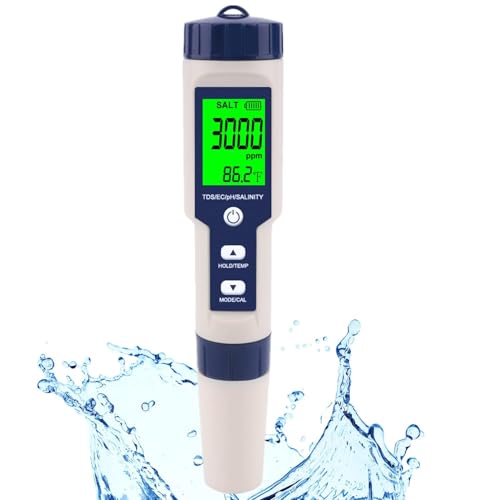
This 5-in-1 digital meter combines salinity, pH, total dissolved solids (TDS), conductivity, and temperature readings. It supports a broad range of applications, including aquariums, pools, spas, hydroponics, and RO/DI systems. Best for hobbyists who want an all-in-one solution and straightforward mode switching between SALINITY and pH. Limitation: some users may need to recalibrate periodically to maintain accuracy across units.
11 in 1 Aquarium Test Strips by SJ WAVE

This 11-parameter strip kit provides rapid, color-chart-based readings for ammonia, pH, nitrite, nitrates, total hardness, carbonate, alkalinity, copper, iron, and temperature. It is versatile for freshwater and saltwater tanks, including reef setups. Best for quick, cost-effective monitoring without a separate meter. Caution: strip interpretation can be less precise than digital meters; readings depend on accurate color matching under consistent lighting.
YINMIK 5-in-1 pH, EC, TDS, Salinity Meter

The YINMIK YK-5 combines pH, EC, TDS, salinity, and temperature in one digital tool. It supports a wide salt range and offers a replaceable probe, which can reduce long-term costs. Best for users who want an electronic, multi-parameter readout with future calibration options. Limitation: some users report the need for occasional probe maintenance and calibration; ensure replacement parts are available from the seller.
ORAPXI 5-in-1 pH and Salt Digital Meter

ORAPXI’s digital meter covers salt concentration and pH, with a 5-in-1 design that includes essential readouts and a user-friendly interface. It emphasizes exact digital readings over color-strips, making it a strong choice for precise maintenance. Best for any saltwater setup that relies on clear, digital values. Limitation: higher reliance on battery life and proper calibration to maintain accuracy.
Buying Guide: Key Considerations for Saltwater pH Testing
- Accuracy vs. convenience: Digital meters offer precise readings, while test strips provide quick, broad checks. Choose based on how exact readings you need for pH and salinity.
- Parameter scope: If you need broader water quality data, consider 5-in-1 or 11-in-1 kits that cover pH, salinity, TDS, ammonia, nitrites, nitrates, and alkalinity.
- Suitability for saltwater: Some meters are labeled for freshwater use only. Verify the product notes about seawater or reef compatibility.
- Calibration and maintenance: Look for replaceable probes and calibration solutions. Regular calibration improves long-term accuracy in marine environments.
- Ease of interpretation: Digital displays reduce guesswork, whereas color charts on strips require consistent lighting for accurate reading.
- Cost considerations: Strips are inexpensive upfront but may require more frequent replacement; digital meters have a higher upfront cost but longer-term value with replaceable parts.
Frequently Asked Questions
- What is the ideal pH range for most saltwater aquariums? Answer: Most saltwater tanks aim for pH around 7.8 to 8.4, with reef tanks often targeting the upper end of that range.
- Why choose a digital meter over test strips for saltwater? Answer: Digital meters provide precise, numeric readings and are easier to read consistently, especially for pH and salinity.
- Do I need a separate salinity tester if I have a pH meter? Answer: Yes. Salinity monitoring is a distinct parameter; many 5-in-1 meters combine this, but dedicated salinity meters can offer higher accuracy for some setups.
- How often should I test saltwater aquarium water? Answer: Regular testing—at least weekly—helps detect shifts early and maintain stable conditions for marine life.
- Can test strips be used for reef tanks? Answer: They can be used for quick checks, but for reef tanks, digital meters are often preferred due to the need for precise pH and salinity readings.
- Is calibration required for pH meters? Answer: Yes. Calibration with fresh calibration buffers ensures accuracy and should be performed per the manufacturer’s recommendations.