Answering your saltwater tank needs starts with choosing a marine-grade salt mix that delivers the right trace elements and stable alkalinity. This guide highlights five reliable options for marine setups, reef systems, and mixed tanks. Best for newcomers: ready-to-use blends with fast dissolving formulas. Best for reef enthusiasts: salts enriched with calcium and trace elements. Best for water prep: conditioners that support a safe transition from tap to salty water. The listed products cover both reef-focused and general marine applications, along with a practical preparation approach for tap water.
The following table summarizes the five products selected for saltwater setups. It highlights the primary use case and the best scenario for each product to help you compare options at a glance.
| Product | Best For | Notes |
|---|---|---|
| Instant Ocean Sea Salt 50 Gallons | General marine tanks | Fast-dissolving mix with major, minor, and trace elements |
| Coralife Reef Salt 15 Gallon | Small reef or mixed tanks | Chlorine/chloramine neutralizer; rapid dissolution |
| Instant Ocean Reef Crystals Reef Salt 50 Gallons | Enhanced reef and high-calcium needs | Extra calcium and trace elements for corals |
| API Aquarium Salt Freshwater Salt 36-Ounce | Water conditioning for mixed systems (when used as part of water prep) | Specifically for freshwater use; helps electrolytes |
| Aqua Natural Oolitic Aragonite Sand 10lb | Substrate for pH stability in reef and marine tanks | High purity calcium carbonate; buffering properties |
Instant Ocean Sea Salt 50 Gallons
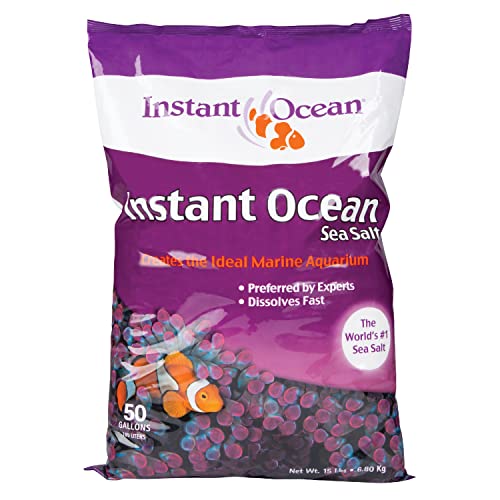
Brand: Instant Ocean
Features: Formulated specifically for marine aquariums; contains every major, minor and trace element delicate marine life need. Dissolves fast to provide a ready-to-use solution in minutes. Ideal pH helps quickly achieve and maintain stable levels, free of nitrate and phosphate.
Best for: New and established saltwater tanks that require a reliable, all-in-one marine salt with quick dissolution. This product suits hobbyists who want a straightforward preparation process and balanced chemistry. Limitations: May require additional adjustments in tanks with very specific trace-element needs or unique coral species.
Coralife Reef Salt 15 Gallon

Brand: Coralife
Features: Neutralizes chlorine and chloramine, while also reducing phosphate to help limit algae growth. Formula can be used with RO water or tap water. Fine grind supports rapid dissolution.
Best for: Small reef or mixed tanks that benefit from a reef-specific formulation with phosphate control and quick mixing. Caution: Using in very large volumes may require more careful mixing to avoid localized salinity fluctuations.
Instant Ocean Reef Crystals Reef Salt 50 Gallons

Brand: Instant Ocean
Features: Formulated specifically for reef aquariums; contains essential ocean reef elements in higher concentrations than natural seawater. Extra calcium to support stony corals and coralline algae growth; includes extra trace elements for healthy reef systems.
Best for: Reef tanks or SPS/LPS setups that require robust calcium and trace elements. Limitation: Higher mineral content may require careful monitoring of alkalinity and calcium dosing in high-demand systems.
API Aquarium Salt Freshwater Salt 36-Ounce

Brand: API
Features: Contains one API Aquarium Salt for freshwater use. Adds electrolytes to the water and can help reduce stress in fish during water changes or transitions. Best for: Freshwater or mixed tanks that require a simple electrolyte supplement. Caution: Not designed for strict marine or reef systems; use salt designed for saltwater as needed for marine setups.
Aqua Natural Oolitic Aragonite Sand 10lb

Brand: Aqua Natural
Features: Unparalleled buffering capability to maintain a stable pH around 8.2. 98% pure calcium carbonate with minimal impurities; naturally renewable oolitic aragonite from a sustainable source.
Best for: Reef and marine tanks seeking pH stability and a natural aragonite substrate. Limitation: Sand substrate may affect detritus buildup and tank cleaning frequency; ensure compatibility with your filtration approach.
Buying Guide
What should I look for in marine salt mixes?
Key factors include element balance (calcium, magnesium, alkalinity), trace minerals, pH stability, and how easily the mix dissolves. Reef-focused formulas tend to have higher calcium and alkalinity for corals, while general marine blends prioritize a balanced seawater proxy for mixed fauna.
Do I need a reef-specific salt?
If you keep corals or a dedicated reef community, reef salts with elevated calcium and trace elements are beneficial. For mixed or beginner tanks, a standard marine salt is typically sufficient to start and maintain a healthy environment.
How important is buffering and pH management?
Buffering helps stabilize pH and alkalinity. Substrates like aragonite sands can contribute to buffering, but you may still need water chemistry testing and, if necessary, dosing plans for alkalinity and calcium.
What about tap water conditioners?
Water conditioners remove chlorine and chloramines and detoxify heavy metals. They are essential for safe water prep and can protect fish during water changes. They do not replace proper salt mixes for salinity in marine tanks.
Which product is best for beginners?
For beginners, Instant Ocean Sea Salt or Reef Crystals provide ready-to-use mixes with straightforward dissolving processes, supporting stable salinity and balanced mineral content in typical beginner tanks.
What should I monitor regularly?
Regular tests for salinity (conductivity), calcium, alkalinity, magnesium, nitrate, and phosphate help maintain a stable environment. Adjustments should be made gradually to avoid stressing aquatic life.
Substance and substrate considerations
Choosing a substrate like aragonite sand can aid buffering and calcium availability, but remember to account for potential detritus accumulation and pumping needs in your filtration design.
Implementation tips
- Always dissolve the salt in a separate container of water before adding to the tank to prevent salinity spikes.
- Match salinity with your tank’s current density gradually when performing water changes.
- Test water consistently after changes and adjust as necessary.
FAQ
- What is the difference between reef salt and marine salt?
Answer: Reef salts have higher calcium and trace elements for corals; marine salts aim for balanced seawater parameters for general marine life. - Can I use freshwater salt in a saltwater tank?
Answer: No. Use a salt mix formulated for marine environments to ensure proper salinity and minerals. - Is buffering necessary for reef tanks?
Answer: Reef tanks often benefit from buffering due to coral calcium demand; testing and dosing may be needed. - Should I use a conditioner every time I add new water?
Answer: Yes, to neutralize chlorine/chloramines and protect fish during water changes. - What testing parameters are most important?
Answer: Salinity, calcium, alkalinity, magnesium, nitrate, and phosphate are critical for stability in most setups.