Choosing the right salt for a saltwater or reef aquarium is essential for stability, coral growth, and vibrant marine life. This guide highlights popular salts designed for marine systems, reef setups, and some freshwater options that hobbyists sometimes use in mixed tanks. Each product is evaluated by solubility, trace element content, and suitability for different tank goals. Use this overview to compare options and find the best match for your aquascape and livestock.
| Product | Brand | Volume / Size | Best For |
|---|---|---|---|
| Instant Ocean Sea Salt | Instant Ocean | 160 gallons | General reef and marine tanks |
| Instant Ocean Sea Salt | Instant Ocean | 50 gallons | Medium-sized marine setups |
| Instant Ocean Reef Crystals Reef Salt | Instant Ocean | 160 gallons | Reef tanks with extra calcium and trace elements |
| Instant Ocean Reef Crystals Reef Salt | Instant Ocean | 50 gallons | Smaller reef tanks |
| API Aquarium Salt Freshwater Salt | API | 36-ounce box | Freshwater tanks; electrolyte support |
Instant Ocean Sea Salt 50 Gallons For Marine Aquariums
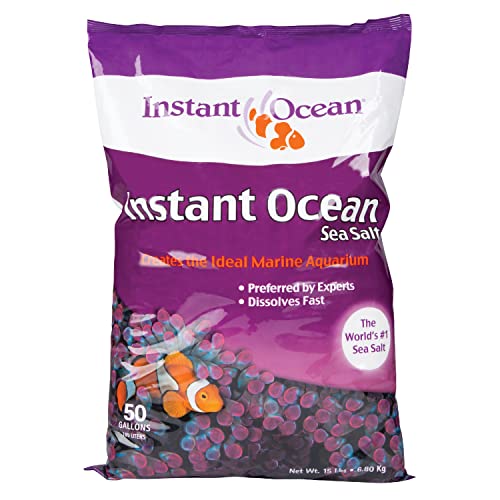
Instant Ocean Sea Salt is formulated specifically for marine environments. It contains essential major, minor, and trace elements necessary for healthy fish and invertebrates, with fast-dissolving properties to help aquarists establish a ready-to-use solution quickly. This product aims to maintain stable calcium, alkalinity, and magnesium levels, supporting coral growth and general reef health. Regular monitoring remains important to keep parameters within species-specific ranges.
Instant Ocean Reef Crystals Reef Salt For 160 Gallons

Designed for reef tanks, this salt provides elevated calcium and trace elements to support stony corals and coralline algae. Its formulation mirrors the mineral content of natural seawater but in higher concentrations for reef systems. Users generally notice improved skeletal growth and color when paired with proper lighting and nutrient management. Compatibility with SPS and LPS corals varies by system, so test frequently after changes to salinity or water chemistry.
Instant Ocean Reef Crystals Reef Salt For 50 Gallons

This smaller-volume reef salt is built to deliver reef-dedicated elements on a per-volume basis suitable for hobbyists maintaining compact reef systems. Like its 160-gallon counterpart, it emphasizes extra calcium and trace elements needed for coral skeletons. As with any reef mix, dosing and water changes should be carefully planned to sustain consistent parameters and coral health over time.
API Aquarium Salt Freshwater Aquarium Salt 36-Ounce Box

Though intended for freshwater tanks, API Aquarium Salt provides electrolytes that support osmotic balance and general fish health in non-saline environments. It can be used to aid in stress recovery and to stabilize salinity in emergencies when water changes are performed. It is not a substitute for marine salt blends in saltwater systems and should be used within freshwater setups according to label directions.
API Aquarium Salt Freshwater Aquarium Salt 17-Ounce Box

This 17-ounce API salt option is another freshwater choice designed to support electrolyte balance and reduce stress in fish. It is suitable for small freshwater setups or as a supplementary product in mixed-tank scenarios where occasional salinity adjustments are needed. It should not be used as a substitute for proper marine or reef salt mixes in saltwater systems.
Buying Guide: Key Purchase Considerations
- Tank type and goals: Reef tanks require high calcium and alkalinity support, while general marine tanks benefit from balanced major and trace elements. Freshwater salts are not appropriate for marine systems unless used strictly as directed for freshwater livestock.
- Volume and dosing: Reef salts are often sold in larger volumes or concentrated blends. Choose a size that matches how often you perform water changes and how many gallons your system holds.
- Calcium, alkalinity, and magnesium: For corals, ensure the product supports calcium and magnesium levels suitable for your species. Regular testing helps maintain stable parameters.
- Solubility and mixing: Opt for salts labeled as fast-dissolving when you need to prepare water quickly. Proper mixing and aeration reduce the risk of undissolved solids.
- Trace elements and compatibility: Check trace element profiles to ensure compatibility with your tank’s inhabitants. Some reef salts include additional trace nutrients that support growth and coloration.
- Test and monitor: Regularly measure salinity, calcium, alkalinity, magnesium, nitrates, and phosphate. Even with high-quality salts, environment stability depends on consistent maintenance practices.
- Emergency readiness: Have a freshwater salt option on hand for quarantine or non-marine needs, but avoid using freshwater salts as substitutes in established saltwater systems.
When selecting a salt mix, align your choice with your tank’s inhabitants, your maintenance routine, and your water chemistry goals. Reef-docused blends are typically best for corals and invertebrates, while general marine salts suit fish-only or mixed reefs. Follow the product directions and test regularly to sustain a healthy, thriving aquarium.