Choosing the right salt for a saltwater or reef aquarium is essential for stability, coral growth, and fish health. This guide compares popular marine salts and reef salts, highlighting their intended use, solubility, and mineral balance. It helps hobbyists select products that align with their tank size, inhabitants, and water source. Below, five well-regarded options are reviewed, followed by a practical buying guide to navigate key considerations.
| Product | Brand | Type | Notes |
|---|---|---|---|
| Instant Ocean Sea Salt | Instant Ocean | Marine salt for general marine tanks | Fast-dissolving, balanced trace elements |
| Instant Ocean Reef Crystals Reef Salt | Instant Ocean | Reef salt for marine/reef tanks | Higher calcium and trace elements |
| Instant Ocean Reef Crystals Reef Salt (50 Gallons) | Instant Ocean | Reef salt for reef/tank setups | Enhanced calcium and alkalinity support |
| Instant Ocean Reef Crystals Reef Salt (160 Gallons) | Instant Ocean | Reef salt for larger systems | Concentrated trace elements for corals |
| Coralife BioCube Aquarium Salt | Coralife | Marine salt for small tanks | Fine grind dissolves rapidly |
Introduction notes: The products below are organized to reflect common choices for saltwater and reef aquariums, ranging from standard marine salts to reef-specific formulations. Where applicable, both general use salts and reef-enhancing options are covered to help you compare solubility, element balance, and suitability for your tank’s inhabitants.
Instant Ocean Sea Salt 50 Gallons
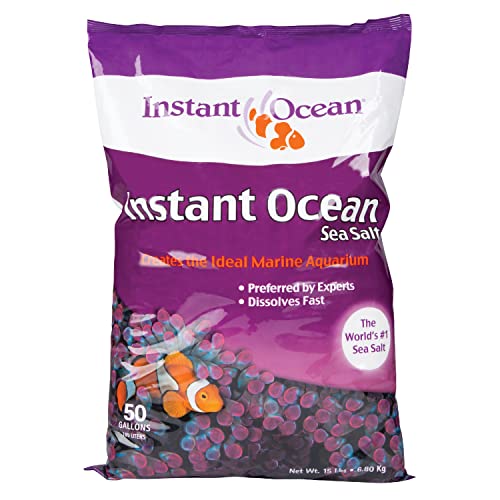
Instant Ocean Sea Salt is a widely used marine salt designed for general saltwater aquariums. It provides a balanced mix of major ions and trace elements to support healthy fish and invertebrates. The product dissolves quickly, yielding a ready-to-use solution that helps establish stable salinity and consistent water chemistry. It is suitable for many standard saltwater setups, including gallon-size to mid-sized tanks, and supports typical pH targets when used as directed.
Instant Ocean Reef Crystals Reef Salt For 160 Gallons

Reef Crystals Reef Salt is formulated for reef aquariums with elevated calcium and alkalinity, catering to stony corals and calcifying organisms. This salt balances trace elements and minerals to support diverse reef inhabitants while maintaining water hardness suitable for SPS and LPS corals. It is designed for larger systems but can be used in compatible smaller setups when dosage and water change schedules align with tank needs.
Instant Ocean Reef Crystals Reef Salt For 50 Gallons

This reef salt variant emphasizes higher calcium and trace elements to support reef-building corals, calcareous algae, and other hard-shelled invertebrates. It is well-suited for mid-sized reef displays and tanks requiring robust mineral supplementation to sustain vibrant coral growth and coloration. Regular testing and dosing may be necessary to maintain optimal alkalinity and calcium levels.
API AQUARIUM SALT Freshwater Aquarium Salt 17-Ounce Box

API Aquarium Salt is labeled for freshwater use, including tropical and goldfish tanks. While primarily intended for freshwater systems, it can be used in emergencies or for aquatic treatments where isolation or acclimation procedures are followed. It introduces electrolytes and minerals to support osmotic balance. It is not a marine reef salt and should not be substituted for reef formulations without guidance from marine-care resources.
Coralife BioCube Aquarium Salt

Coralife BioCube Marine Salt is formulated for use with small marine tanks, including BioCube setups. It aims to neutralize chlorine and chloramine, while delivering a balanced salt mix with a fine grind for rapid dissolution. This option is convenient for compact systems that require reliable, quick-dissolving salt to maintain stable salinity and water chemistry in smaller reefs or nano-tanks.
Buying Guide: Key Purchase Considerations
- Tank type and inhabitants: Reef tanks demand higher calcium, alkalinity, and trace elements. General marine salts work for many fish-only systems but may under-deliver for corals.
- Water source and initial conditions: If using RO/DI water, ensure the salt provides the necessary minerals to reach target salinity and alkalinity. Consider how your source water may interact with the salt’s composition.
- Calcium and alkalinity targets: Reef salts often emphasize calcium and alkalinity; monitor levels with reliable test kits and adjust water change schedules accordingly.
- Solubility and dissolution: Quick-dissolving salts reduce leftover particulates and cloudy water after mixing. Powdery or fine-grind formulations can dissolve faster in routine water changes.
- Size and replacement rate: Large-volume salts are cost-effective for big tanks but require careful mixing to prevent local highs in salinity. Plan replacements based on your weekly water change routine.
- Maintenance considerations: Regular testing for pH, alkalinity, calcium, magnesium, and salinity helps determine when and how to dose or change water. Some reef salts require dosing of buffering agents to maintain stability.
- Emergency compatibility: Keep a freshwater salt option on hand for non-marine emergencies or medical treatments where guidance suggests using a freshwater formulation temporarily, while understanding limitations.
Usage Tips and Best Practices
- Always dissolve salt in a separate container of freshly drawn water before adding to the tank to prevent undissolved particles from clogging filters or injuring wildlife.
- Test water parameters after mixing and before introducing any livestock. Typical targets vary by tank type; consult species-specific guidelines.
- Gradual adjustments: If changing salt formulations or significantly altering alkalinity or calcium, perform small, incremental changes over several days to avoid stress to fish and corals.
- Label and store salts in a cool, dry place to preserve mineral integrity and prevent clumping.