Answering the demand for pure, reliable water for aquariums, these RO/DI systems remove contaminants, odors, and dissolved solids to protect fish, plants, and décor. The best picks here suit hobbyists with varying needs—from compact, budget-friendly setups to higher-capacity, premium configurations. This guide highlights who each product is best for, plus clear pros and limitations to help you compare options quickly.
| Product | Best For |
|---|---|
| Aquatic Life RO Buddie 4-Stage | Entry-level hobbyists needing four-stage filtration |
| Aquatic Life Twist-In 4-Stage | Moderate-DI performance, easy cartridge changes |
| iSpring RCC1DP Tankless | High-flow, compact setup with pump-assisted filtration |
| Max Water 6 Stage 100 GPD | 0-TDS output with DI stage for sensitive species |
| Geekpure 4 Stage Portable | Portable or apartment use with multiple stages |
Aquatic Life RO Buddie 4-Stage RO/DI System
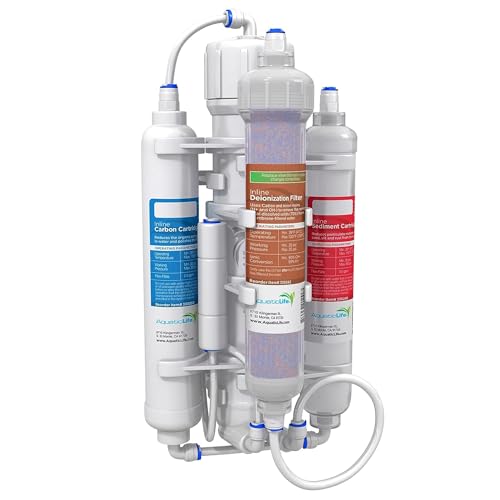
The Aquatic Life RO Buddie uses a four-stage approach to remove debris, odors, and particulates from tap water. It includes a sediment filter to trap dirt and a carbon block to reduce chlorine and odors. It is best for hobbyists who want reliable basic purification for standard freshwater tanks, small reefs, or humidifiers and fountains. A limitation is that it does not remove chloramines, which may require an additional treatment for chloramine-treated municipal water. The system is suited for tank setups where moderate purification suffices and daily volume needs are modest.
Aquatic Life Twist-In 4-Stage RO/DI System
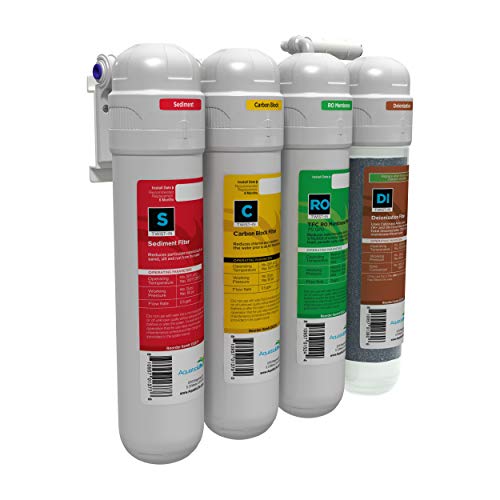
This four-stage system integrates sediment, carbon, RO membrane, and a color-changing DI resin to deliver purified water up to 75 GPD. It’s best for hobbyists seeking a compact, easy-to-maintain system with real-time DI status indication. Note that this model does not remove chloramines, so it’s ideal where chloramines are not a concern or where chloramine removal is achieved via alternate dosing or a pre-treatment. Choose this if you want the DI stage to confirm near-zero TDS water for sensitive livestock.
iSpring RCC1DP Tankless RO/DI System

The RCC1DP is a tankless RO/DI unit with a pump-assisted filtration approach, designed for consistent performance even in low-pressure environments. It features a 150 GPD RO membrane for fast filtration and broad application—from aquariums to laboratories. This model is best for users who need a high flow rate and reliable performance in spaces with limited tank space. A potential limitation is the complexity of setup and maintenance for first-time buyers, given the integrated pump and optional DI cartridge.
Max Water 6 Stage 100 GPD RODI System

The Max Water 6-stage system provides RO/DI filtration with a 100 GPD capacity and a deionization stage to achieve very low TDS. It’s best for reef tanks or sensitive freshwater species that require near-0 TDS water. The DI stage lowers residual solids after the RO process, delivering high-purity water for aquariums. A caution is that DI resin color changes and potential particulate byproducts may require monitoring and resin replacement intervals for optimal results.
Geekpure 4 Stage Portable RO System

The Geekpure 4-stage portable system combines a PP sediment filter, activated carbon, RO membrane, and a mixed-bed DI resin. It is well-suited for apartments, travel, or temporary setups where portability is essential. It can deliver water with TDS near 0 ppm after DI treatment. A limitation is that it emphasizes portability over rugged, long-term home installation performance, so it may require more frequent cartridge changes in high-usage scenarios.
Buying Guide: Key Considerations For Your RO/DI System
- Water source and contaminants: Check your local water report for chlorine, chloramines, nitrates, and hardness. Systems without chloramine removal need a pre-treatment or DI stage to handle TDS spikes.
- GPD and daily demand: Match the system’s gallons per day to your tank size and water-changing schedule. Reef tanks often require higher purity and flows.
- DI stage presence: Systems with DI resin offer near-zero TDS water. DI maintenance includes resin color changes and periodic replacement.
- Membrane quality and replacement intervals: Higher-quality RO membranes deliver better impurity removal. Replacement frequency depends on usage and water quality.
- Ease of installation and maintenance: Tankless and pump-assisted models save space but may require more technical setup. Portable models are convenient for temporary needs but may demand more frequent cartridge changes.
- Space and setup location: Consider cabinet or countertop space. Some units are compact enough for apartments, others require dedicated plumbing.
- Cost of ownership: Include cartridge and DI resin replacement costs, not just the upfront price. Some systems have longer-lasting membranes or more readily available parts.
Frequently Asked Questions
- What does an RO/DI system remove from aquarium water?
– RO membranes remove dissolved solids, chlorine, and many contaminants; DI resin further reduces residual TDS to near zero in most cases. - Do all aquarium setups need a DI stage?
– Not necessarily. Freshwater tanks with moderate impurity levels may do well with RO only, while reef and sensitive species often benefit from DI. - Is it necessary to pre-treat water before the RO/DI system?
– In some cases, chloramines or hardness may require a pre-filter or additional treatment to protect the RO membrane and DI resin lifespan. - How often should I replace DI resin or filters?
– Replacement frequency depends on water quality, usage, and resin color changes; monitor TDS levels to determine when to replace. - Can I install an RO/DI system myself?
– Many systems are designed for DIY installation, but tankless or pump-assisted units may require careful setup and plumbing knowledge. - What output should I expect from a 100 GPD system?
– Real-world output depends on water pressure and temperature; 100 GPD is a peak rate under optimal conditions and may be lower in practice.