If you keep fish or other aquatic life, you need reliable, contaminant-free water. This guide compares top reverse osmosis (RO) systems designed for aquariums, fountains, and similar setups. The recommended models provide clear filtration stages, low total dissolved solids (TDS), and easy maintenance. These options suit hobbyists seeking consistent water quality, beginners setting up a new tank, and professionals needing steady water supply for sensitive species.
Summary table of selected products
| Product | Stage Count / Capacity | Best For | Notable Consideration |
|---|---|---|---|
| Aquatic Life RO Buddie 4-Stage | 4-Stage, 50 GPD | General freshwater tanks, fountains, humidifiers | Chloramines not removed |
| Aquatic Life Twist-in 4-Stage | 4-Stage, up to 75 GPD | Purist water for sensitive species | Does not remove chloramines |
| Aquatic Life RO Buddie 3-Stage | 3-Stage, 50 GPD | Quick, reliable water filtration | Less comprehensive than 4-stage on some contaminants |
| iSpring RCC1D Tankless RO/DI | 5-Stage, 150 GPD | High-flow, space-saving setups | DI removal varies with feed water quality |
| 4-Stage RO/DI System, Filterelated | 4-Stage, 50 GPD | Compact, tankless flexibility | DI resin color change signals replacements |
Aquatic Life RO Buddie 4-Stage Aquarium Water Filter System
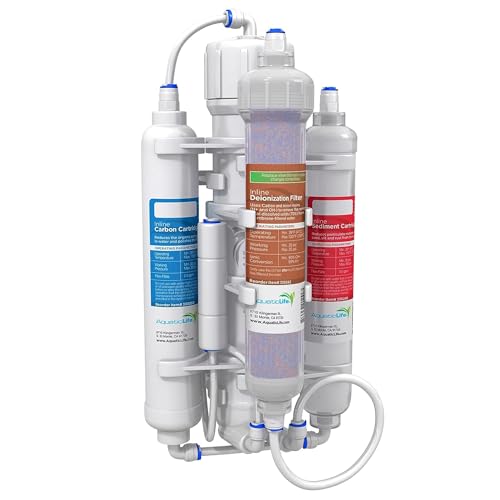
The Aquatic Life RO Buddie 4-Stage system uses reverse osmosis to produce clean water for aquariums, ponds, and other water features. It removes debris from tap water and provides filtered outputs suitable for fish tanks, humidifiers, and fountains. The sediment stage captures dirt, sand, and silt before they enter the RO membrane, improving water clarity and filtration efficiency. The carbon stage reduces chlorine and odors, helping to protect fish and plants. Note that chloramines are not removed by this model.
Best for: hobbyists who want reliable, compact filtration for standard freshwater tanks and decorative water features. Choose this if you need straightforward, affordable RO filtration with a familiar 4-stage design.
Caution: Do not rely on this model to remove chloramines; if your municipal water contains chloramines, separate treatment may be required.
Aquatic Life Twist-In 4-Stage RO/DI Aquarium Water Filter System
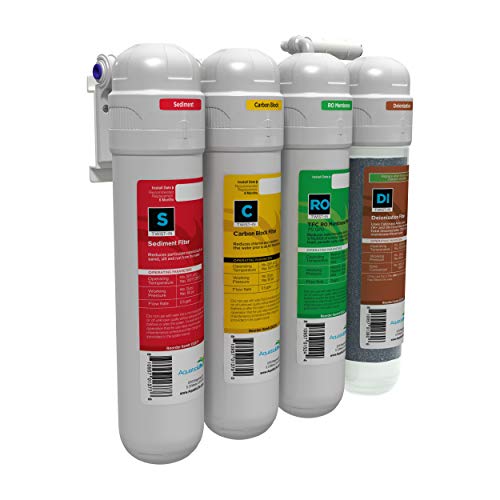
The Twist-In 4-Stage system combines sediment, carbon, RO membrane, and DI resin stages to deliver purified water at up to 75 GPD. The sediment and carbon stages remove particulate matter and chlorine, reducing cloudiness and odor. The RO membrane minimizes total dissolved solids, while the DI resin offers final polish for near-zero TDS water. This model excels for aquariums that benefit from very clean water for unusually sensitive species.
Best for: aquarists needing very pure water with a straightforward 4-stage setup, especially when high purity benefits delicate fish or reef setups (where applicable). It’s a strong choice if you want higher daily production without sacrificing filtration depth.
Limitation: This system does not remove chloramines, so water with ammonia-based disinfectants may require additional treatment.
Aquatic Life RO Buddie 3-Stage Aquarium Water Filter System

The RO Buddie 3-Stage system provides efficient filtration using reverse osmosis to remove debris from tap water for quick, clean outputs. It includes a sediment filter to capture dirt and prevent water quality issues, plus a carbon stage to remove chlorine and odors. It’s designed for aquariums, fountains, and humidifiers, delivering water that supports healthy plant and fish life.
Best for: beginners or hobbyists who want a reliable, lower-complexity RO setup without a DI stage, ideal for general freshwater tanks where moderate TDS reduction is sufficient.
Limitation: It offers fewer filtration stages than 4-stage models; consider DI or additional treatment if you need ultra-pure water for sensitive species.
4-Stage Aquarium Reverse Osmosis System with DI and Flushing Valve
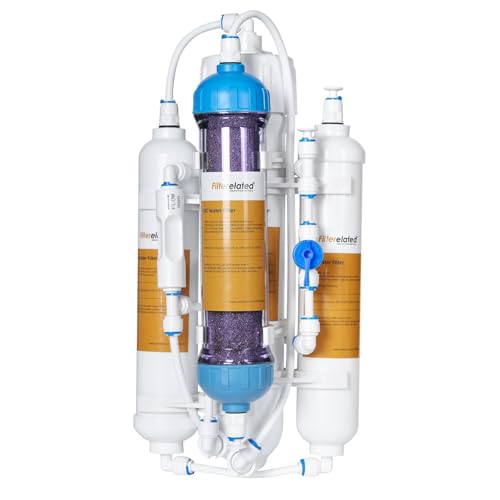
This 4-stage RO/DI system adds a deionization stage after RO filtration, delivering near-zero TDS water. The DI resin changes color to indicate depletion, helping you plan resin replacement. It includes a flushing valve and 100 GPD capacity, with quick-connect fittings for easy cartridge changes. It aims for consistent, high-purity output for aquariums and other water needs.
Best for: aquarists who require very low TDS water and want an indicator-driven DI resin to monitor resin life in real time. It’s well-suited for tanks with sensitive species that react to trace contaminants.
Limitation: DI resin color change means you’ll need to monitor resin wear; plan for resin replacement as indicated.
iSpring RCC1D Tankless RO/DI System

The RCC1D combines an RO stage with a DI filter in a tankless design, delivering up to 150 GPD without a storage tank. It targets high-demand setups and aquariums that require a steady flow of purified water. The system claims removal of a broad range of contaminants, including heavy metals and chlorine, with DI providing additional purification. Its tankless design saves space and simplifies installation for compact areas.
Best for: larger or high-demand aquariums, dental or veterinary environments where a continuous, high-volume supply of clean water is advantageous. It’s a good fit when space is a concern and you want to minimize storage components.
Limitation: The absence of a traditional tank means you’ll rely on a continuous feed that may require adequate water pressure to maintain flow rates.
4 Stage RO/DI Water Filter System with DI Color-Changing Resin

This 4-stage RO/DI system combines sediment filtration, carbon filtration, RO membrane, and DI resin to produce water with very low TDS. The DI resin changes color to signal replacement, helping maintain filtration efficiency. The system is rated at 50 GPD, making it suitable for tanks and small to medium water-change needs. It includes practical flushing and easy cartridge replacements for ongoing maintenance.
Best for: hobbyists who want a compact RO/DI setup with a user-friendly DI resin indicator. It’s a solid fit for mid-sized tanks and setups where daily water changes require reliable, near-pure water.
Limitation: Not all users may achieve zero TDS depending on feed water quality; regular maintenance remains essential for best results.
Buying Guide: Key Considerations When Choosing an Aquarium RO System
- Water quality needs: Determine your tank’s sensitivity. Delicate fish and planted tanks benefit from higher-purity water and, in some cases, DI stages.
- Production capacity: Match GPD to your water change schedule. Higher GPD systems support larger tanks or frequent top-offs without waiting for output.
- Number of filtration stages: More stages generally reduce TDS further, but consider maintenance complexity and cost.
- Chloramines and chlorine handling: If your water supply contains chloramines, ensure the system includes or is paired with a chloramine-removing stage or additional treatment.
- Tankless vs. tank-based design: Tankless models save space but may require consistent water pressure; tank-based systems provide steady storage for uninterrupted use.
- DI resin indicators: Color-changing DI resin helps track resin life, reducing the risk of degraded water quality.
- Installation and maintenance: Look for quick-connect fittings, straightforward cartridge replacement, and clear maintenance schedules.
- Compatibility with aquariums: Some membranes better suit freshwater, while reef or heavily planted tanks may require stricter TDS control.
Frequently Asked Questions
- What is RO water, and why is it good for fish tanks?
RO water is produced by removing most dissolved solids from tap water. It yields very clean water, reducing chlorine, chloramines, heavy metals, and other contaminants that can stress fish and hinder plant growth.
- Do all RO systems remove chloramines?
No. Some systems remove chlorine but not chloramines. If your water contains chloramines, look for a system that explicitly includes chloramine removal or pair with an appropriate additive or reactor.
- What does GPD mean, and how do I choose?
GPD stands for gallons per day. Choose a model with higher GPD than your daily water-change needs to avoid delays and ensure a steady supply.
- Is a DI stage always necessary for aquariums?
Not always. Freshwater tanks may be adequately served by RO alone, but DI stages provide near-zero TDS water for particularly sensitive species or high-precision needs.
- What maintenance should I expect?
Regular cartridge changes, periodic membrane replacement, and monitoring of output quality are common. DI resin indicators can help time resin replacement.
- Can I use RO water directly for all fish?
While RO water is very pure, it may require remineralization for freshwater fish to maintain proper mineral balance and pH levels. Always tailor mineral content to your species’ needs.