Maintaining pristine water is essential for aquatic life. A reliable reverse osmosis (RO) system removes impurities, chlorine, and contaminants, providing water that supports stable pH, better fish health, and clearer tanks. Below are five top-rated RO/DI systems that cater to aquarium needs, balancing filtration power, ease of use, and reliability.
Summary of Selected Products
| Product | GPD | Stages | Key Benefit |
|---|---|---|---|
| Aquatic Life RO Buddie 4-Stage RO/DI | 50 | 4 | Strong filtration suitable for mid-sized tanks |
| iSpring RCC7AK | 75 | 6 | Alkaline remineralization for balanced pH |
| Aquatic Life Twist-In 4-Stage RO/DI | 75 | 4 | High output with reliable sediment and TDS filtration |
| iSpring RCC1DP Tankless RO/DI | 150 | 5 | High flow for large setups and laboratories |
| Aquatic Life 4-Stage RO/DI 100 GPD | 100 | 4 | High capacity with DI resin for 0 TDS output |
Aquatic Life RO Buddie 4-Stage RO/DI Filtration Unit

The Aquatic Life RO Buddie 4-Stage system delivers up to 50 gallons per day. It includes a sediment filtration stage to capture sand and silt, ensuring clearer source water before the RO membrane acts. The system targets reduced Total Dissolved Solids (TDS) and provides reliable filtration for most freshwater aquariums.
iSpring RCC7AK 75 GPD Alkaline 6-Stage RO System

This six-stage system combines RO filtration with a mineral restoration stage to deliver water with a balanced pH and essential minerals. A top-mounted design simplifies installation above the sink, and a transparent first-stage housing lets you monitor filter life easily.
Aquatic Life Twist-In 4-Stage RO/DI 75 GPD
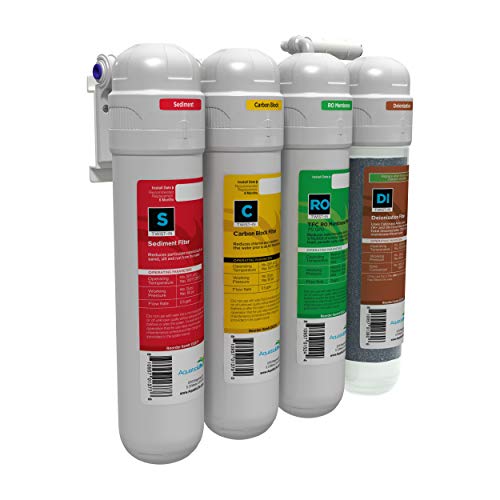
This 4-stage unit provides up to 75 GPD, with membrane filtration to reduce TDS and a sediment stage to remove particulates. The twist-in design facilitates quick cartridge changes and maintenance, suitable for steady aquarium care.
iSpring RCC1DP Tankless RO/DI System

The RCC1DP is a tankless RO/DI system featuring a pump-enhanced filtration process and a 150 GPD membrane. It targets a broad range of contaminants (lead, chlorine, fluoride, and more) and aims to maintain consistent performance even under low water pressure, making it suitable for larger aquariums and laboratories.
Aquatic Life 4-Stage RO/DI Filtration Unit with Carbon Plus, 100 GPD
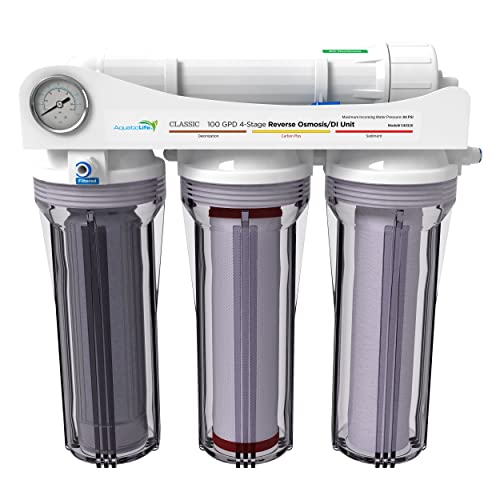
This 4-stage system provides up to 100 GPD with a comprehensive filtration lineup that includes a Carbon Plus cartridge designed to reduce chloramines and chlorine efficiently. A refillable DI resin cartridge supports low-TDS output, making it suitable for sensitive aquariums.
Buying Guide: Key Purchase Considerations
- Water demand and tank size: Larger aquariums benefit from higher GPD systems (e.g., 100–150 GPD), while smaller tanks can use 50–75 GPD units without excessive waste.
- Filter stages and filtration goals: A multi-stage RO/DI setup (RO membranes plus DI resin) provides the lowest TDS levels. remineralization stages help maintain healthy water chemistry for freshwater fish.
- Removal efficiency: Look for systems that specify TDS reduction levels and contaminant removal rates (lead, chlorine, chloramines, fluoride, etc.).
- Maintenance access: Easy cartridge and membrane changes save time and reduce downtime. Transparent housings help monitor filter life.
- Installation and space: Some models are countertop-friendly with top-mounted fittings, while others may require under-sink or dedicated space.
- Pump and pressure considerations: Tankless or pump-assisted units maintain performance under varying water pressures, which matters in homes with fluctuating supply.
- DI resin lifespan: Refillable DI cartridges can extend output life and reduce cost per gallon, especially in high-TDS tap water.
- Compatibility: Ensure the system’s fittings and tubing match your aquarium setup and any existing RO storage tanks or mixing reservoirs.
Additional Considerations and Perspectives
- Water quality goals: For freshwater planted tanks, consistent mineral content and pH stability may require remineralization. For reef tanks, higher purity water can be critical, favoring systems with robust DI stages and reliable chloramine removal.
- Operational efficiency: Tankless or high-GPD systems reduce wait times when preparing water, which is useful for frequent water changes or large tanks.
- Maintenance planning: Consider a maintenance schedule that aligns with your tank’s needs—filters usually require replacement every 6–12 months, while DI resin life depends on water quality and usage.
- Cost of ownership: While initial cost varies by capacity and features, factor in cartridge and membrane costs, DI resin replacements, and potential upgrades (AK remineralization, carbon cartridges).
- Environment and water waste: RO systems produce wastewater. Look for models with efficient recovery ratios and consider using waste water for non-potable tasks if appropriate.