Answering the question, these phytoplankton foods are ideal for reef aquariums that rely on micro-food sources to support corals, copepods, and other filter-feeders. This guide highlights options for soft and hard corals, clams, and invertebrates, with clear guidance on suitability, feeding methods, and limitations. The top picks below target different tank setups, circulation patterns, and feeding styles to help you choose what’s best for your system.
| Product | Best For | ||
|---|---|---|---|
| Phyto-Feast Phytoplankton Food for Corals | Active reef tanks needing diverse nutrients | Live phytoplankton food | Very concentrated; good for corals and invertebrates |
| Polyp Lab Nano Reef-Roids Coral Food | Direct feeding with low-flow or off-circulation periods | Coral-specific powder | Effective when dispersion is controlled |
| Brightwell PhytoChrom | Color and health boost for a range of invertebrates | Concentrated phytoplankton suspension | Multi-type phytoplankton spectrum |
| Brightwell Ultraplanktos PCWM | Temperate marine tanks needing targeted growth | Liquid phytoplankton suspension | Amino-acid enhanced for coloration |
| OceanMagik Live Phytoplankton | Fresh, live blend for corals and copepods | Live mixed phytoplankton | Shipped weekly; best for dynamic systems |
Phyto-Feast Live Phytoplankton for Corals

Overview: Phyto-Feast provides a diversity of phyto-pigments, lipids, omega-3 fatty acids, amino acids, carbohydrates and cell sizes, mirroring Reef Nutrition’s live product. Particle size ranges from 1–15 microns, enabling widespread uptake by corals and invertebrates. Best for aquariums that want a robust, nutrient-rich plankton feed to support a variety of reef inhabitants.
- Best for: tanks needing broad nutritional coverage to attract and sustain diverse coral- and invertebrate-feeders.
- Why selected: high concentration delivers substantial nutrition per feeding.
- Limitation: very concentrated feeds may require careful dosing to avoid overfeeding.
Polyp Lab Nano Reef-Roids Coral Food

Overview: Nano Reef-Roids is a coral-focused food designed for direct feeding during periods when tank circulation can be minimized. It is best used by hobbyists who want targeted delivery to small polyp structures without relying on aggressive water movement.
- Best for: aquariums with controllable feeding windows or reactors where direct dosing is feasible.
- Why selected: precision-feeding capability supports delicate corals and polyp extension.
- Limitation: effectiveness depends on controlled dispersion; may be less convenient in high-flow tanks.
Brightwell PhytoChrom Phytoplankton Suspension

Overview: PhytoChrom suspends six phytoplankton types in a single bottle, offering a broad-sized range from 1–30 microns. It targets soft corals, clams, sponges, tunicates, and more, aiming to support coloration and overall health with high cell counts per milliliter.
- Best for: mixed-reef systems needing reliable, multi-size nutrition for diverse invertebrates.
- Why selected: broad phytoplankton spectrum supports multiple organisms with one product.
- Limitation: larger cell types may require careful dosing to avoid overfeeding slower species.
Brightwell Ultraplanktos P CWM

Overview: Ultraplanktos PCWM is a temperate-marine compatible liquid phytoplankton supplement. It includes a proprietary amino acid blend to aid coloration and is sized for many corals, clams, sponges, tunicates, tube worms, and crustaceans.
- Best for: temperate aquariums needing a targeted, color-enhancing feed.
- Why selected: amino-acid enrichment supports coloration and health in a cooler-water setup.
- Limitation: formulated for temperate systems, may be less ideal for tropical setups without confirmation.
Brightwell PhytoGreen S Phytoplankton Suspension

Overview: PhytoGreen S provides phytoplankton ideally sized for many soft corals, clams, sponges, tunicates, tube worms, and larval invertebrates. It contains over 1 billion cells per milliliter and includes a proprietary amino acid for enhanced coloration.
- Best for: soft-coral dominated tanks needing robust cell counts and coloration support.
- Why selected: high cell density increases feeding efficiency for small invertebrates.
- Limitation: extremely high cell density may require gradual introduction to avoid sudden water column changes.
OceanMagik Live Phytoplankton
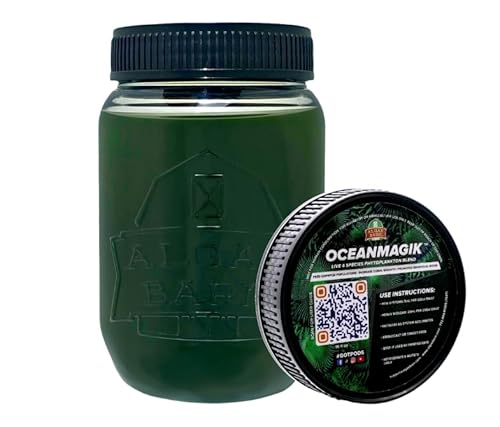
Overview: OceanMagik brings a four-species live phytoplankton blend (Nanno, Iso, Tetra, Thal) in a weekly-shipped format, designed to boost coral health, copepods, and filter-feeders. Expect better ongoing availability of live cells for immediate uptake.
- Best for: hobbyists who want fresh, live phytoplankton with a simple weekly replenishment.
- Why selected: live cultures often yield quicker uptake and diversified nutrition.
- Limitation: live products require timely usage; open containers may smell temporarily as noted in product notes.
Buying Guide: Phytoplankton Food For Corals
Key questions to guide your choice:
- What feeding approach suits my tank: direct dosing, or regular addition with water movement? Some products are designed for off-circulation feeding, while others rely on tank flow to distribute.
- What corals and invertebrates are in my system: softer or hard corals, clams, and bryozoans have different feeding needs and preferred particle sizes.
- Am I using temperate or tropical water? Some formulations target temperate systems, while others are optimized for tropical reefs.
- How important is coloration versus sheer nutritional breadth? Some products emphasize amino acids and pigments for coloration, others focus on broad nutrition.
- Is the product live, or a stable suspension? Live phytoplankton can require quicker use, whereas suspensions offer longer shelf-life and easier dosing control.
Practical selection checklist
- Particle size and compatibility with your corals’ feeding mechanisms.
- Concentration and ease of dosing to avoid overfeeding and water quality issues.
- Suitability for your tank’s flow pattern and feeding routine.
- Coloration benefits versus general nutrition depending on your aesthetic and health goals.
- Storage and shelf-life considerations, especially for live cultures.
FAQ
- Q: How often should I feed phytoplankton to corals?
A: Feeding frequency depends on tank bioload, coral species, and feeding method. Start with small, regular doses and adjust based on polyp response and water clarity. - Q: Can I mix different phytoplankton products?
A: Yes, but introduce new products gradually to monitor water quality and avoid overfeeding. - Q: Which product is best for beginners?
A: A multi-species, readily-dosed suspension with clear feeding guidelines is typically easiest for new reef keepers. - Q: Are live phytoplankton safe for fish?
A: Live cultures primarily benefit corals and invertebrates; some products can affect water chemistry if fed excessively. Follow dosing instructions carefully. - Q: Do these products require refrigeration?
A: Many live cultures and suspensions benefit from refrigeration or cool storage; refer to product labeling for specifics.