The best pH test strips for fish tanks help keep your aquarium water stable and safe. This guide compares top 5 8-in-1 or 7-in-1 strip kits, ideal for freshwater and saltwater setups. Each product is suited for different user needs, from beginners to serious hobbyists. The focus is on accuracy, ease of use, and how many parameters you can test at once. Below you’ll find quick picks, clear reasons to choose each, and a practical buying guide to minimize guesswork.
Summary table of selected products:
| Product | |||
|---|---|---|---|
| AAwipes 8-in-1 Aquarium Test Kit (K02-50) | 8 parameters; pH, ammonia, chlorine, nitrate, nitrite, carbonate, total alkalinity, hardness | Active hobbyists needing frequent checks | Fast results in minutes |
| 11 in 1 Aquarium Test Strips (SJ WAVE) | 11 parameters; pH, ammonia, iron, chlorine, GH, carbonate, nitrate, nitrite, alkalinity, copper, temp | Comprehensive home testing | Includes temperature readout |
| API 5-in-1 Test Strips (25-count) | pH, nitrite, nitrate, carbonate, general hardness | Budget-friendly basic monitoring | Simple 5-parameter kit |
| AAwipes 8-in-1 (K02-25) | 8 parameters; pH, ammonia, chlorine, nitrate, nitrite, carbonate, hardness, alkalinity | Smaller tanks or starter kits | Compact 25-strip pack |
| AAwipes 8-in-1 (K02-150) | 8 parameters; same as above | Regular testers with larger supply | Large pack reduces reordering |
AAwipes 8-in-1 Aquarium Test Kit (K02-50)

Best for active fish keepers who need quick, multi-parameter results. This 50-strip kit tests Free Chlorine, Nitrate, Nitrite, Hardness, Carbonate, Total Alkalinity, pH, and Ammonia nitrogen. The kit uses high-quality fiber paper and non-bleeding colors, aiming for clear charts and repeatable readings. Ideal for freshwater and pond environments, including shrimp tanks and pools. Caution: read ammonia nitrogen separately for precise early warning in some setups.
11 in 1 Aquarium Test Strips (SJ WAVE)

Best for users seeking a broad spectrum with an included thermometer. This kit covers 11 parameters, including ammonia, pH, iron, chlorine, total hardness, carbonate, nitrate, nitrite, total alkalinity, copper, and temperature. It provides easy-to-read color charts and aims for fast, reliable home testing. Choose this if you want a single kit that monitors both water chemistry and temperature. Limitation: more parameters can make interpretation slightly more complex for beginners.
API 5-in-1 Test Strips (25 count)
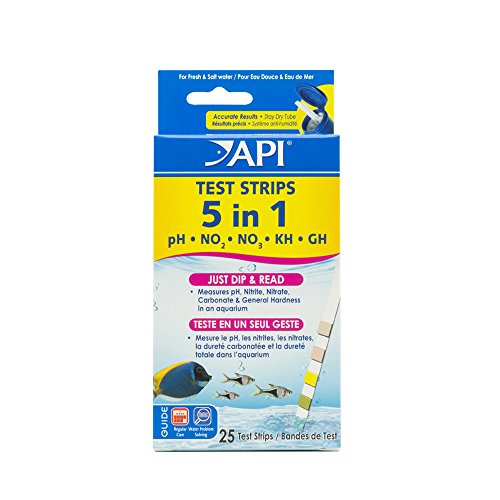
Best for budget-conscious hobbyists who still want reliable, quick checks. This API kit monitors pH, nitrite, nitrate, carbonate, and general hardness. It’s a straightforward option for ongoing baseline monitoring in both freshwater and saltwater tanks. Caution: fewer parameters may miss subtle shifts that require a broader panel for some setups.
AAwipes Aquarium Ammonia Test Strips 8-in-1 (K02-100)

Best for regular testers who want a large supply. This 100-strip kit tests eight parameters, including pH, ammonia nitrogen, and alkalinity, with fast dip-and-read methods. It’s suitable for freshwater and saltwater routines and supports twice-weekly monitoring. Limitation: large packs can be bulkier to store for very small tanks.
AAwipes 8-in-1 Aquarium Test Kit (150 Strips)

Best for regular, long-term monitoring with a large supply. This 150-strip kit tests eight parameters, including Free Chlorine, Nitrate, Nitrite, Hardness, Carbonate, Total Alkalinity, pH, and Ammonia nitrogen. It suits active tanks and larger setups. Choose this when you want fewer reorder intervals and consistent readings over time. Caution: ensure proper storage to maintain strip integrity over the full pack.
Buying Guide
What should you prioritize when choosing pH test strips for a fish tank?
- Parameter breadth: More parameters help track complex tanks, especially mixed reefs or ponds. If you need many metrics, 8–11 parameter kits are better.
- Ease of use: Look for kits with clear color charts and simple dip-and-read steps. Separate readings for ammonia are helpful in new tanks.
- Frequency of testing: Larger packs are cost-effective for weekly testing. For beginners, smaller packs reduce waste if you’re just starting.
- Environment compatibility: Ensure the kit covers freshwater, saltwater, or both, depending on your setup.
- Storage and shelf life: Keep strips sealed and protected from moisture to prevent color bleed and degraded accuracy.
Tips for accurate results:
- Test at the same time of day and after water changes to maintain consistency.
- Compare results to the chart within the recommended reading window for best accuracy.
- Follow the kit’s instructions for any separate ammonia readings or unique steps.
FAQ
- How often should I test aquarium water?
Most hobbyists test at least twice weekly for active tanks and after water changes or new livestock introduction.
- Can I rely on a single parameter kit?
Yes for basic monitoring, but for healthier systems with multiple species, a kit that covers more parameters provides better insight.
- Are color charts difficult to read?
Good strips use high-contrast charts; if reading is challenging, try a kit with larger charts or digital results.
- Should I test ammonia separately?
If your kit includes ammonia, use it as directed. In new or stressed tanks, ammonia readings are critical.
- Is a thermometer included in all kits?
Some kits include temperature; if not, use a separate aquarium thermometer to monitor heat-related changes.
- Which kit is best for beginners?
A kit with fewer parameters and straightforward charts is ideal for beginners, gradually expanding to multi-parameter kits as you gain experience.