If you’re shopping for an aquarium oxygen pump, you want reliable airflow, quiet operation, and the right capacity for your tank size. This guide highlights five top options that balance performance with disturbance-free use. Each product is best for specific tank sizes and setups, from small nano tanks to larger community aquariums. Below is a quick summary of the chosen models to help you compare at a glance.
| Product | ||
|---|---|---|
| AQUANEAT Aquarium Air Pump (100 Gallon) | Up to 100 gal | Dual outlets; compact; quiet with stabilizers |
| HITOP Dual Outlet Aquarium Air Pump | 10–100 gal | Adjustable flow; very quiet; durable ABS construction |
| AQUANEAT Aquarium Air Pump (20 Gallon) | Up to 20 gal | Compact; includes tubing, stone, valve; ideal for small tanks |
| Pawfly Aquarium 3–20 Gallon Pump | 5–20 gal | Small footprint; low noise; reliable aeration |
| hygger Quiet Aquarium Air Pump | Up to 120 gal | Adjustable flow; very quiet; multiple outlets |
AQUANEAT Aquarium Air Pump, 100gal

Best for larger tanks or multiple filtration devices. This dual-outlet pump provides two independent air streams, enabling simultaneous operation of sponge filters, air stones, or hydroponic aeration setups. It’s sized to fit 100-gallon tanks and is designed for quiet, stable performance with four rubber feet to dampen vibration. Suitable for aquariums with live plants or delicate fry that require steady oxygenation. Avoid this if you have a very small tank and need ultra-compact equipment.
HITOP Dual Outlet Aquarium Air Pump

Best for mid-to-large tanks, especially where adjustable flow is desired. The HITOP unit features two outlets, a manually adjustable air volume, and a compact, durable ABS housing. Soft rubber feet minimize noise and movement. Not ideal if you need a single outlet or extremely tiny footprint, but ideal for rooms where silent operation matters and you want precise air control for 20–100 gallon setups.
AQUANEAT Aquarium Air Pump, 20 Gallon

Best for small tanks or nano setups. This compact 4×2.75×1.5 inch pump ships with airline tubing, a stone, and a check valve, making it a convenient all-in-one starter kit for tanks up to 20 gallons. Its soft feet help reduce vibration, and its quiet operation is suitable for bedrooms or offices. Choose this if you prioritize a compact footprint and a bundled package; avoid if you need multiple outlets for larger filtration arrays.
Pawfly Aquarium 3–20 Gallon Pump
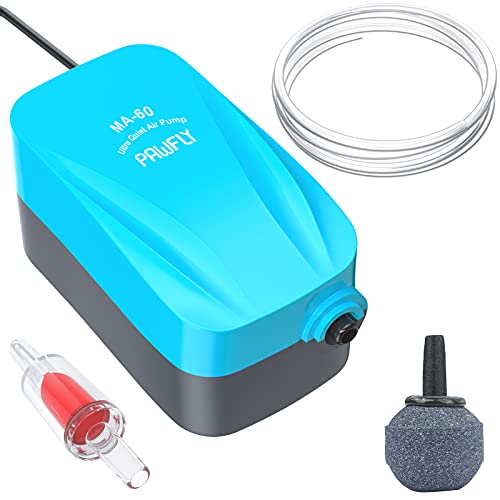
Best for space-constrained tanks, the Pawfly unit offers a compact footprint with a max of about 30 GPH airflow and a 0.012 MPa pressure rating. It is quiet due to integrated diaphragms and rubber feet, making it suitable for 5–20 gallon setups where you want dependable aeration without drawing attention. Consider a larger model if you have heavy bio-load or need higher oxygenation.
AQQA Aquarium Air Pump, 3W/6W/10W

Best for larger tanks up to 200 gallons with two outlets and stainless steel construction. The AQQA model offers a high airflow range and a robust dual-outlet design, making it flexible for multi-zone aeration and stone or bubbler stone setups. It’s a good pick when you need resilient performance and can allocate space for a larger pump. A potential limitation is its size for very compact tanks where wall-mited or ultra-small pumps are preferred.
AQUANEAT Aquarium Air Pump, 100gal (Revisited)
Best for ongoing, high-capacity aeration where reliability matters. This model’s dual outlets support multiple accessories, including sponge filters and air stones, to maintain steady oxygenation in larger tanks. It’s especially suitable for planted or densely stocked aquariums where consistent airflow improves gas exchange. Note that larger setups require careful tubing management to avoid tangling or excessive airflow to delicate biofilters.
Buying Guide
- Tank size and airflow: Match pump capacity to tank volume. Larger tanks often require dual outlets or higher GPH ratings for consistent oxygenation.
- Noise and vibration: Look for models with rubber feet and insulated casings to minimize disruption in living spaces or bedrooms.
- Outlets and tubing: If you plan to run multiple accessories, choose a pump with multiple outlets and compatible tubing sizes.
- Durability and materials: ABS plastics are common; stainless steel components offer corrosion resistance for brackish or marine setups.
- Energy efficiency: Wattage and airflow per watt determine long-term running costs; consider energy-efficient options for continuous use.
- Placement and space: For compact tanks, select a low-profile pump; for large setups, wall-mount or floor-standing models may be preferable.
Frequently Asked Questions
- What size aquarium should I buy an air pump for? Choose based on tank capacity in gallons and desired aeration level; larger tanks typically need higher GPH or multiple outlets.
- Are dual-outlet pumps better? Dual outlets provide independent airflow to several devices, improving oxygen distribution in larger or heavily planted tanks.
- Will a quiet pump affect performance? Quiet designs often use rubber feet and insulated housings; performance is driven by wattage and outlet configuration rather than noise.
- Can I use these in saltwater tanks? Most are suitable for freshwater; check the product description for compatibility with saltwater to avoid corrosion concerns.
- How do I reduce pump noise further? Place the pump on a soft mat, ensure level positioning, and keep tubing connections secure to minimize vibration transfer.
- Is it better to have one powerful pump or multiple small pumps? For even oxygenation across a large tank, multiple outlets or a larger dual-outlet pump can provide more consistent flow than a single small unit.