Answering the right question for aquarists and hobbyists: the best oxygen for a fish bowl or small tank comes from a compact, quiet air pump that delivers reliable aeration without disturbing your living space. The listed products cater to small tanks up to about 15 gallons, making them ideal for bettas, guppies, shrimp, and nano tanks. This guide highlights five strong choices, each chosen for quiet operation, adequate airflow, and simple setup. It’s written for beginners seeking clear, practical factors to compare.
Summary at a glance: the following table highlights each product’s focus and the type of buyer it suits best.
| Product | Best For | Notes |
|---|---|---|
| AQUANEAT Aquarium Air Pump | Small tanks up to 20 gallons | Quiet with rubber feet; good with small air stones or filters |
| hygger MINI 1.5W | Bedrooms and offices; 0.5–12 gallon tanks | All-in-one kit; includes stone, valve, tubing, suction cups |
| Pawfly Nano Silent | Very quiet spaces; 1–15 gallon tanks | Low noise; includes check valve for back-siphon protection |
| hygger Ultra Silent 1.5W | Up to 15 gallons; compact setup | Ultra quiet; comes with needed accessories |
| FEDOUR Mini Whisper | Up to 10 gallons; small tanks | Very compact; low energy, minimal noise |
AQUANEAT Aquarium Air Pump

The AQUANEAT air pump is designed for aquariums up to 20 gallons. It features a compact 4×2.75×1.5 inch build and four rubber feet to reduce vibration and noise. It pairs well with a small air stone, sponge filter, or bubble ornaments. This pump is best for hobbyists seeking a simple, unobtrusive aeration solution for small community tanks or hydroponic setups.
Best for: small tanks where quiet operation and reliable bubble production are priorities. Limitations: not ideal for larger systems beyond 20 gallons or heavy filtration needs.
hygger MINI 1.5W Fish Bowl Aqaurium Silent Air Pump

This hygger kit is a compact, all-in-one solution for tanks from 0.5 to 12 gallons. It runs quietly at under 33 dB and delivers about 25 L/H airflow with 12 kPa pressure, ensuring good oxygenation in nano to small tanks. The box includes an air stone, check valve, tubing, suction cups, and hooks, so setup is straightforward for beginners.
Best for: users who want a ready-to-go kit with minimal setup and quiet performance. Limitations: may be less powerful for higher bioload or larger nano tanks near the 12-gallon end.
Pawfly Nano Silent Aquarium Air Pump

The Pawfly nano pump is compact and very quiet, driven by a piezoelectric ceramic plate. It offers up to 450 mL/min (7.1 GPH) airflow, suitable for 1–3 gallon Betta tanks or 3–15 gallon setups with smaller bioload. It includes a backflow-preventing check valve for safety during power outages and placements below water level.
Best for: ultra-quiet operation in small tanks or near sleeping areas. Limitation: airflow may be insufficient in heavily stocked or larger nano tanks without upsizing.
hygger Ultra Silent 1.5W

This Hygger model emphasizes a unique shape and compact design with a 1.5W motor. It includes all necessary accessories and offers ultra-quiet operation, making it suitable for small bowls and desktop setups. It’s a solid match for viewers who want a dependable pump with minimal footprint and straightforward setup.
Best for: quiet operation in desktop tanks and small bowls. Caution: not intended for larger filtration systems or very densely stocked tanks.
hygger Quiet Mini Air Pump
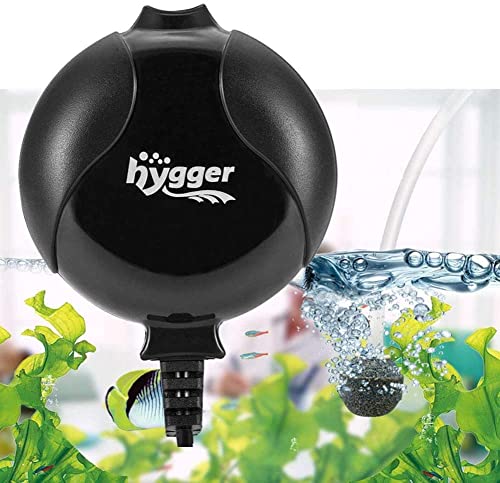
The hygger Quiet Mini Air Pump is designed for 1–15 gallon tanks and uses a piezoelectric ceramic plate to keep noise levels low. It’s compact, light, and includes features that reduce vibration. This makes it a strong option for bedrooms or offices where disruption is a concern.
Best for: bedsides and quiet spaces requiring low noise. Limitation: performance is best in smaller tanks; very heavy aeration demands may require a larger unit.
FEDOUR Mini Whisper Aquarium Air Pump

The FEDOUR mini whisper pump is a compact solution for up to 10 gallons, designed for nano and betta tanks. It runs quietly (under 33 dB) and includes a 1M air tube, air stone, and hook. It’s a practical choice when a minimal footprint and straightforward setup matter most.
Best for: very small tanks and quiet environments. Limitation: airflow is best suited for lighter aeration needs and not for heavily stocked setups.
Buying Guide: Key Considerations For Choosing An Oxygen Pump
- Tank size and stocking: Match pump power to tank volume and bioload. Small bowls need gentler, quieter output; larger nano tanks benefit from modest airflow without excess noise.
- Noise level: Look for pumps advertised as ultra-quiet or whisper-quiet and verify placement options (on tank wall, above water, or underneath).
- Included accessories: Kits that include air stone, tubing, check valve, and suction cups simplify setup and ongoing maintenance.
- Valve and backflow protection: A check valve helps prevent back-siphoning during power outages, protecting the pump and tank.
- Power efficiency: Low wattage pumps reduce energy use; consider long-term running costs for 24/7 operation.
- Footprint and mounting: Compact designs save space; wall-mounted or suction-cup options keep the surface tidy.
Frequently Asked Questions
- What size aquarium is best for a small air pump?
Tiny bowls and 0.5–12 gallon tanks pair well with compact pumps. For up to about 15 gallons, select a model rated for that range.
- Do all oxygen pumps need a check valve?
Not always, but a check valve helps prevent water from flowing back into the pump during outages, reducing risk of damage.
- Are quieter pumps less powerful?
Not necessarily; many quiet pumps deliver adequate airflow for small tanks. Check the specified airflow (L/H or GPH) to ensure it meets your needs.
- Can I use a single pump for multiple small tanks?
Yes, if each tank’s capacity aligns with the pump’s output and you use appropriate tubing and adapters safely.
- Should I choose a kit or a bare pump?
Kit options simplify setup (stone, tubing, valves). Bare pumps offer flexibility if you already have some accessories.
- Are these pumps safe for freshwater aquariums?
Yes, these units are designed for freshwater applications and light hydroponic use in small volumes.