Discover the best magnetic powerheads to boost water movement, oxygenation, and filtration in both freshwater and saltwater tanks. This guide highlights top models ideal for 15–80 gallon setups, with clear notes on who each product is best for. Use the summary table to compare key specs at a glance.
| Product | Tank Size Range | Approx. Flow | Best For |
|---|---|---|---|
| Hygger Mini Wave Maker | 15–40 gal | 530 GPH | Small, quiet tanks with mixed coral/fish needs |
| FREESEA Wave Maker | 20–75 gal | 1600 GPH | Medium to large tanks needing strong flow |
| Hygger 1050 GPH Wave Maker | 20–60 gal | 1050 GPH | Powerful circulation with quiet operation |
| Pawfly Wave Maker | 15–80 gal | 550 GPH | Balanced flow for mixed fish communities |
| Hygger Lite Wave Maker | 10–50 gal | 792 GPH | Entry-level, adjustable for small tanks |
Hygger Mini Wave Maker For 15-40 Gallon Tanks

The Hygger Mini Wave Maker offers a 360-degree rotatable ball joint and a compact 530 GPH motor. It creates a gentle surge near the surface to increase oxygenation, while aiding debris movement toward filtration. The unit supports varied angles for optimal cross-tank flow and reduces dead zones. It is best for small to mid-sized tanks where quiet operation matters and where precise current direction is needed. Caution: verify your tank wall thickness and ensure the powerhead is fully submerged during operation.
FREESEA Wave Maker For 20-75 Gallon Tanks

The FREESEA model delivers 1600 GPH with an 8W motor and dual heads for broad circulation. Its magnetic stand stabilizes the unit for quiet operation and easy placement in larger tanks. Best for enthusiasts who want strong, comprehensive flow and improved debris movement across the tank. It may be louder than smaller heads at maximum speed, so consider placement and noise tolerance when choosing this model.
Hygger 1050 GPH Wave Maker With Magnetic Base
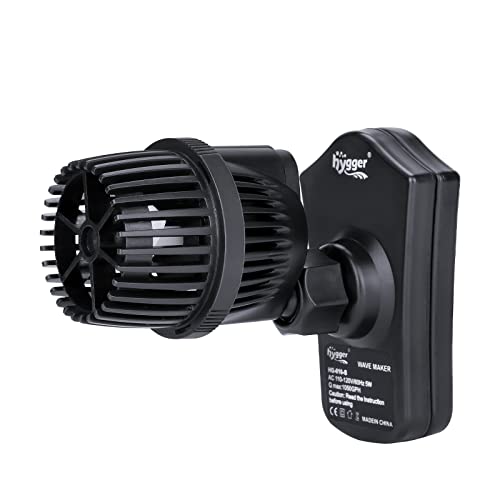
This 1050 GPH model emphasizes strong, quiet circulation with a 360-degree rotating head. Its magnetic base and suction cups provide secure mounting on tank walls, reducing vibrations and noise. Best for mid to large tanks that require robust flow to prevent sludge buildup and to help with even temperature distribution. Limitation: higher flow may be overkill for very small or densely planted tanks.
Pawfly Wave Maker For Aquarium

The Pawfly unit provides 550 GPH with 360-degree all-angle rotation and a robust magnetic base. It fits 15–80 gallon tanks, making it a flexible choice for diverse setups. It helps simulate natural currents to keep fish active and supports better oxygenation. Best for mixed communities where stable, broad circulation is desired. Caution: ensure full submersion and monitor for any wobble in larger tanks.
Hygger Lite Wave Maker For 10-50 Gallons

The Hygger Lite focuses on 792 GPH with a magnetic base and a digital controller. Four wave modes plus adjustable speed and frequency allow customized circulation for smaller systems. Best for beginners or budget-conscious setups that still need reliable, adjustable flow. Limitation: fewer features than premium models may reduce customization for complex reef tanks.
Hygger Wave Maker For 40-100 Gallon Tanks

Note: This model offers 1056 GPH with a 360-degree head and robust construction for larger systems. It is ideal for tanks needing substantial circulation and better mix of oxygen, nutrients, and heat distribution. Best for larger, heavily stocked tanks where robust water movement is essential. Caution: confirm tank dimensions align with mounting clearance on the chosen wall.
Buying Guide: Key Purchase Considerations
What size tank are you targeting, and how much flow do you need? For small tanks (10–20 gallons), choose models around 530–792 GPH to avoid excessive current. For mid to large tanks (40–80 gallons), 800–1600 GPH models are often preferable to prevent dead zones and improve filtration efficiency.
How important is noise? Magnetic base pumps with sturdy mounts typically run quietly, but higher flow can generate more sound. Consider placement, tank depth, and the pump’s been-rated noise level when selecting a model for a living space.
Is adjustable flow essential? If you need precise control over waves, look for models with multiple modes (constant, pulse, sine, random) and adjustable frequency or speed. This helps tailor currents to coral, fish, or plant needs.
How easy is maintenance? Removable guards, easy disassembly, and corrosion-resistant materials extend life and simplify cleaning. Check whether the unit allows straightforward access to the impeller and shaft for routine maintenance.
What about mounting and compatibility? A strong magnetic base supports stable mounting against tank walls up to typical glass thickness. Ensure the base accommodates your tank dimensions and that the device can be fully submerged as required by the design.
Frequently Asked Questions
- What’s the main purpose of a magnetic powerhead? To circulate water, improve oxygenation, and assist filtration by moving debris toward the filter, all within a compact, easily adjustable unit.
- Can I run more than one powerhead in a single tank? Yes, but balance flow to avoid creating excessive currents in any one area. Place heads at opposite ends to promote cross-tank circulation.
- Which model is best for a 30-gallon reef tank? A mid-range model around 700–1000 GPH with adjustable flow is typically suitable to support corals without blasting them with current.
- Are these safe for saltwater? Most magnetic powerheads are designed for both freshwater and saltwater, but always verify corrosion resistance and proper submersion requirements for your setup.
- Do these replace a filter? No. They aid water movement and oxygenation but should be used in conjunction with a proper filtration system.
- How do I install a magnetic powerhead? Clean the tank wall, attach the magnetic base to the glass, align the head for desired flow, and ensure the unit is fully submerged if required by design.