Whether you’re setting up a new freshwater tank, a thriving reef, or a hydroponic display, the right inline water pump keeps water moving, improves oxygenation, and supports stable tank conditions. This guide highlights five practical inline and submersible pumps that suit common aquarium setups, from small nano tanks to larger systems. Each option is chosen for dependable performance, ease of use, and clear compatibility with typical filtration and return lines. The buyer’s profile for each product is noted to help you decide who benefits most.
| Product | Best For | Key Benefit | Notes |
|---|---|---|---|
| Decdeal Submersible Water Pump | Small to medium tanks | Flow adjustment with LED indicators | IP68 waterproof, USB-compatible |
| Active Aqua Submersible Pump | Hydroponics and decorative water features | Consistent flow with durable ceramic shaft | Multiple nozzle options |
| JEREPET 520GPH DC Pump | Nano reefs and compact setups | Variable speed, 10-minute feeding mode | Quiet operation |
| JEREPET 800GPH DC Pump | Medium tanks with higher flow needs | Higher lift, 6-speed control | Similar features to 520GPH model |
| EcoPlus Eco 396 Pump | Inline or submersed installations | Fixed 396 GPH, versatile fittings | UL listed |
Decdeal Submersible Water Pump With Flow Adjustment

Best for small to mid-sized aquariums that require adjustable flow and easy cleaning. The pump is fully submersible with IP68 waterproof protection and a detachable design for cleaning. Features include a flow adjustment with LED indicators and a memory function after power-off. A built-in filter helps prevent inlet clogging. Best for hobbyists who value straightforward control and reliability in tight spaces. Caution: ensure proper heat dissipation during continuous operation to prolong life.
Active Aqua Submersible High-Performance Pump

Best for hydroponic setups and decorative aquariums that need dependable air exchange and nutrient distribution. This pump emphasizes powerful, consistent flow across various GPH ratings, with a durable ceramic shaft to resist wear in both fresh and saltwater. Multiple nozzle attachments make it easy to fit different tubing sizes. Choose this if you need robust performance across a range of tank sizes and installations. Limitation: higher power draw compared to ultra-quiet nano pumps might be noticeable in very quiet rooms.
JEREPET 520GPH 24V DC Pump With Controller

Best for nano reef setups and small fish tanks needing adjustable flow and a feeding mode. The 520GPH model provides a max flow with a 10 ft lift and six-speed control, allowing users to scale flow from 30% to 100%. It operates quietly thanks to a ceramic shaft and sealed impeller. Use this when you want tight control over daily water movements and a simple feeding timer. Caution: verify nozzle size compatibility with your tubing to maintain the expected flow rate.
JEREPET 800GPH 30W DC Pump With Controller
Best for medium tanks that need higher flow and reliable return capabilities. This 800GPH model offers a higher lift (12.5 feet) and six-speed control, with a 10-minute feeding mode and wave maker function. It shares the quiet operation and ceramic shaft advantages of the 520GPH model. Choose this when you require stronger circulation without increasing noise. Limitation: higher power draw means closer attention to energy use in large, continuous runs.
EcoPlus Eco 396 Submersible Or Inline Pump
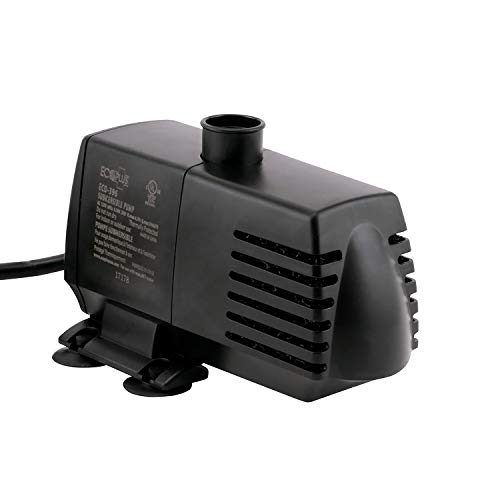
Best for flexible installations where inline or submersible use is desired. The EcoPlus 396 delivers 396 GPH with a 36-watt motor and includes multiple fittings for various tubing sizes. Suitable for aquariums, ponds, fountains, and hydroponic setups. Best for users who want a compact, UL-listed option that can adapt to different configurations. Caution: fixed flow means less fine-grained adjustment than variable-speed models.
Buying Guide: Inline Water Pumps For Aquariums
Key questions to guide your purchase:
- What size is my tank, and what lift height is needed? Larger tanks often require higher GPH and greater lift. Choose a pump that maintains adequate flow at your maximum head height.
- Do I prefer adjustable flow or fixed performance? Variable-speed models offer fine control but can be more complex; fixed-flow options are simpler and reliable for standard setups.
- Is the pump going to be inline or submersible? Inline pumps work well with external filters and skimmers, while submersible pumps are common when space behind the display is limited and returns are inside the tank.
- What tubing and fittings are compatible? Check nozzle options and threading sizes to ensure seamless integration with existing filtration and return lines.
- What about noise and heat? Ceramic shafts and sealed impellers reduce noise and heat, but larger, more powerful pumps can still introduce noticeable sound in quiet rooms.
- What maintenance is required? Detachable designs and accessible filters simplify cleaning to prevent blockages and extend pump life.
Quick decision checklist
- Small nano tanks: prefer compact, quiet, adjustable pumps like 520GPH or similar with easy maintenance.
- Medium tanks with show features: look for higher lift and robust construction, such as 800GPH models with multiple speeds.
- Hydroponics or decorative water features: prioritize pumps with durable flow and versatile nozzle options.
- Inline use: ensure the pump includes compatible fittings and supports inline installation.
Frequently Asked Questions
- What is the difference between inline and submersible pumps?
- How do I choose the right GPH for my tank?
- Will a higher lift height reduce flow?
- Is a ceramic shaft necessary?
- How often should I clean my pump?
Inline pumps are typically mounted outside the tank with external filtration connections, while submersible pumps sit inside the water. Inline units are often used for higher flow setups and easier tubing routing, whereas submersibles save space and reduce visible components.
Rule of thumb is to turn over your tank volume 4-6 times per hour for healthy filtration and oxygenation. Larger organisms or sensitive corals may require higher turnover rates.
Yes. Flow rates typically drop as lift height increases. Check the manufacturer’s flow curve for expected performance at your lift height and nozzle size.
Ceramic shafts reduce wear and noise, especially in pumps running continuously. They are a common feature in higher-quality models.
Clean the inlet screen and impeller monthly or whenever you notice reduced flow, unusual noise, or restricted water movement.