Keeping pond water from freezing while ensuring a safe, breathable environment for fish is the main goal of a pond heater. This guide highlights five reliable options best suited for different pond sizes and fish-keeping needs. The selections emphasize reliability, automatic temperature control, and safety features. Ideal buyers include small to mid-size pond owners, hobbyists who want automated de-icing, and hobbyists seeking durable, submersible designs for both freshwater and mild saltwater environments. The article includes a quick comparison table of the featured products.
| Product | Best For | Key Feature | Approximate Range |
|---|---|---|---|
| HITOP Outdoor Pond Heater (300W) | Medium outdoor ponds | Automatic 68-72°F control | Hotspot near heater |
| hygger Aquarium Heater (800W) | Medium to large tanks | Digital LED controller | 80–220 gal |
| HiTauing Aquarium Heater (300W) | Smaller tanks | Intelligent water sensing | 40–75 gal |
| K&H Pond Heater (250W) | Outdoor ponds of various sizes | Thermostatically controlled | Floating or submersible |
| MantaMaze Heater (500W/1000W variants) | Medium to large tanks | External digital controller | 20–300 gal |
HITOP Outdoor Pond Heater — 300W

The HITOP 300W pond heater is designed to prevent complete pond freezing by creating a melt hole for fish to breathe. It is best suited for small to mid-size outdoor ponds (roughly 80–160 gallons near the heater). The heater floats due to an upgrade foam design and keeps the bottom elevated to avoid mud contact. It operates within a constant temperature range of 68–72°F and automatically begins or stops heating to maintain this level. Caution: avoid plastic ponds to ensure effective heat distribution and safe operation.
Who it’s for: best for small outdoor ponds where a gentle, localized de-icing effect is desired and mechanical simplicity is valued. Why selected: reliable automatic cycling and a floatable design minimize maintenance in cold weather.
Limitation: temperature control is localized around the heater, not the entire pond volume; heavier weather or large water bodies may require multiple units or larger wattage.
hygger Aquarium Heater — 800W

The hygger 800W heater supports larger tanks and provides a digital LED controller with a temperature range of 59–93°F and ±1°F accuracy. It includes multiple protections, such as automatic shutoff if water levels fall or temperatures rise too high, and an audible error code. The controller is designed to mount on the tank edge for easy viewing. This model is ideal for aquariums up to about 220 gallons, including mixed freshwater and saltwater setups.
Who it’s for: best for hobbyists who want precise digital control and thorough safety protections in mid-to-large aquariums or outdoor pond-adjacent setups. Why selected: robust high-heat capacity with clear feedback and alarms helps prevent fish stress from overheating or dry-running.
Limitation: installation requires positioning the controller at the tank edge, and very large outdoor ponds may need additional heating solutions for even coverage.
HiTauing Aquarium Heater — 500W
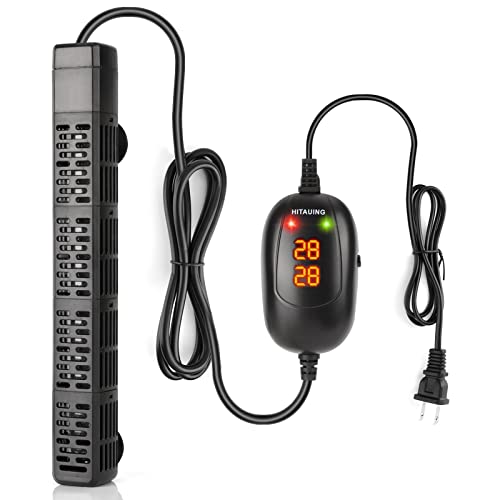
The 500W HiTauing heater is designed for tanks roughly 75–120 gallons. It offers a dual temperature control system in Fahrenheit and Celsius and features intelligent water sensing with an auto-off when out of water or over-temperature. It uses explosion-proof quartz glass and a high-temperature-resistant nickel-chromium heating wire with silicon carbide conduction for faster heating and longer service life. Best for: standard freshwater or lightly brackish environments where reliable, compact heating is needed.
Who it’s for: best for hobbyists looking for strong safety features in a mid-range heater. Why selected: robust protection and a quick-heating design help reduce fish stress during cold periods.
Limitation: not ideal for very large ponds or tanks beyond the 120-gallon range; may require higher wattage or multiple units for larger volumes.
K&H Pond Heater — 250W

The K&H Pond Heater is thermostatically controlled to keep outdoor ponds from freezing by cycling on and off as needed. It can be used as a floating device out of the box or converted to a submersible unit, offering flexible installation in a variety of pond shapes and sizes. This option is useful for smaller to medium outdoor ponds that require a simple, energy-saving de-icer approach.
Who it’s for: best for pond owners seeking a versatile, energy-conscious de-icer with easy placement. Why selected: thermostatic control reduces energy use and maintains a safer water surface for gas exchange and fish respiration.
Limitation: 250W may be insufficient for larger ponds or extremely cold climates; ensure wattage matches pond zone recommendations before purchase.
MantaMaze Heater — 500W/1000W

The MantaMaze heater line includes 500W and 1000W models suitable for 20–300 gallon setups. It features two durable heating tubes in explosion-proof quartz glass, a flame-retardant housing, and an external digital controller that shows current temperature and setpoint. Overheat and dry-run protections prevent damage to fish and equipment. Best for: larger home aquariums or ponds where quick, consistent heating and external temperature control are preferred.
Who it’s for: best for serious hobbyists needing a robust, high-capacity heater with clear external control. Why selected: strong safety features and fast heating help maintain stable conditions for diverse aquatic life.
Limitation: larger wattage versions require adequate power supply and water volume to justify the investment; avoid under-wattage for big ponds in cold climates.
Buying Guide: Key Considerations For Pond Heaters
- Pond size and water volume: Match heater wattage to the pond’s gallons and climate. Bigger ponds and harsher winters require higher wattage or multiple units for even heating.
- Placement and installation: Floating de-icers work well for surface ice control, while submersible heaters offer consistent heating throughout the water column. Consider pond shape and depth when choosing a mounting method.
- Temperature control: Look for thermostatic or digital controllers with a safe, stable setpoint. A narrow range and accurate readings reduce stress on fish.
- Safety features: Overheat protection, low-water protection, and auto-shutoff are essential for preventing fish injury and equipment damage.
- Material and build: Explosion-proof quartz glass and flame-retardant housings improve durability in wet environments and reduce risk of breakage.
- Energy efficiency: Thermostatically controlled deicers avoid unnecessary power use, keeping operating costs down across the season.
- Maintenance and accessibility: Easy access for cleaning and inspection helps maintain performance, especially in outdoor setups subject to debris and sediment.
FAQ
- How do I know what wattage my pond needs?
– Consider pond size, climate, and whether you want to keep a breathable hole in ice. Use zone charts or manufacturer guidance to pick a wattage that reliably maintains a safe ice-free region without overheating. - Can I use a pond heater in a plastic pond?
– Some heaters are not recommended for plastic ponds due to heat distribution and durability concerns. Follow the product’s precautions to avoid damage and ensure safe operation. - Is it better to use a floating de-icer or a submersible heater?
– Floating de-icers are great for surface ice control and simple setups. Submersibles provide broader heating and may suit deeper or larger ponds, but require proper immersion. - What safety features are most important?
– Auto shut-off for out-of-water conditions, overheat protection, and clear error indicators help prevent harm to fish and equipment. - Can I run multiple heaters in one pond?
– Yes, but ensure wattage is distributed to avoid uneven heating and that electrical supply can handle the load. Consider coordinating heaters with controllers for synchronized operation. - Do pond heaters affect water chemistry?
– Heaters primarily influence temperature. If used correctly, they do not inherently alter chemistry, but maintaining good aeration and filtration is important for fish health during winter.