Finding the right aquarium heater is essential for maintaining a stable environment for fish and invertebrates. This guide highlights top picks that balance reliability, safety features, and ease of use for both freshwater and saltwater setups. The selections are suitable for a range of tank sizes and needs, from small desk tanks to large reef setups. Below, you’ll see quick comparisons and practical why-to-buy notes to help you decide which heater best fits your aquarium goals.
Summary table of chosen products:
| Product | Tank Range | Best For | Key Benefit |
|---|---|---|---|
| HiTauing 300W Submersible Heater | 40-75 gallons | ||
| Orlushy 100W Submersible Heater | 10-20 gallons | ||
| HANLESHUKA 100W Heater | 10-20 gallons | ||
| Orlushy 300W Submersible Heater | 40-55 gallons | ||
| SEAOURA 800W Heater | 100-180 gallons |
HiTauing 300W Submersible Heater
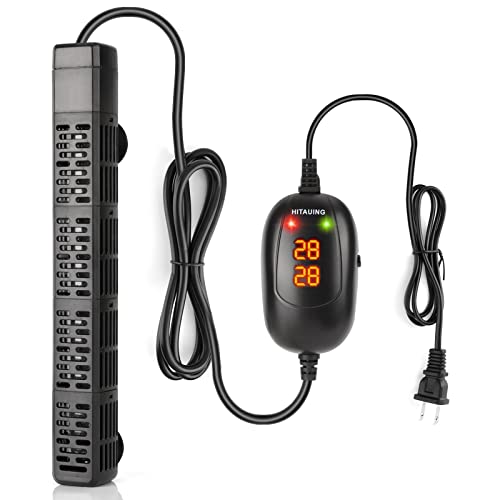
The HiTauing 300W heater is designed for 40-75 gallon tanks, using a nickel-chromium heating wire for rapid, stable heat. It supports Fahrenheit and Celsius settings (63-94℉ / 17-34℃) and features an intelligent water sensor with over-temperature protection. The device automatically stops heating if the heater is dry or if it risks overheating, helping prevent accidents. Best for larger community tanks or basic reef setups where quick warm-up is needed. Limitations include a range that may not cover very large or heavily planted tanks without a higher wattage unit.
Orlushy Submersible Aquarium Heater, 100W

Orlushy’s 100W heater targets 10-20 gallon tanks. It includes an adjustable temperature area and uses explosion-proof quartz glass with a durable shell. Best for compact freshwater setups or small saltwater bowls where space is limited. Choose this if you prefer a simple dial adjustment and easy concealment behind decor. A potential limitation is precision: the temperature adjust area may not read increments as finely as higher-end models.
HANLESHUKA 100W Aquarium Heater

HANLESHUKA’s 100W model is built for 10-20 gallon tanks and features a dry-burn prevention system, overheat protection, and a maximum temperature limit. The external digital controller shows real-time temperature and target settings, with color cues indicating heating status. Best for beginners and small setups that require clear alarms and safe auto-restart. Caution: the included alarm can be audible; ensure it won’t disturb nearby environments if used in a quiet room.
Orlushy 300W Submersible Heater
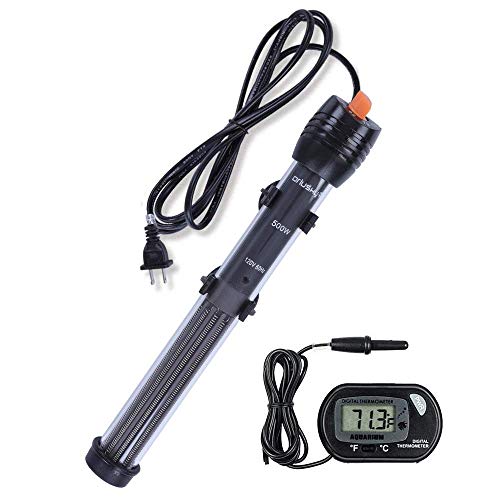
The 300W Orlushy heater suits 40-55 gallon tanks, featuring a 2mm thick quartz glass build and explosion-proof design. Easy to hide and compatible with both freshwater and saltwater systems. Best for mid-to-large tanks where robust heating is required and space is a consideration. A limitation is that temperature adjustments may be less precise than digital controllers, depending on your setup.
SEAOURA 800W Aquarium Heater

SEAOURA’s 800W model is designed for very large tanks (100-180 gallons). It includes an external intelligent controller with over-temperature protection and an audible alarm. This heater is best for large community tanks, reefs, or turtle enclosures where powerful, precise heating is needed. Avoid this if you have a smaller tank due to possible overshoot and higher energy use in routine environments.
Buying Guide
What size tank do you have?
Select wattage based on tank volume. Smaller tanks (10-20 gallons) typically need 50-100W, while mid-sized tanks (40-75 gallons) may require 150-300W, and large tanks (100-180 gallons) often need 600-800W. Match the heater to tank size to avoid temperature swings.
Do you prefer digital control or dial adjustment?
Digital controllers provide precise setpoints, temperature readouts, and alarms. Dial-based heaters are simpler and often cheaper but may offer less precise control. For sensitive species, a digital unit with over-temperature protection is recommended.
What safety features matter most?
Key features include: dry-burn protection to shut off when out of water, overheat protection, auto shut-off once the set temperature is reached, and alarm indicators if the heater is exposed to air. Explosion-proof or quartz glass housings enhance durability and safety.
Is it saltwater, freshwater, or mixed-use?
Some heaters are explicitly rated for both saltwater and freshwater, which can simplify maintenance. If you keep delicate corals or invertebrates, prioritizing a model with stable, gentle heat output is advantageous.
How easy is maintenance and placement?
Consider the length of power cords, visibility, and whether the heater is submersible. Models with clear indication lights and simple mounting systems can reduce setup time and troubleshooting.
What about energy use and efficiency?
Look for intelligent temperature control and energy-saving modes. Some models heat only when needed and adjust power gradually, which can lower electricity costs over time in larger tanks.
FAQ
- What wattage heater do I need for a 20-gallon tank? Typically a 100W heater is sufficient for most 20-gallon tanks, depending on room temperature and fish species.
- Can I use a heater in a saltwater tank? Yes, many heaters are designed for both freshwater and saltwater; check the product specifications for compatibility.
- What is dry-burn protection? A feature that shuts the heater off if it is exposed to air, preventing overheating or damage.
- Do all heaters have an automatic shut-off when the set temperature is reached? Most modern heaters include this safety feature to prevent overheating and temperature swings.
- Is a digital controller necessary? Not strictly, but it provides precise control and safer operation, especially for sensitive aquatic life.
- How do I conceal a heater in a planted tank? Choose a low-profile model with a slim rod and consider placing it behind decor or against the back glass to keep it discreet.