Answering your search for reliable freshwater aquarium air pumps, this guide highlights five top options that balance quiet operation, adjustable airflow, and dependable performance for 10–100 gallon tanks. These pumps are best for hobbyists seeking steady oxygenation, reliable aeration for filters or stones, and flexible setup in small to medium tanks. Ideal buyers include beginner hobbyists building a calm, low-maintenance tank, as well as experienced aquarists running multiple devices or larger aquariums.
Summary table of selected products:
| Product | Best For | Key Benefit | Outlets |
|---|---|---|---|
| Uniclife 64 GPH Aquarium Air Pump | Medium tanks (10–100 gallons) | Dual outlets with adjustable flow | 2 |
| AQQA Aquarium Air Pump | Larger tanks up to 200 gallons | Stainless steel dual outlets, low noise | 2 |
| Pawfly 50 GPH Air Pump | 10–60 gallon tanks | Low power, quiet operation | 2 |
| HITOP Dual Outlet Pump | 20–100 gallon tanks | Whisper-quiet with adjustable flow | 2 |
| QZQ 3W/5W Dual Outlet Pump | Up to 80 gallons | Quiet, robust air flow | 2 |
Uniclife 64 GPH Aquarium Air Pump with Dual Outlets
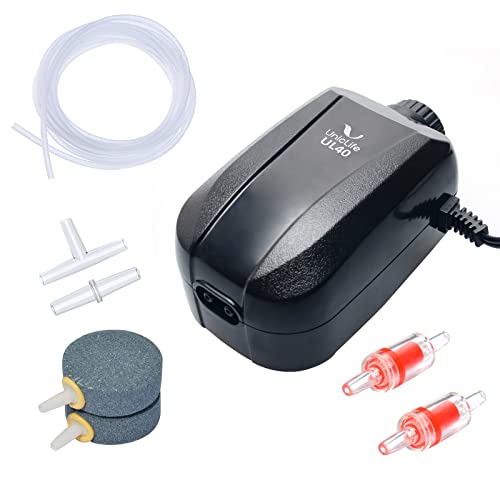
Best for moderate-sized freshwater setups that require reliable dual-output aeration. This pump delivers a steady air flow of up to 64 GPH and includes a rotary air flow adjustment for both outlets. It is designed for tanks ranging from 10 to 100 gallons, making it versatile for many home aquariums. The unit operates quietly, with a low-noise mode around 25 dB and up to 45 dB at higher throughput. Be aware that blocked intake cotton can reduce output, so periodic maintenance is recommended. Suitable for hobbyists who need dependable aeration with simple flow control.
- Best for: Mid-sized freshwater tanks that need adjustable dual outlets.
- Why selected: Combines simple control, dual outputs, and quiet operation in a compact package.
- Limitation: Air volume may drop if intake cotton becomes blocked; replace cotton as needed.
AQQA Aquarium Air Pump with Stainless Steel Dual Outlet

Best for larger freshwater setups or multi-tank configurations due to its robust dual outlets and stronger air flow. The pump states energy-efficient operation, with a maximum air volume around 100 GPH and 18 KPa pressure, suitable for tanks up to 80–200 gallons depending on configuration. Notable for a durable stainless steel exterior and reduced noise thanks to a thickened outer shell and rubber pads. Choose this for dependable aeration in bigger tanks or when pairing with multiple air stones. Caution: ensure compatibility with your stones and tubing lengths to avoid reduced performance.
- Best for: Larger or multi-tank applications needing steady dual-outlet aeration.
- Why selected: High air volume with durable construction and quiet operation.
- Limitation: Heavier unit; installation may require careful cable and tubing management.
Pawfly Aquarium Air Pump 50 GPH

Best for small-to-medium freshwater tanks (up to 60 gallons) seeking a compact, energy-efficient aerator with adjustable flow. The Pawfly pump provides up to 50 GPH and 0.013 MPa, with a top-adjustable knob for flow control. It includes quiet operation and four shockproof feet to minimize vibration, keeping noise under 30 dB. Ideal for readers who want a budget-friendly option without sacrificing reliability. Limitation: Lower maximum flow than larger dual-outlet models, which may be insufficient for heavily stocked or heavily aerated setups.
- Best for: Small to mid-sized tanks needing quiet, adjustable aeration.
- Why selected: Balanced performance, low power draw, and easy controls.
- Limitation: Not ideal for very large or heavily aerated tanks.
HITOP Dual Outlet Quiet Aquarium Air Pump

Best for medium to large freshwater tanks (20–100 gallons) needing a robust, quiet aerator with adjustable flow. HITOP offers a two-outlet design and a compact form factor with ABS plastics and rubber feet to cushion operation. Its manual flow adjustment avoids electronic noise and reduces failure risk. Consider this option if you want adjustable airflow with a relatively long service life and a straightforward setup. Limitation: Some users may prefer a digital readout or more granular electronic controls for precise automation.
- Best for: Tanks requiring stable two-outlet aeration with simple manual control.
- Why selected: Quiet, durable design with reliable dual outlets.
- Limitation: Manual adjustment may be less convenient for automated setups.
QZQ Aquarium Air Pump With Dual Outlets

Best for tanks up to 80 gallons needing a balance of quiet operation and higher airflow. The QZQ pump delivers up to 95 GPH with a maximum pressure around 20 KPa. Its double-layer construction and thick outer shell help to minimize noise to under 35 dB, making it suitable for bedrooms or living spaces. The top-adjustable knob provides easy air-volume tuning for delicate fish or vegetation. Limitation: Might be larger than ultra-compact models, requiring space above or behind the tank for mounting.
- Best for: Medium-to-large tanks requiring more airflow with quiet operation.
- Why selected: High airflow with practical noise reduction and simple adjustability.
- Limitation: Slightly bulkier than some compact options.
hygger Aquarium Air Pump, Quiet Dual Outlet

Best for homeowners seeking a balance of power and energy efficiency in tanks up to 120 gallons. The hygger air pump delivers up to 95 GPH per outlet and up to 20 KPa pressure, with two outlets and a noise level around 35 dB. Its design emphasizes energy efficiency and stable flow, with four rubber pads to reduce vibration. Choose this for hydroponic setups or larger freshwater aquariums that require dependable aeration with modest energy use. Limitation: Noise and vibration may increase slightly at maximum airflow in particularly large setups.
- Best for: Large freshwater tanks or hydroponics needing two outlets and reliable airflow.
- Why selected: High airflow per outlet with energy-conscious design.
- Limitation: At max flow, noise may be more noticeable than smaller units.
Buying Guide: Freshwater Aquarium Air Pumps
What size should you choose? For 10–60 gallon tanks, a 50–64 GPH model with two outlets often provides adequate aeration. For 60–100+ gallon tanks or multi-tank setups, look for higher airflow (80–100+ GPH) and dual outlets to support stones, filters, and decorations. Consider noise level, especially for bedrooms or living spaces, and prioritize models with rubber feet or reinforced casings to minimize vibration.
Power and efficiency matter. Pumps running longer hours benefit from energy-efficient designs, which can save electricity over time. If you run air stones, ensure the pump can handle the required back-pressure and tubing lengths without significant loss.
Maintenance and longevity. Regularly inspect intake filters and replace any clogged components to maintain airflow. A simple 1–2 minute check can prevent reduced oxygenation and unnecessary wear on the pump.
What about placement and setup? Place pumps in a dry, elevated area away from direct water exposure. Use check valves and airline tubing appropriately to prevent backflow into the pump and to control water movement across devices in multi-tank setups.
Compatibility considerations. Ensure your air pump’s outlets match your tubing size and air stones. If you plan to run multiple stones or sponges, verify total airflow requirements align with the pump’s capabilities to avoid under-aeration.
FAQ
- What is a good airflow for a 20–40 gallon tank? A pump delivering 40–70 GPH with dual outlets typically provides sufficient aeration for standard setups with air stones and filters.
- How quiet should an aquarium air pump be? Look for models rated around 25–35 dB for bedrooms or living spaces; higher flow often increases noise slightly.
- Do I need a dual-outlet pump? Dual outlets help distribute air to multiple stones or devices and are beneficial for larger tanks or complex setups.
- How often should I replace intake filters? Check monthly and replace as needed to maintain efficient airflow and prevent clogging.
- Can I use an air pump with saltwater tanks? Yes, many dual-outlet pumps are suitable for either freshwater or saltwater, but verify material compatibility with marine environments.
- Is a higher wattage pump always better? Not necessarily. Higher wattage often means more airflow, but matching to tank size and noise tolerance yields better results.