Finding the right water testing kit helps keep fish healthy and tanks stable. This guide highlights reliable options for common freshwater and saltwater setups, focusing on ease of use, accuracy, and actionable results. Best for beginners: simple strips with clear charts. Better for seasoned aquarists: multi-parameter kits with precise readouts. The following picks cover a range of needs, from all-in-one strips to master test kits.
| Product | Type | Best For | Why Included |
|---|---|---|---|
| API Freshwater Master Test Kit | Master test kit | Careful monitoring of multiple key parameters | Widely used, comprehensive parameter coverage |
| SJ WAVE 11 in 1 Test Strips | Test strips | All-in-one convenience | 11 parameters, quick home results |
| AAwipes 8-in-1 Aquarium Test Kit (K02-50) | Strip-based 8-in-1 | Frequent testing for active tanks | Ammonia, pH, nitrates, nitrite, hardness, alkalinity, chlorine |
| DaToo 8 in 1 Aquarium Test Kit | Strip-based 8+1 | Healthy water for mixed tanks | Includes temperature as an extra parameter |
| Pawfly 5 in 1 Aquarium Water Master Test Kit | Master test kit | Core parameter tracking | pH, nitrite, nitrate, ammonia, phosphate |
API Freshwater Master Test Kit

Designed to monitor five vital freshwater parameters, this kit includes bottles of testing solutions, a color card, and tubes for convenient analysis. It helps prevent invisible water problems in home aquariums and is suitable for ongoing, routine checks. Best for: hobbyists who want a reliable, widely supported master test kit to track pH, ammonia, nitrite, and nitrate with straightforward interpretation. Caution: reading accuracy depends on strict adherence to timing and color matching.
SJ WAVE 11 in 1 Test Strips

This all-in-one strip kit tests 11 key parameters, including ammonia, pH, iron, chlorine, total hardness, carbonate, nitrate, nitrite, total alkalinity, copper, and temperature. It’s suitable for both freshwater and saltwater setups. Best for: aquarists who prefer a single kit for broad water quality awareness and quick decisions. Limitation: color interpretation requires good lighting and a consistent color chart for accuracy.
AAwipes 8-in-1 Aquarium Test Kit (K02-50)

This 50-strip kit covers eight parameters, including free chlorine, nitrate, nitrite, hardness, carbonate, total alkalinity, pH, and ammonia nitrogen. It’s designed for rapid, color-accurate results with a straightforward dip-and-read method. Best for: active tanks needing frequent checks to catch issues early. Caution: reading ammonia separately requires following the specific step sequence for accuracy.
AAwipes Ammonia Test Strips 8-in-1 (K02-25)

This 25-strip kit delivers eight-parameter testing, including ammonia nitrogen alongside pH, carbonate, alkalinity, hardness, chlorine, nitrate, and nitrite. Best for: hobbyists seeking a compact, affordable option for regular checks. Limitation: fewer strips may require more frequent restocking for larger or heavily stocked tanks.
DaToo 8 in 1 Aquarium Test Kit
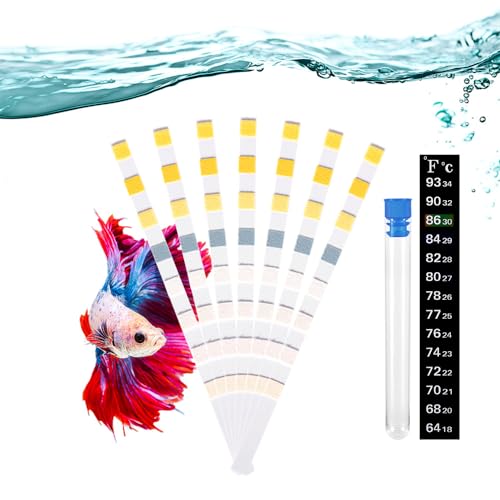
DaToo’s kit adds a thermometer and covers nine key parameters: pH, ammonia, total alkalinity, carbonate, hardness, free chlorine, nitrate, nitrite, and temperature. Best for: mixed tanks needing a broader snapshot, especially when temperature is a factor. Caution: the manufacturer emphasizes high sensitivity; follow the chart precisely for accurate results.
Pawfly 5 in 1 Master Test Kit

This kit focuses on five core parameters: pH, nitrite, nitrate, ammonia, and phosphate. Best for: hobbyists wanting a concise, core-parameter checklist for both freshwater and saltwater tanks. Advantage: simple color matching for quick decisions. Limitation: does not include some parameters like carbonate or alkalinity in every version, so cross-check needs may arise in sensitive setups.
Buying Guide
- What needs most testing in your tank? Choose a kit that covers the parameters critical to your species and setup (freshwater vs. saltwater, high-bioload communities, or planted tanks).
- How often will you test? For high-maintenance tanks, multi-parameter strips (8-in-1 or 11-in-1) can save time, while master test kits suit routine maintenance.
- Readability matters. Look for color charts with clear references and a straightforward dip-and-read method to minimize interpretation errors.
- Number of strips or tests. Larger aquariums or busy communities may require kits with more strips or broader parameter coverage to avoid frequent replacements.
- Temperature considerations. Some kits include a temperature readout or temperature as a parameter; temperature affects chemical reactions and fish health.
FAQ
- What is the primary purpose of aquarium test strips?
They provide a quick snapshot of multiple water parameters to help detect potential problems early. - How often should I test new setups?
Test at least twice a week during cycling or when introducing new fish, and adjust as needed based on stability. - Can test strips be used for saltwater tanks?
Yes, many kits are designed for both freshwater and saltwater, but verify parameter coverage for seawater needs. - What should I do if results show high ammonia?
Investigate filtration, partial water changes, and potential source of ammonia; follow kit-specific guidance for action steps. - Is a master test kit better than strips?
Master kits offer broader parameter coverage and often higher accuracy for ongoing monitoring. - Are there any common pitfalls with test kits?
Inaccurate readings can stem from improper timing, wrong sample depth, or reading under poor lighting; follow instructions precisely.