Answering your search for reliable aquarium water testing, this guide highlights five standout fish tank water test kits. Each choice is explained with who it’s best for, why it stands out, and any limitations to consider. These kits help maintain safe, healthy environments for fish, corals, and invertebrates by tracking essential water parameters. The recommendations cover both beginner setups and more experienced tanks, including options suitable for freshwater and saltwater aquariums. Use the quick-reference table to compare core features at a glance.
| Product | Best For | Key Benefit |
|---|---|---|
| AAwipes 8-in-1 Aquarium Test Kit (K02-50) | Small to medium freshwater tanks; ponds | 8-in-1 testing with fast results |
| API Freshwater Master Test Kit | New to intermediate freshwater setups | Trusted standard with multiple parameters |
| Pawfly 5 in 1 Master Test Kit | Compact setups needing core parameters | 5 essential parameters in one kit |
Note: All products listed are designed for both freshwater and saltwater contexts where applicable. When selecting a kit, consider the number of tests you perform weekly, your tank size, and whether you need ammonia, nitrate, nitrite, pH, and total alkalinity monitoring in one package or a broader parameter set.
AAwipes 8-in-1 Aquarium Test Kit (K02-50)

The AAwipes 8-in-1 kit provides measurements for Free Chlorine, Nitrate, Nitrite, Hardness, Carbonate, Total Alkalinity, pH, and Ammonia nitrogen. It is designed for quick, color-based readings with high-contrast results. This kit is best for small to medium freshwater tanks and ponds where monitoring multiple parameters helps catch water quality issues early. It is suitable for both freshwater and ponds, and is often favored by hobbyists who routinely test water a couple of times per week. A potential limitation is color interpretation under varying lighting, which can affect perceived accuracy if not compared against the included chart carefully. Best for: hobbyists needing a broad, all-in-one test solution with a straightforward workflow.
SJ WAVE 11 in 1 Aquarium Test Strips

The SJ WAVE kit tests 11 key parameters, consolidating ammonia, pH, iron, copper, nitrate, nitrite, total hardness, carbonate, alkalinity, temperature, and more into a single kit with color charts. This breadth makes it a strong choice for both freshwater and saltwater setups that require comprehensive monitoring without stocking multiple separate kits. The main caveat is the volume of information; users should keep the color charts handy and verify readings against reference scales to avoid misreadings in high-stress scenarios. Best for: those who want a broad, one-kit solution for diverse water conditions and hobbyists who keep multiform tanks.
Pawfly 5 in 1 Aquarium Master Test Kit

The Pawfly 5-in-1 kit focuses on pH, nitrite, nitrate, ammonia, and phosphate, providing a compact solution for monitoring the core health indicators of both freshwater and marine tanks. Its color-matching charts emphasize ease of use, making it suitable for beginners or busy hobbyists who want quick checks. A limitation to consider is that it omits some magnesium and total alkalinity measurements, which can be relevant in reef or advanced planted tanks. Best for: beginners and intermediate users who need a fast, practical read on primary water quality factors.
DaToo 8 in 1 Aquarium Test Kit
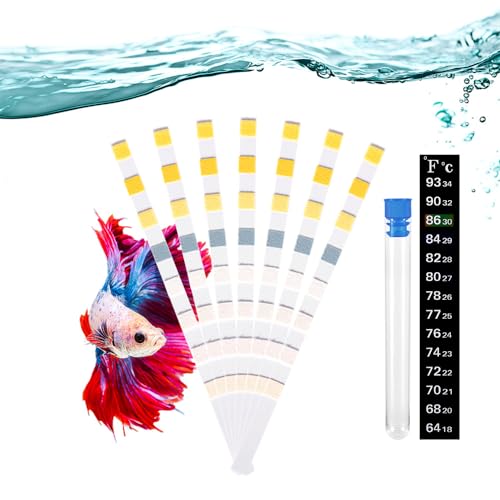
DaToo presents an all-in-one kit featuring 9 parameters when including temperature, covering pH, ammonia, total alkalinity, carbonate, hardness, free chlorine, nitrate, nitrite, and temperature. The inclusion of a thermometer adds value for monitoring thermal stability, an essential factor in successful fish keeping. DaToo emphasizes durability and a sealed design to protect reagents. A caveat is that some users may need more rapid or precise readings in professional setups. Best for: hobbyists who want a robust, all-around kit with temperature monitoring as part of the package.
Additional Buying Guide
Key purchase considerations help align your choice with tank size, species, and testing needs.
What parameters matter most for your tank?
- Freshwater only: pH, ammonia, nitrite, nitrate, and hardness are often sufficient.
- Saltwater or reef tanks: you may need alkalinity, carbonate, calcium, magnesium, and trace metals in addition to pH and ammonia.
- Plastic strips vs. liquid reagents: strips are quick and simple, but liquid reagents can offer higher precision in some setups.
How often should you test?
New setups typically require more frequent testing (daily to every few days) during the first month. Once stable, many hobbyists test 1-2 times per week and after major water changes or filter maintenance.
Which format is easiest for beginners?
Strip-based tests with color charts are generally easiest for beginners. Kits that consolidate multiple parameters into a single strip can save time but require careful color matching against charts.
What are common limitations to expect?
- Color interpretation can vary with lighting or eyesight; always compare against the included chart under consistent lighting.
- Some kits may not cover all parameters needed for complex or high-maintenance tanks; consider a broader kit if you keep corals or sensitive species.
- Ammonia readings are especially critical in new setups; ensure you conduct ammonia checks as part of your routine.
Choosing a kit: quick decision aid
- Want broad coverage with minimal kits? Choose 8-in-1 or 11-in-1 strips for convenience.
- Need a trusted standard for freshwater? The API Freshwater Master Kit is a widely recognized option.
- Prefer a compact option with essential parameters plus temperature? Pawfly or DaToo can fit smaller tanks well.
FAQ
- How often should I test my fish tank water? — Start with 2-3 times per week in new setups, then adjust to 1-2 times per week for established tanks.
- Do test strips provide accurate results? — They offer practical accuracy for routine checks; for critical environments, confirm with liquid-reagent tests.
- Can I mix different test kits? — Yes, but ensure you follow each kit’s instructions and keep readings separate to avoid confusion.
- Which parameter should I monitor first after a water change? — Ammonia and pH are often the first to monitor, as sudden shifts can stress fish.
- Are these kits suitable for both freshwater and saltwater? — Many are designed for both, but verify the kit’s parameter list to ensure it covers your needs.
- What is the best way to read colors accurately? — Compare under stable, neutral lighting and reference the included color chart for each parameter.