Finding a dependable auto feeder for your aquarium helps maintain consistent feeding while you’re away. The following selections cover a range of capacities, power options, and programming features to support bettas, small tanks, and larger setups alike. Each model is designed to minimize waste, keep food dry, and simplify care without daily manual feeding.
| Product | Brand | Key Benefit |
|---|---|---|
| Petbank Automatic Fish Feeder | Petbank | Moisture-proof design with multiple feed grids and two mounting options |
| FISHNOSH Automatic Fish Feeder | FISHNOSH | Programmable up to 9 feedings per day with simple setup |
| FISHNOSH Model-ML | FISHNOSH | Three daily feedings, easy refilling, no display screen |
| Aoyar Automatic Fish Feeder | Aoyar | Three feeding intervals, 200ml capacity, moisture-proof lid |
| FREESEA Automatic Fish Feeder | FREESEA | Manual and automatic modes with adjustable portions and moisture protection |
Petbank Automatic Fish Feeder With Moisture-Proof Design

Petbank’s feeder features 16 separate grids, enabling up to 15 meals with precise portions—each grid accommodates about 2 grams. This design aims to improve feeding accuracy beyond single-compartment models. It offers two installation methods: an adjustable clamp base to mount directly on the tank, or a suction cup setup for placement on the tank cover. A fully sealed, moisture-resistant chamber helps prevent clumping and keeps various foods dry. Suitable for pellets, small sticks, and powder, it is not recommended for shrimp or flakes.
FISHNOSH Automatic Fish Feeder

This model is designed for versatile use across small tanks to larger setups. It supports up to 9 feedings per day, with the ability to distribute food in three rounds per day. The setup is straightforward, and the manufacturer notes that it’s simple enough for caretakers of all ages to operate. The device emphasizes consistency, helping ensure pets aren’t skipped feeding times during busy days or travel.
FISHNOSH Automatic Feeder Model-ML

The Model-ML offers a compact, user-friendly solution with up to three daily feedings and a single round per feeding. Its design prioritizes ease-of-use, including a window for quick refills and straightforward operation. A display screen is not required, which some users prefer for simple everyday use. The feeder is positioned as a practical vacation feeder for both small and larger aquariums, with reliable portion control and simple maintenance.
Aoyar Automatic Fish Feeder

Aoyar’s unit includes three fixed feeding modes with intervals of 8, 12, or 24 hours. The device offers a 200 ml capacity and a moisture-proof lid to reduce clumping and keep food dry. It supports both automatic scheduling and manual feeding, making it flexible for vacations and everyday use. The design emphasizes straightforward operation and reliable feeding at specified times to prevent overfeeding.
FREESEA Automatic Fish Feeder
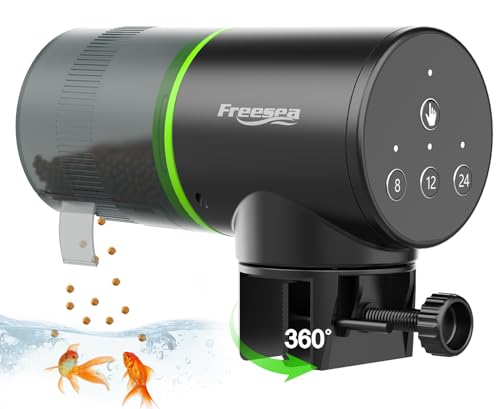
FREESEA combines manual and automatic modes, enabling scheduled feeding at 8-hour, 12-hour, or 24-hour intervals while allowing manual feeding as needed. The unit uses an open-top design to adjust feeding amounts easily without removing the timer. Its moisture-protection helps maintain the freshness of varied foods, including strips, powder, granules, and flakes, across different tank setups.
Buying Guide: Key Considerations For Choosing a Fish Feeder
- Feeding schedule and frequency: Determine how many feedings per day you need, and whether you require multiple daily cycles or flexible intervals for longer trips.
- Portion control and capacity: Look for precise portions per feeding and enough capacity to prevent frequent refills during vacations or weekends.
- Power options: Decide between USB, battery, or dual power sources. Battery backups or dual power can help during outages.
- Moisture protection: A moisture-proof lid or sealed chamber helps prevent clumping, jammed feeders, and food spoilage.
- Mounting compatibility: Check whether the feeder fits your tank type (hooded tanks, open-top tanks, or glass). Consider clamping bases or suction cup options.
- Food compatibility: Ensure the feeder supports the type of food you use (pellets, flakes, powders, strips) and avoid models that are too restrictive.
- Ease of use: Favor models with simple setup, easy refills, and clear indicators. Some users prefer no display screens for simplicity.
- Monitoring features: Some models include additional features such as temperature sensors or LCD displays to assist with tank maintenance.
- Durability and material quality: Look for sturdy housings and water-resistant components to withstand aquarium conditions.