Looking for the right filter media pads to keep your tank pristine? This guide highlights five top options, each with distinct advantages for different setups. Ideal for beginners, hobbyists upgrading canister systems, or keepers seeking better water clarity, these pads offer reliable mechanical filtration and easy customization. The best pick depends on tank type, filtration method, and how often you want to clean or replace media.
Summary of selected products (quick reference):
- ALEGI Aquarium Sponge Filter Pad — Cut-to-size, high-density foam for efficient mechanical filtration.
- Aquatic Experts FilterFirst Pad — Dual-density roll, easy to trim for canisters and HOB filters.
- AQUANEAT Dual Density Bonded Pad — White open fibers plus green dense fibers for fine and large particle trapping.
- MAQIHAN Filter Pad — Multi-layer design with good water permeability and cut-to-fit flexibility.
- sunjojo 8-Layer Filter Pad — Eight-layer construction for enhanced filtration and versatility.
ALEGI Aquarium Sponge Filter Pad

ALEGI offers a high-density sponge filter pad designed for effective mechanical filtration. The foam structure captures impurities and suspended particles, helping maintain a clear, stable environment for fish and invertebrates. It is built to resist deformation over time, supporting long-term filtration efficiency. Best for tanks that require easy customization and straightforward installation in smaller sumps or canister setups.
Who it’s best for: beginners or hobbyists who want a simple, cut-to-fit pad for standard sponge-filter setups. If you need durable, long-lasting filtration material, this pad provides reliable performance.
Why selected: Its combination of high-density foam and easy-cut sizing makes it a practical choice for a range of tank sizes, particularly where a custom fit is advantageous. A potential limitation is that it focuses on mechanical filtration, so you may still need additional media for chemical or biological filtration in larger systems.
Caution: Cut edges should be smoothed to avoid tearing secondary media or obstructing flow in tight spaces.
Aquatic Experts FilterFirst Aquarium Pad

The FilterFirst roll from Aquatic Experts is a dual-density media designed to trap large debris and fine particles. Its 12″ x 72″ width and length allow for versatile trimming to match many filter shapes, including canisters, sumps, and hang-on-back units. The pad is reusable and durable, with thick polyester fibers that resist tearing and can be rinsed multiple times, reducing ongoing replacement costs.
Who it’s best for: tank owners who want a flexible, cut-to-fit solution for larger or irregular filter housings. It works well for medium to large aquariums requiring easy maintenance and extended media life.
Why selected: The two-layer design improves overall cleaning efficiency, making it a solid choice when you need effective polishing and debris removal without frequent media changes.
Caution: Rinsing should be thorough but gentle to preserve the integrity of the dual-density layers.
AQUANEAT Dual Density Bonded Pad

AQUANEAT combines a white open-fiber layer with a green dense layer to trap both large and fine particles. The pad is easily cut to fit canister, sump, wet/dry, or power filters, making it a versatile pre-filter or polishing pad. The data suggests it can improve water clarity by providing mechanical filtration that addresses a range of particle sizes.
Who it’s best for: aquarists needing a single media that handles multiple particle sizes and fits a wide variety of filters. Best for systems where space allows a single multi-density media to replace several separate pads.
Why selected: The dual-density concept helps balance flow and filtration efficiency. A limitation is that the exact density balance may vary by batch, so some users may prefer additional polishing media for ultra-clear water in heavily stocked tanks.
Caution: Ensure you cut to fit precisely to avoid gaps that could bypass filtration flow.
MAQIHAN Aquarium Filter Pad
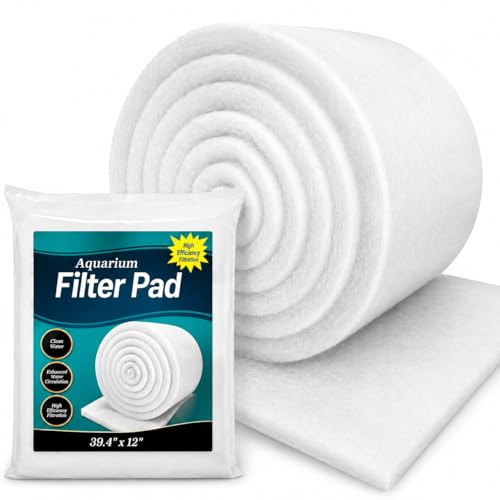
MAQIHAN’s filter pad focuses on efficient filtration with multi-layer white and green media designed to trap impurities and sediments. It emphasizes good water permeability to maintain smooth flow and reduce stagnation. The pad is cut-to-fit for flexible installation in various filter configurations, including canisters, sumps, and power filters. It’s suitable for both freshwater and saltwater environments and can work as a polishing pad to improve water clarity over time.
Who it’s best for: tankkeepers who want a dependable, cut-to-fit pad with reliable mechanical filtration across different water types. It suits setups where filtration efficiency and water flow are priorities.
Why selected: The combination of good permeability and cut-to-fit convenience supports consistent filtration performance. A potential limitation is that it is primarily mechanical filtration; users may still need supplementary media for chemical filtration in some tanks.
Caution: When cutting, ensure clean edges to prevent fraying that could release fibers into the tank.
sunjojo 8-Layer Filter Pads

Sunjojo advertises an eight-layer filtration system with a combination of honeycomb mesh, three-dimensional fiber, fine mesh fiber, nano bio sponge, and more. The layered approach is designed to enhance filtration efficiency and ease of cleaning. The pad is cut-to-fit for various filtration types, including hang-on-back, canister, wet/dry, and pond systems, suitable for freshwater, saltwater, reef tanks, shrimp tanks, and even aquaponics.
Who it’s best for: advanced hobbyists or those running multi-stage setups who want maximum filtration depth from a single pad. It’s a strong choice for complex systems seeking thorough mechanical filtration with fewer media changes.
Why selected: The multi-layer approach can provide improved water polishing and debris capture. A caution is that the eight-layer design may require more frequent rinsing to maintain optimal flow in heavily stocked tanks.
Caution: If you have a very small filter compartment, verify the thickness and layering won’t restrict flow in your unit.
Buying Guide: Key Purchase Considerations
- Tank size and filter type: Match pad thickness and cut-to-fit capability to your filter’s dimensions and flow rate.
- Filtration goals: Choose single-density for straightforward filtration or multi-density layers for broader particle capture.
- Durability and maintenance: Reusability and rinsing frequency affect long-term costs and tank cleanliness.
- Water type: Consider whether you need a pad for freshwater, saltwater, or mixed environments.
- Flexibility: If you anticipate future tank upgrades, prioritize pads that can be cut to fit a range of filters.
FAQ
- Q: Can filter pads replace carbon or bio-media entirely? A: Not usually. Media pads primarily provide mechanical filtration and should be complemented with carbon or bio-media where chemical filtration or biological filtration is needed.
- Q: How often should I replace or rinse filter pads? A: Rinse pads when you notice reduced flow or cloudy water. Replace when the pad shows wear, tearing, or significant degradation in filtration performance.
- Q: Are these pads safe for reef tanks? A: Many pads are suitable for mixed environments, but always confirm compatibility with saltwater and reef-specific needs before use.
- Q: Can I cut pads to fit any filter model? A: Most pads are designed to be cut-to-fit; use clean, sharp scissors for precise edges to maintain filtration efficiency.
- Q: Do pads affect fish health? A: Proper filtration improves water quality, which supports fish health. Avoid overloading pads with debris to prevent oxygen depletion.