Small aquariums can heat up quickly in warm weather, stressing fish and corals. Aquarium chiller fans offer a quiet, energy-efficient way to maintain stable temperatures without expensive equipment. This guide highlights five compact, effective options that suit freshwater, saltwater, and nano tanks. Each product is evaluated on cooling performance, noise, build quality, and ease of use to help you choose the right fit for your tank.
Summary of Selected Products
| Product | Brand | Key Benefit |
|---|---|---|
| Hygger Aquarium Chillers Fan (1-Fan Head) | hygger | Adjustable speed with quiet operation; energy-saving cooling |
| PAIZOO Aquarium Chiller Fan | PAIZOO | Three speed modes; dual copper motor for efficiency |
| AQUASMITH Aquarium Chiller Fan | AQUASMITH | Smart temperature control; evaporative cooling; quiet |
| DaToo Aquarium Chiller | DaToo | Two-level wind speed; strong, durable design; easy mounting |
| Hygger Aquarium Chillers Fan (3-Fan Head) | hygger | Higher cooling capacity with five wind speeds; versatile for larger small tanks |
Hygger 1-Fan Head Aquarium Chiller Fan

The Hygger 1-Fan Head unit addresses common heat sources in small tanks, including pumps, filters, and lights. It features an adjustable timer and wind-speed settings across five levels, enabling use across seasons. The ABS plastic shell and copper-core motor deliver durable performance with low noise. This compact design fits tight spaces and reduces ambient heat around the tank. Ideal for freshwater and small reef setups seeking energy-efficient cooling without complicated installation.
PAIZOO Aquarium Chiller Fan

The PAIZOO chiller fan uses dual turbo fans with a sturdy ABS body and a dual-drive copper motor. It offers three adjustable air-speed modes, including a quiet soft mode and a higher-speed mode for quick cooling. The design emphasizes quiet operation and reliability for both freshwater and saltwater tanks. Its compact footprint and three-speed flexibility make it suitable for axolotl and other small aquatic setups where temperature control matters.
AQUASMITH Aquarium Chiller Fan

The AQUASMITH chiller combines temperature control with evaporative cooling to deliver 3°F–7°F of cooling. It features a high-precision LED temperature display and a real-time sensor for stable water temperatures. The dual fans and adjustable airflow angle maximize surface cooling while minimizing noise (below 40 dB). Designed for axolotls, corals, and mixed tanks, it offers a smart balance between performance and quiet operation.
Tokenkuko Fake Motion Fish Tank Mini Aquarium Lamp

Note: This item is primarily a decorative night light rather than a cooling device. It contributes ambiance and may be suitable for small nano tanks where lighting effects are a desired feature. It is not a substitute for dedicated cooling equipment but can complement tank aesthetics in a compact setup.
DaToo Aquarium Chiller Fan
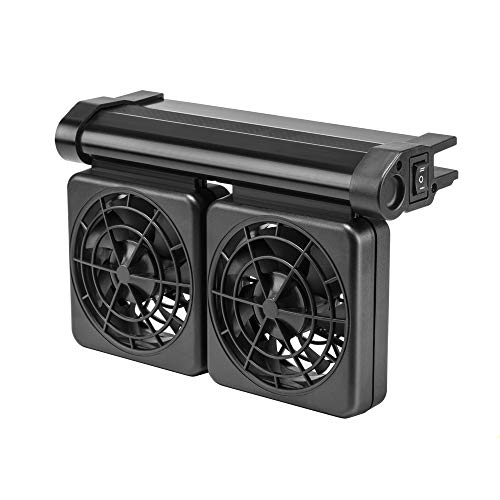
DaToo’s chiller fan emphasizes strong wind and quiet operation, with a two-level speed setting. The aluminum clip and engineering-grade ABS provide durability for long-term use. It’s a simple plug-and-play cooling solution that can be attached to the edge of a small tank, delivering consistent airflow to accelerate heat dissipation without requiring complex setup.
Hygger 3-Fan Head Aquarium Chiller

This higher-capacity Hygger model uses three fans to boost airflow across the water surface, offering five wind-speed levels. It suits medium-sized nano tanks and paludariums that require more aggressive cooling. The design prioritizes energy efficiency and quiet operation, making it suitable for bedrooms or offices where minimal noise is valued.
Buying Guide: Key Purchase Considerations
When selecting a small aquarium cooling fan, consider the tank size, heat sources, and desired level of automation. Fans with multiple speed settings provide flexibility for seasonal changes and different tank habitats. Look for robust mounting options and a durable body to withstand humidity and salt exposure in marine setups.
- Tank compatibility: Ensure the fan fits the width and lip of your tank, especially for rimless or nano tanks.
- Cooling capacity: For small tanks, fans with 3–5 mph of airflow typically suffice; larger small tanks may benefit from multi-fan or high-speed variants.
- Noise level: Read product specifications or reviews for decibel ratings; quieter models are preferable for bedrooms and offices.
- Power and controls: Adjustable wind speeds and timers simplify operation and energy use. Check whether the unit requires USB power or standard outlets.
- Durability: ABS plastic housings and copper-core motors tend to offer longer life in humid environments; consider anti-corrosion features for saltwater tanks.
- Maintenance: Look for easy-access filters or unobstructed airflow paths to keep performance consistent over time.
- Installation: Clip-on or suction-based mounts are common; ensure your setup can accommodate the mounting method without crowding livestock or decor.
For users maintaining reef, freshwater, or mixed tanks, balancing cooling with humidity and evaporation is important. Fans can help maintain stable temperatures but should be considered as part of a broader cooling strategy that may include room cooling, shading, or airflow improvements. Visual monitoring of water temperature with a reliable controller is recommended to avoid rapid fluctuations that stress aquatic life.