The best complete CO2 system for a planted tank delivers reliable, consistent CO2 injection, simple setup, and safe operation for hobbyists at all levels. This guide highlights five top kits that balance power, safety, and ease of use. It helps beginners decide which system fits their tank size and maintenance routine, while offering insights for more advanced aquarists seeking precise control. The following picks are well-suited to community tanks, nano setups, and mid-sized aquariums alike. Below, a quick buyer table compares core strengths across the chosen products.
| Product | Best For | Core Advantage |
|---|---|---|
| Hygger CO2 5L | Mid-sized planted tanks | Motor valve with timer control |
| FZONE 2.5L | Compact, accurate dosing | Integrated solenoid, bubble counter, regulator |
| FZONE 5L | Long-term, higher demand setups | Robust safety design, all-in-one system |
| MagTool 2.5L | DIY-ready kits with durability | All-in-one solenoid and bubble counter |
| Hygger 2L | Small to medium tanks with budget | Thick-walled bottle, safety valve |
Hygger CO2 5L Upgrade System

Best for mid-sized planted tanks requiring steady CO2 with programmable control. The kit features a timer-enabled motor valve that replaces traditional solenoids, enabling precise on/off cycles to match plant growth needs. A built-in program supports automatic dosing after initial setup. The system is best for hobbyists who want hands-off operation once configured, and for tanks around 20–40 gallons. Limitations: the motorized valve can produce a soft click or hum during switching, and the valve is not waterproof, so keep electronics dry and away from moisture. Diffuser soaking for 24 hours before use helps achieve immediate CO2 release.
Who this is for: Aquarists seeking reliable, adjustable CO2 with timer automation for regular dosing without manual refills. This is a solid middle-ground choice for growing carpet plants and fast-growing foreground species.
FZONE 2.5L Upgraded CO2 System
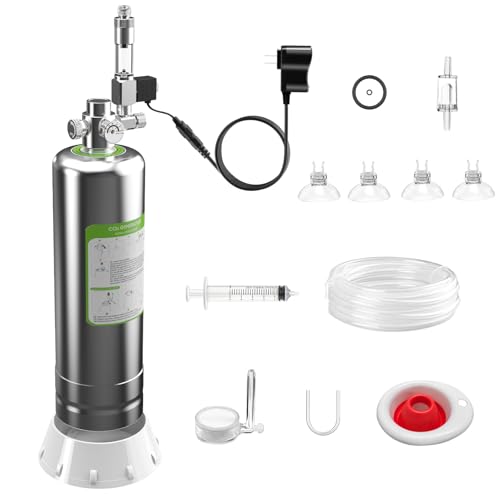
Best for compact setups that still demand precise CO2 control. This kit combines a high-efficiency reaction system with a regulator, bubble counter, and integrated solenoid—offering straightforward, reliable dosing. The stainless steel build adds strength and pressure resistance, while a manual shut-off valve and automatic pressure-relief valve provide dual safety. Limitations: some users may need to source additional powders (citric acid and baking soda) for CO2 generation.
Who this is for: Small or nano tanks where space efficiency and easy watchability of CO2 flow are key. Choose this if you want a compact, all-in-one solution with clear pressure readouts.
FZONE 5L Upgraded CO2 System
Best for larger or high-demand planted aquariums needing sustained CO2 supply. This kit emphasizes a thicker stainless body and enhanced safety features, including a manual shut-off and automatic pressure relief. The upgraded all-in-one solenoid reduces leak points, improving long-term stability. Limitation: bulkier footprint means it’s better suited for larger setups with space for equipment.
Who this is for: Aquarists running mid-to-large tanks or those growing demanding plant species that require consistent CO2 delivery over extended periods.
MagTool 2.5L DIY CO2 Kit
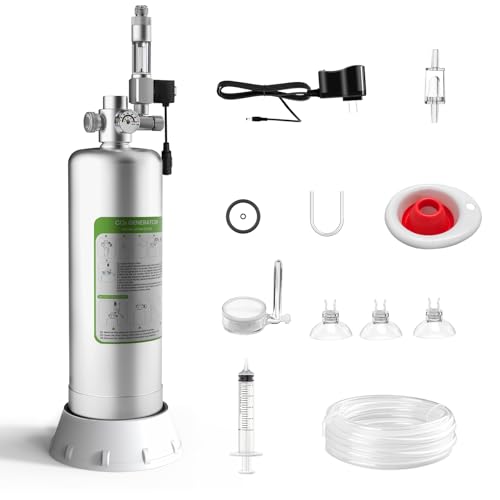
Best for hobbyists who want a durable, DIY-ready solution with a built-in solenoid and bubble counter. The bottle is made from high-grade SUS304 stainless steel with thicker walls, designed for higher pressure and longer life. A compact integrated design reduces leak risks and simplifies maintenance. A manual shut-off valve and automatic relief valve add safety for off-cycle periods. Limitation: does not include the CO2 generation powders; users must supply citric acid and sodium bicarbonate separately.
Who this is for: Enthusiasts who prefer a robust, all-in-one kit with room for customization and longer bottle life, suitable for mid-sized planted tanks.
Hygger 2L Aquarium CO2 System

Best for budget-conscious users with smaller tanks who still need reliable CO2 control. This system uses a thicker SUS304 bottle, automatic pressure relief, and a 12V waterproof solenoid to minimize leakage and improve safety. A noted benefit is the strong safety protections paired with a straightforward setup. Limitation: the motorized valve may emit a soft operating sound, and the valve is not waterproof, so care is needed to prevent water exposure.
Who this is for: Beginners or hobbyists running smaller, low-to-medium demand tanks who want a solid, safe CO2 solution without premium pricing.
Buying Guide: Key Considerations For A Complete CO2 System
- Tank size compatibility: Match system capacity to your aquarium volume to avoid under- or over-dosing CO2.
- Control precision: Look for a unit with a needle valve, bubble counter, and a readable pressure gauge for stable dosing.
- Valve design: Motor valves offer timer-based automation; solenoids are traditional but can have more leak points in some setups.
- Safety features: Automatic pressure relief valves and manual shut-offs reduce risk when CO2 isn’t needed or during maintenance.
- Material durability: Stainless steel bottles (SUS304) tend to be more durable and safer under high pressure than lighter materials.
- Maintenance needs: Consider whether you’ll need to source CO2 generation powders separately and how easy it is to clean diffusers and tubing.
- Space and footprint: Larger 5L kits deliver longer run times but require more tank space and cabinet room.
- Ease of setup: Systems with integrated all-in-one components reduce assembly complexity and leak risk.
FAQ
- What size CO2 system should I start with for a 20 gallon tank?
Answer: A 2L to 5L system is typically suitable, depending on plant demand and fixture efficiency. - Do CO2 systems require special powders?
Answer: Some systems generate CO2 using citric acid and baking soda powders, which are sold separately in many kits. - Is a motor valve better than a solenoid valve?
Answer: Motor valves enable programmable timers for automated dosing; solenoids are traditional but may require more manual adjustment in some setups. - What maintenance do CO2 systems need?
Answer: Regular diffuser soaking, tubing checks for leaks, and ensuring calibration of the regulator and bubble counter help maintain performance. - Can CO2 systems be used with nano tanks?
Answer: Yes, compact 2L or 2.5L kits are commonly used for nano and small-to-mid-sized tanks with careful flow control. - What safety features are essential?
Answer: Manual shut-off valves and automatic pressure relief valves protect equipment and aquatic life during operation and downtime.