Maintaining proper carbon dioxide levels is vital for healthy aquatic plant growth. This guide highlights top CO2 test kits and drop checkers to help hobbyists read CO2 concentration accurately, adjust dosing, and keep fish safe. Each product below is designed for reliable at-home monitoring, with easy-to-interpret color indicators and clear setup steps to fit diverse planted tanks and skill levels.
| Product | Brand | Key Feature |
|---|---|---|
| FZONE Aquatic CO2 Glass Drop Checker | FZONE | Accurate 4dKH solution, color-coded readings |
| Pawfly Glass CO2 Drop Checker | Pawfly | Complete kit with solution and suction cups; clear color interpretation |
| ZRDR Glass Drop Checker Kit | ZRDR | Pre-mixed indicator solution; direct use, color-change reading |
| Pawfly Acrylic CO2 Drop Checker | Pawfly | Acrylic indicator container; straightforward 15 drops dosing |
| API GH & KH Test Kit | API | Measures general carbonate hardness and general water quality alongside CO2 context |
Note: The list focuses on CO2-related monitoring tools and reliable general water tests that support CO2 management in planted aquariums.
FZONE Aquatic CO2 Glass Drop Checker

The FZONE CO2 Drop Checker uses a precision 4dKH solution to provide a straightforward CO2 reading. Set up is quick: fill the drop checker to half with the provided solution, attach it to the glass, and check the reading about an hour later. Color codes help interpret levels: BLUE indicates CO2 is low, GREEN shows adequate CO2, and YELLOW signals excessive CO2. This setup supports steady monitoring of CO2 in the water column, helping maintain plant health and stable tank conditions.
Pawfly Glass CO2 Drop Checker

This complete CO2 monitor kit includes curved glass tubing, a reagent solution bottle, and two suction cups. To read CO2, add 20 drops of reagent into the tubing and mount it vertically on the tank wall. Results typically appear within about two hours. Color interpretation is straightforward: Green or Light Green indicates balanced CO2, Yellow warns of too much CO2, and Blue signals too little CO2. The kit emphasizes ease of use and clear, at-a-glance results for planted tanks.
ZRDR Glass Drop Checker Kit

The ZRDR Drop Checker Kit includes a glass drop checker with a pre-mixed CO2 indicator solution, designed for convenient use without measuring solution ratios. Reading guidance is simple: the solution shifts from blue (low CO2) to green (optimal around 30 ppm) and toward yellow if CO2 is too high. The kit comes with a suction cup for easy mounting and aims to deliver quick, dependable CO2 readings for planted tanks.
Pawfly Acrylic CO2 Drop Checker
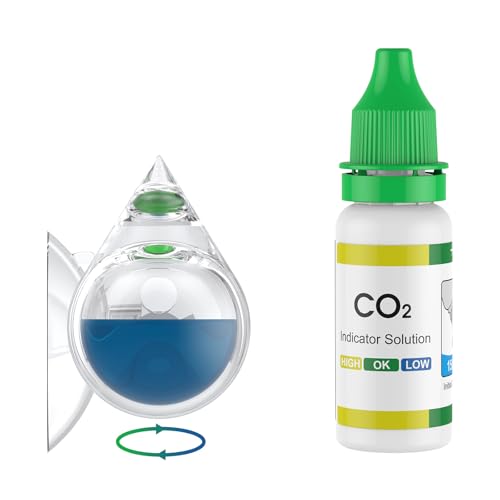
The Pawfly Acrylic CO2 Drop Checker features a tear-shaped acrylic container with a reagent solution and two suction cups for easy placement. To use, add 15 drops of reagent, seal tightly, and attach to the tank wall with suction. For accuracy, monthly reagent replacement is recommended. The indicator provides a quick color readout to help maintain plant-friendly CO2 levels in a home aquarium setup.
API GH & KH Test Kit

The API GH & KH Test Kit helps monitor essential water parameters in freshwater aquariums, including general hardness and carbonate hardness, along with accompanying solutions and test tubes. While not a CO2 indicator itself, understanding GH and KH supports CO2 stability by informing buffering capacity and plant nutrient availability. This kit helps prevent invisible water problems that can harm fish and plants, contributing to a healthier planted tank ecosystem when used alongside CO2 monitoring tools.
Buying Guide: CO2 Monitoring For Planted Aquariums
- Purpose and scope: Choose a drop checker if you want continuous CO2 readings in the water column, or a test kit if you prefer periodic checks and broader water quality data.
- Ease of use: Look for pre-mixed solutions, clear color indicators, and simple mounting (suction cups or wall attachment) to minimize guesswork.
- Reading accuracy: Some checkers require waiting times (e.g., 30 minutes to 2 hours). Plan maintenance and reagent replacement on a schedule to avoid stale readings.
- Tank compatibility: Larger tanks may benefit from multiple checkers or additional test kits to ensure uniform CO2 distribution and reliable readings across the aquarium.
- Maintenance and updates: Regularly replace reagents and keep indicator solutions within expiry to preserve accuracy. Consider kits that provide long-term value (bundled solutions, reusable components).
- Parameter context: Combine CO2 monitoring with general water quality testing (GH/KH, ammonia, nitrate) to understand buffering capacity and plant compatibility, ensuring a stable environment for both plants and fish.
- Interpretation and actions: Color-coded indicators help quick decisions, but correlate readings with plant growth stage, lighting, and fertilizer regimen to optimize dosing strategies safely.
- Cost and availability: Compare upfront kit costs with ongoing reagent needs, and check availability of refills to maintain consistent monitoring without disruption.