For planted aquariums, a reliable CO2 regulator with a bubble counter helps you deliver stable, measurable CO2 to aquatic plants. This guide highlights five top options, explaining who they’re best for, why they stand out, and any practical caveats. Ideal buyers include beginners seeking simple, ready-to-use kits and advanced hobbyists who want dual-stage control and expandability.
| Product | Best For | Why It Stands Out |
|---|---|---|
| FZONE Aquarium Co2 Regulator DC Solenoid with Bubble Counter | Entry-level setups | Newest DC solenoid, precise bubble readout, all-in-one tools |
| FZONE Pro Series Dual Stage CO2 Regulator | Two-tank systems | Dual stages, independent blocks, safety valve, wide 0–65 PSI range |
| FZONE Aquarium CO₂ Regulator Kit | Compact tanks | Integrated solenoid and bubble counter, small footprint, CGA320 compatibility |
| Hygger CO2 Aquarium Regulator | Durable, versatile pools | Dual gauge, 12V DC solenoid, upgraded bubble counter with check valve |
| Hygger CO2 Upgraded Regulator With Motorized Valve | Multi-tank automation | Expandable manifold, timer-enabled motorized valve, two counters |
FZONE Aquarium Co2 Regulator DC Solenoid with Bubble Counter

This regulator uses a DC solenoid for safer, stable operation and provides a high-precision adjustment suitable for keeping a consistent CO2 bubble every few seconds. It includes a bubble counter with a check valve to prevent backflow and comes with installing tools, making it easier for beginners to set up.
Best for: hobbyists starting a new planted tank who want an all-in-one package with clear bubble rate readout. Limitations: less modular than dual-stage systems, so growth to higher CO2 needs may require an upgrade.
FZONE Pro Series Dual Stage CO2 Regulator
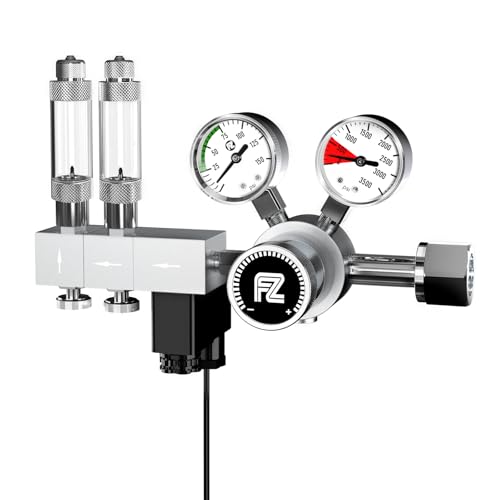
The Pro Series uses dual-stage regulation to maintain stable output regardless of tank pressure and includes two independently operable manifold blocks. It supports a wide output range (0–65 PSI) and includes a safety valve to vent excess pressure, plus a precise needle valve for CO2 flow control.
Best for: aquariums with two tanks or future expansion. Better for: users needing reliable, scalable CO2 delivery. Caution: may be bulkier and pricier than single-regulator models.
FZONE Aquarium CO₂ Regulator Kit
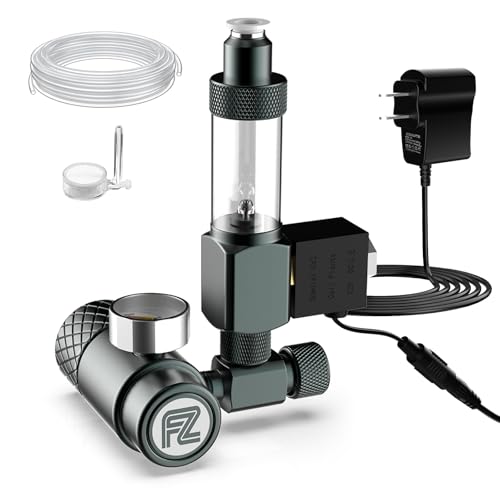
This compact kit integrates the solenoid and bubble counter into one unit, reducing space and potential leak points. It uses a 12V DC solenoid for safer operation and is compatible with CO2 tanks that use CGA320 fittings, making it suitable for small to mid-size planted tanks.
Best for: small setups where space and simplicity matter. Choose this if you want an all-in-one, compact regulator. Limitation: might offer fewer expansion options than modular systems.
Clscea Aquarium Co2 Regulator Dual Pressure Gauge

This model emphasizes a modular electromagnetic design with a micro solenoid valve and a straightforward, fixed assembly method. It is designed for reliable operation and straightforward maintenance, with emphasis on stable gas delivery and easy setup.
Best for: users who value a simplified, serviceable design. Caution: detailed specs on outputs aren’t listed here; confirm compatibility with your CO2 system before purchase.
Hygger CO2 Aquarium Regulator

This regulator features dual gauges with clear readings, a 12V DC solenoid, a bubble counter with check valve, and a robust aluminum body. It’s designed for compatibility with CGA320 tanks and aims for precise control and reliability in daily use.
Best for: hobbyists seeking durable hardware and accurate readouts. Better for: home aquariums that require stable, easily readable CO2 dosing. Limitation: heavier and may be over-specified for very small tanks.
Hygger CO2 Upgraded Regulator With Motorized Valve

This kit supports multi-tank setups with an expandable manifold and two bubble counters. A motorized valve paired with a timer provides automation to CO2 control, reducing the need for manual intervention, while the quick-connect fittings streamline installation.
Best for: multi-tank setups requiring automation. Choose this if you want scalable CO2 delivery and scheduled operation. Caution: motorized valve adds complexity and requires power management planning.
Buying Guide: Key Considerations For Choosing A CO2 Regulator With Bubble Counter
- Tank compatibility: Ensure CGA320 fittings match your CO2 cylinder and barometer’s thread standard.
- Regulator type: Dual-stage vs single-stage affects stability under varying tank pressures; dual-stage is preferred for multi-tank systems or long-term stability.
- Flow control precision: Look for a fine-tuning needle valve and a reliable bubble counter to read flow rate clearly.
- Safety features: Built-in safety valves help release excess pressure; consider models with protective enclosures for the solenoid.
- Power options: DC solenoids typically run cooler and are quieter than AC; motorized valves offer automation but add complexity and power needs.
- Expansion potential: Modular designs or expandable manifolds support additional tanks without replacing the regulator.
- Size and footprint: Compact units fit smaller tanks or nano tanks; larger setups benefit from dual blocks and additional outlets.
- Ease of installation: Integrated kits with bubble counters and tools simplify setup for beginners.
FAQ
- What is a bubble counter and why is it important?
A bubble counter lets you read your CO2 flow rate directly, helping maintain stable dosing for plant growth. - Do I need a dual-stage regulator for a single-tish aquarium?
Not strictly, but dual-stage designs improve consistency as tank pressure changes over time. - Can I use these regulators with any CO2 diffuser?
Most are CGA320-compatible and work with common diffusers, but always verify fittings with your hardware. - Is a motorized valve worth it for a home aquarium?
Motorized valves enable automated timing for CO2, which helps maintain schedules with less manual adjustment. - What should I check before buying?
Check compatibility (tank fittings and wire options), expansion potential, safety features, and readouts on the gauges.