If you’re building or upgrading a planted aquarium, a reliable CO2 regulator is essential for steady, precise CO2 delivery. This guide highlights five well-regarded options, each suited to different tank sizes and user needs—from nano desktops to multi-tank setups. Whether you’re seeking compact portability, advanced dual-stage control, or expandable configurations, these regulators help maintain stable CO2 levels and support lush aquatic plants. The buyer intent sections explain who each product is best for and why it stands out.
Summary table of selected products:
| Product | Best For | Why It Stands Out |
|---|---|---|
| FZONE DC Solenoid Regulator with Bubble Counter | Small to mid tanks | Precise 1 bubble per 3 seconds, compact unit with bubble counter |
| FZONE Pro Dual-Stage Regulator | Two-tank systems | Two independently operable blocks, 0-65 PSI, safety valve |
| FZONE Compact Regulator Kit | Small desktops | Built-in solenoid, bubble counter, and leak-proof design |
| Hygger Dual-Stage Regulator | Multi-tank or expandable setups | Expandable manifold, motorized valve option, timer |
| DaToo Regulator with Bubble Counter | Long-term planted tanks | Stable output, durable materials, 3–4x life expectancy claims |
FZONE Aquarium Co2 Regulator DC Solenoid with Bubble Counter

Best for small to medium aquariums that need precise, simple CO2 control. This regulator uses a 12V DC solenoid for safer, cooler operation than AC models. It features a high-precision structure that makes achieving 1 bubble every 3 seconds straightforward, plus a bubble counter that shows the gas flow rate. A built-in check valve helps prevent backflow into the bottle, and all installation tools are included for quick setup. Caution: suited for smaller systems; larger tanks may require a multi-outlet solution.
FZONE Pro Series Dual-Stage CO2 Regulator
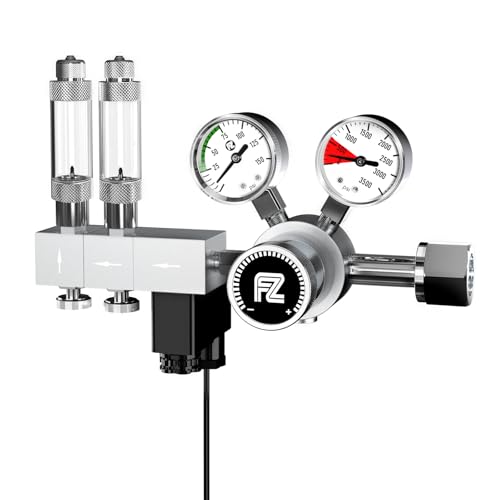
Best for two-tank systems and users who want independent control. Its dual-stage design stabilizes output regardless of remaining cylinder gas, and an adjustable output of 0–65 PSI covers diverse plant needs. The kit includes two manifold blocks with high-precision needle valves, enabling separate control for each aquarium. A built-in safety valve releases pressure above 100 PSI. Consider this if you maintain multiple tanks and want reliable, adjustable performance.
FZONE CO2 Regulator Kit with Integrated Solenoid and Bubble Counter
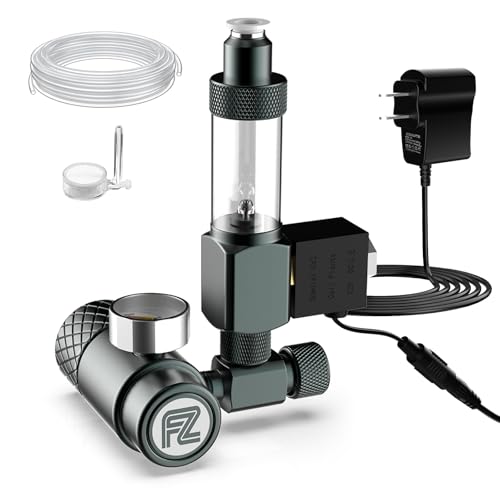
Best for compact desks and small to mid-sized tanks. This kit integrates the solenoid and bubble counter in one slim unit for a clean setup. It uses a 12V DC solenoid for safer operation and features professional leak-proof sealing. Compatibility includes CGA320 tanks, and the compact footprint fits limited spaces. Choose this if you value a minimal, all-in-one design with reliable leak resistance, but be mindful of potential limitations on larger CO2 volumes.
Hygger CO2 Upgraded Regulator with Motorized Valve

Best for expandable multi-tank setups and automated control. The kit includes a timer and two bubble counters, enabling simultaneous supply to two tanks and easy future expansion via quick-connect fittings. The motorized valve with a timer allows programmable CO2 cycles, reducing heat from continuous operation. Opt for this if you want automation and scalability, but verify electrical compatibility and power reliability in your space.
FZONE Desktop Co2 System with 45g Cartridge
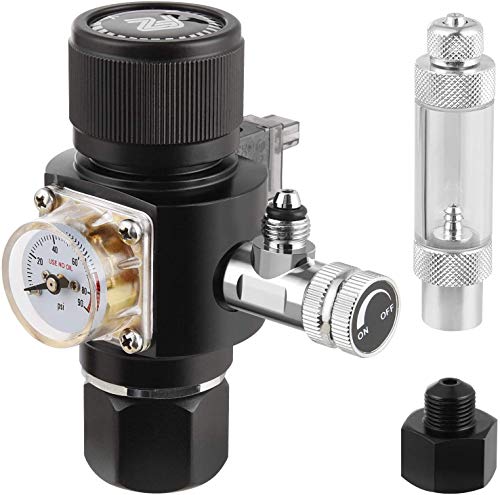
Best for nano and desktop aquariums that need a portable solution. This compact system ships with a 45g disposable cartridge and fits 5/8″ and 3/8″ threaded interfaces with adapters included. It promises long cartridge life and a straightforward setup for smaller tanks. Choose this if you want a lightweight, off-branch CO2 setup for limited space, but be prepared to swap cartridges regularly for active tanks.
Buying Guide: Key Purchase Considerations
- Tank size and configuration: Determine whether you need a single-regulator unit or an expandable, multi-outlet system for two or more tanks.
- Control mechanism: Decide between a fixed-output regulator, dual-stage design, or motorized valve with timer for automation and stability.
- Safety features: Look for built-in safety valves, check valves, and leak-proof seals to prevent backflow and over-pressurization.
- Solenoid type and power: 12V DC solenoids are typically cooler and safer than AC models; consider energy efficiency and heat generation.
- Compatibility and connections: Ensure CGA320 compatibility and the appropriate thread sizes for your CO2 cylinders and diffusers.
- Maintenance and parts: Favor kits with readily available spare parts, bubble counters, and needles valves for precise adjustments.
- Space and aesthetics: For desktop tanks, prioritize compact designs that minimize visual clutter while delivering reliable control.
Frequently Asked Questions
- What is a CO2 regulator used for in aquariums? The regulator controls the rate of CO2 gas delivered to the aquarium, helping maintain stable carbon levels for plant growth.
- What is a dual-stage regulator? A dual-stage regulator provides two stages of pressure reduction for more stable CO2 output, reducing fluctuations as tank gas changes.
- Why choose a DC solenoid over an AC solenoid? DC solenoids typically run cooler, with lower heat generation and safer operation in enclosed setups.
- What does a bubble counter indicate? A bubble counter shows the CO2 flow rate in bubbles per second, helping aquarists calibrate delivery precisely.
- Is an expandable regulator important for multi-tank setups? If you maintain more than one planted tank, an expandable regulator simplifies management by sharing a single system across tanks.
- How do I know which regulator is right for my tank? Consider tank size, desired CO2 dosing rate, space, and whether you need automation or multi-tank support.