When selecting a bubble pump for your fish tank, consider tank size, noise levels, power use, and adjustability. This guide highlights five top options suited for common setups, from compact nano tanks to larger 100-gallon systems. Each choice pairs quiet operation with adjustable airflow to keep oxygen levels steady. Ideal buyers include beginners building a simple betta or fry tank, hobbyists maintaining community aquariums, and those upgrading to more robust aeration without excess noise.
Below is a quick overview of the recommended products. The table helps compare core specs and suitability at a glance.
| Product | Best For | Air Flow | Outlets | |
|---|---|---|---|---|
| Uniclife 64 GPH Aquarium Air Pump | Medium to large freshwater/marine tanks | 64 GPH | Dual | 10-100 gal |
| Pawfly Aquarium 15-40 GPH | Compact spaces and small tanks | 30 GPH | Single | 5-20 gal |
| Pawfly 50 GPH Air Pump | Up to mid-size tanks with dual outlets | 50 GPH | Dual | Up to 60 gal |
| AQUANEAT 100gal Air Pump | Large freshwater or hydroponics setups | 100 GPH | Dual | Up to 100 gal |
| AQUASMITH 14Kpa Ultra-Quiet Pump | Quiet operation with higher pressure needs | 14Kpa | Single | 20-40 gal |
Uniclife 64 GPH Aquarium Air Pump
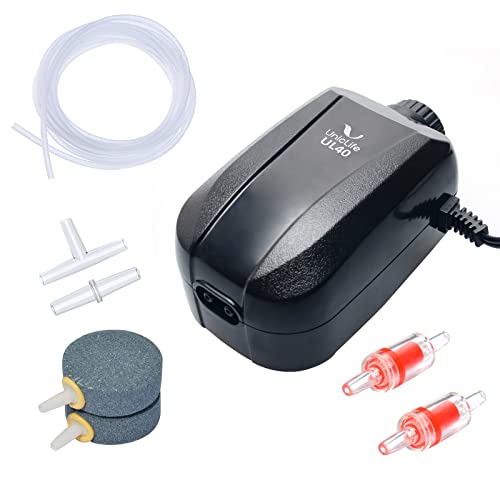
This dual-outlet pump delivers steady airflow up to 64 GPH with a low-pressure design (0.016 MPa) and 4 W power. It’s suitable for 10-100 gallon tanks and includes an adjustable rotary knob to tailor oxygenation. Noise is minimized at around 25 dB on Low and up to 45 dB at max, making it a strong choice for bedrooms or living spaces. Best for mid-to-large freshwater or marine tanks where adjustable aeration is needed. A potential limitation is that air volume can drop if intake cotton is clogged; periodic cotton replacement keeps performance optimal.
Pawfly Compact Air Pump 15-40 GPH
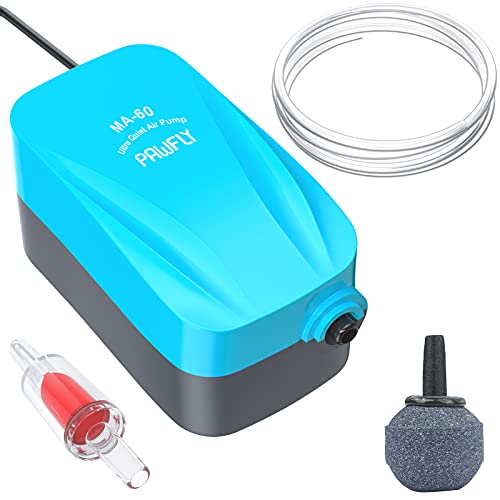
Designed for tight spaces, this compact unit measures 3.3″ x 1.8″ x 1.6″ and is ideal for 5-20 gallon tanks. It delivers up to 30 GPH and operates at 0.012 MPa with 2 W consumption. Quiet operation comes from diaphragms and four shockproof feet, keeping noise under 45 dB. Best for small desktop setups or nano tanks where space is at a premium. Limitation: lower airflow means it’s best for smaller volumes; not ideal for larger or heavily stocked tanks.
Pawfly 50 GPH Dual Outlet Pump

This pump provides a steady 50 GPH airflow with 0.013 MPa pressure and only 1.25 W power usage. The top knob allows manual airflow adjustment, delivering reliable aeration for tanks up to 60 gallons. Quiet operation is supported by four rubber feet to minimize vibration. Choose this for medium-sized tanks where a simple adjustment is enough; consider higher-capacity units for larger systems.
AQUANEAT 100gal Dual-Outlet Air Pump

Built for larger aquariums, this 100-gallon-capable pump features dual outlets and a quiet operation profile. Its dimension profile (4×2.25×1.75 inches) supports running multiple sponge filters or air stones. Best for serious aquarists or hydroponic systems needing sustained aeration without disrupting daily life. A caveat is that high-output usage may necessitate compatible tubing and stones to optimize airflow distribution.
AQUASMITH Aquarium Air Pump

Compact and designed for small to mid-sized tanks (20-40 gallons), this pump offers a whisper-quiet operation with a single outlet and adjustable airflow. It emphasizes low power consumption and anti-vibration pads to minimize sound. Best for quiet bedrooms or offices where space and noise are critical. Limitation: single outlet means you’ll need external splitters if you want to run multiple air stones from one unit.
Buying Guide
What tank size should guide your choice? For tanks under 20 gallons, prioritize compact, low-power models with single outlets. For 20-60 gallons, dual-outlet pumps that balance airflow and noise are ideal. For 100 gallons or hydroponics, look for high airflow and robust dual outlets to distribute oxygen evenly.
Which features matter most? Adjustability helps tailor aeration to fish activity and plant needs. Quiet operation supports living spaces. Power consumption matters for daily use, particularly in rooms where noise or heat can be an issue. Check for anti-vibration feet or dampening pads to reduce disturbances.
How important is outlet configuration? Dual outlets allow running air stones, sponge filters, or multiple decorations without extra adapters. If you only need a single outlet, a compact pump can be simpler and cheaper.
What maintenance is required? Regularly inspect intake filters or cotton, replace as needed to prevent flow decline. Bag or cover your unit if it’s near water splashes to prolong life. Most pumps are designed for steady, long-term use, but occasional servicing keeps airflow consistent.
Installation tips: place the pump on a stable surface, away from direct water exposure, and ensure tubing routes avoid kinks. Position air stones at the bottom of the tank for even oxygen distribution and avoid creating strong currents that stress fish.
FAQ
- What is the typical noise level of bubble pumps? Most listed models operate under 30-45 dB depending on air flow and enclosure. Look for units with anti-vibration feet for quieter operation.
- Can I run multiple air stones from one pump? Dual-outlet models support multiple stones; if using a single-outlet pump, use a splitter.
- How do I know if my pump needs maintenance? If you notice reduced bubble size or weaker aeration, check the intake filter or cotton and replace if clogged.
- Is a higher GPH always better? Not necessarily. Match airflow to tank size and stock; overly strong aeration can cause unnecessary water movement in small tanks.
- Do these pumps work with marine tanks? Yes, many listed models are suitable for both freshwater and marine setups, but verify material compatibility with saltwater if needed.
- What safety steps help prolong pump life? Keep the pump dry on exterior surfaces, avoid touching moving parts, and unplug during maintenance or water changes.