Answering the need for a safe, compact home for tiny fry, these baby fish nursery tanks provide controlled spaces that protect newborns from tank mates while allowing easy feeding and monitoring. They are ideal for hobbyists with small to mid-size tanks who want to improve fry survival rates. The top picks span small to large capacities and include floating or suction-cup designs for flexible placement. The following table offers a quick snapshot of the best fits for different setups.
| Product | Best For |
|---|---|
| Pawfly Aquarium Fish Breeding Box (Small) | Very small fry or shrimp, compact tanks |
| AQUANEAT Fish Tank Breeder (Small) | Breeding in community tanks, easy mounting |
| Pawfly Aquarium Fish Breeding Box (Medium) | Greater space for fry, room to isolate |
| Boxtech Aquarium Fish Tank Hatchery | Clear separation and easy viewing, beginner-friendly |
| Fluval Multi-Chamber Holding and Breeding Box | Multiple compartments, larger setups, better for acclimation |
Pawfly Small Hatchery Isolation Box

Best for ultra-small fry or shrimp, this box has a tiny inner size of 4.2″ L x 2.7″ W x 2.8″ H to protect newborn fry from being eaten or attacked. It uses a slotted bottom to prevent debris buildup and avoid escape. The floating design, aided by a balancing panel and two handles, helps keep the box buoyant while suction cups secure it inside the tank. Use this for quick, space-saving containment in small setups. Caution: suitable primarily for feeding tiny fry or shrimp; larger fry may outgrow the space quickly.
AQUANEAT Small Mesh Net Fry Saver

Best for isolating newborn fry within a community tank while allowing water flow, this net breeder uses a soft polyester net and plastic frame. The nylon mesh protects fry and pregnant females while enabling water circulation. It’s easy to mount with suction cups at any height in the tank. Choose this when you want a simple, temporary nursery that doesn’t require a full hatchery box. Limitation: smaller spaces may limit feeding options for very active fry.
Pawfly Medium Hatchery Box
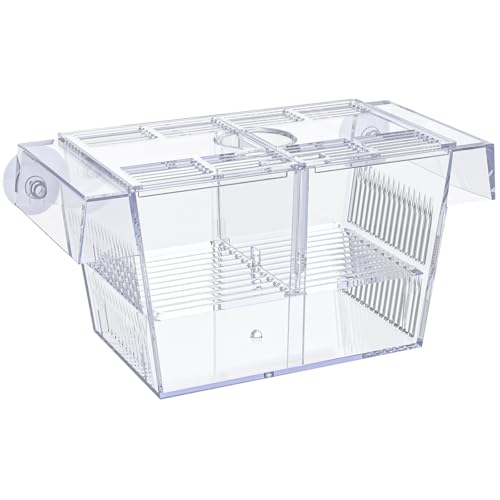
Best for improved fry protection in a slightly larger space, this medium box offers 5.3″ L x 3.5″ W x 3.9″ H interior and two removable separators that create up to three rooms. The bottom hatchery section keeps fry safe, while the other rooms can isolate aggressive or sick fish. It floats with a balancing panel and suction cups for secure placement. Choose this when you need more room without committing to a large setup. Caution: ensure the separators are properly sealed to avoid fry escape.
Boxtech Hatchery Incubator

Best for a clear, beginner-friendly breeding setup, Boxtech uses crystal-clear plastic for easy viewing. It’s designed for breeding, isolation, or general fry protection. The bottom chamber supports fry and new-born fish while enabling straightforward observation. The device is easy to clean and can be secured with suction cups. Use this if you want a straightforward, easy-to-see nursery with simple maintenance. Limitation: lacks the multi-chamber flexibility of some higher-end models.
Fluval Multi-Chamber Holding and Breeding Box

Best for larger setups, Fluval’s multi-chamber box offers up to three separate compartments to protect fry, isolate weak fish, or acclimate new arrivals. Attachments fit most aquariums up to 1 inch thick. An air pump and airline tubing are required separately, enabling reliable water circulation. This option is ideal for hobbyists who want robust, configurable nesting spaces. Caution: depends on compatible air system and may require additional components for full operation.
Penn-Plax Aqua Nursery and Hatchery

Best for natural separation in a dedicated breeding setup, this aquarium nursery gently coaxes fry away from the mother and prevents stagnation. It serves as a practical, separate transfer system from fry to a dedicated tank. It’s useful for breeders who want a natural flow from nursery to a separate rearing tank. Limitation: design assumes a secondary tank is available for fry transfer, which adds setup needs.
Buying Guide: Key Purchase Considerations
- Size and capacity: Match the nursery to your fry species and expected brood size. Smaller boxes are ideal for beta or baby shrimp; larger boxes support multiple fry and longer rearing periods.
- Floating vs. anchored: Floating options simplify placement in most tanks; suction-cup designs offer stable, adjustable positioning.
- Separation flexibility: Multi-chamber designs help isolate aggressive or sick fry while providing a dedicated nursery space for hatchlings.
- Water flow and filtration: Ensure the chosen unit allows adequate water exchange or supports a gentle flow to prevent stagnation without disturbing fry.
- Ease of cleaning: Removable dividers and simple construction reduce maintenance time and improve hygiene between uses.
- Material safety: Look for BPA-free, aquarium-safe plastics and clear visibility to monitor fry without stressing them.
- Compatibility: Check tank dimensions and whether the device requires additional equipment (air pump, tubing) for optimal operation.
FAQ
- What is the main purpose of a baby fish nursery tank?
– To protect fry from predators, reduce predation, and provide a controlled feeding and growth environment. - Do these devices require any extra equipment?
– Some models require suction cups or an air pump; check each listing for included components and needs. - Can I use a nursery tank for all fish species?
– Most are suitable for small fry like guppies and bettas, but space and water flow requirements vary by species. - How many fry can I rear in a single box?
– Capacity depends on box size and the species; avoid overcrowding to reduce stress and disease. - Is it necessary to transfer fry to a separate tank later?
– For many setups, yes; nurseries are interim spaces before juvenile fish move to permanent tanks.