For aquarium owners, automatic fish feeders offer dependable feeding while you’re away, holidays, or busy. The right model provides consistent portion control, moisture resistance, and flexible schedules to keep fish healthy. Below are five top entries that balance ease of use, reliability, and compatibility across small to large tanks.
| Product | Brand | Key Benefit |
|---|---|---|
| FISHNOSH Automatic Fish Feeder (Model-ML) | FISHNOSH | 3 daily feedings, stress-free operation |
| FISHNOSH Automatic Fish Feeder (Blue) | FISHNOSH | Up to 9 feedings per day, clear operating guide |
| Petbank Automatic Fish Feeder (USB Rechargeable) | Petbank | Moisture-proof, 16-grid capacity, LCD display |
| FREESEA Automatic Fish Feeder | FREESEA | Manual & automatic modes, adjustable portions |
| FISHNOSH Automatic Fish Feeder With Digital Thermometer | FISHNOSH | Thermometer alert, up to 9 portions daily |
These products illustrate a range of capabilities—from simple, user-friendly models to feature-rich options with moisture protection and smart scheduling. When selecting, consider tank size, food type, power source, and how many feeding times you need per day.
FISHNOSH Automatic Fish Feeder (Model-ML)

The FISHNOSH Model-ML is designed for stress-free feeding with a programmable daily schedule. It supports up to three feedings per day with one round per feeding, making it suitable for small tanks and larger aquariums alike. The user-friendly design focuses on simple operation and reliable dispensing, with a visible window and a spare part for easy refilling. Ideal for vacation use, it helps maintain a consistent feeding routine without complex programming.
FISHNOSH Automatic Fish Feeder (Blue)

This blue variant extends FISHNOSH’s core features with enhanced flexibility, offering up to nine feedings per day and three rounds per feeding. The setup is designed for straightforward operation, with clear instructions that accommodate busy households or vacation use. It supports customizable schedules to ensure fish receive meals even if owners are temporarily unavailable, while still being easy enough for families to manage.
Petbank Automatic Fish Feeder (LCD Display)

Petbank’s automatic feeder focuses on precise portioning and moisture resistance. It features 16 feeding grids, enabling up to 15 separate meals and supporting a variety of foods, including pellets and powders. Two installation methods accommodate different tank setups, and the fully sealed design minimizes moisture exposure, reducing clumping. An LCD display helps with easy programming and monitoring of daily schedules, making it suitable for more demanding feeding plans.
FREESEA Automatic Fish Feeder
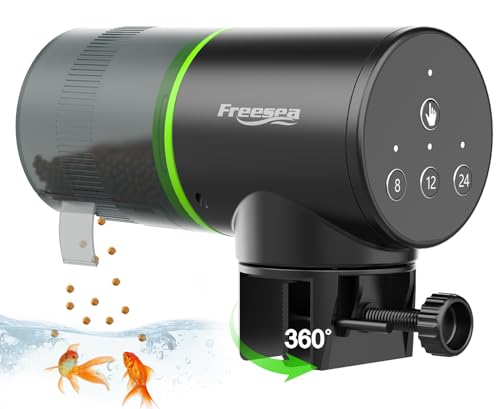
FREESEA offers a flexible option with both manual and automatic modes. Users can set feeding intervals at 8h, 12h, or 24h and adjust the amount by simply pressing a top button. The design emphasizes moisture resistance to prevent blockages, enabling compatibility with strips, powders, granules, and flakes. Manual feeding is easy at any time, making it useful for holidays and short trips where precise control is required alongside automated programming.
FISHNOSH Automatic Fish Feeder With Digital Thermometer
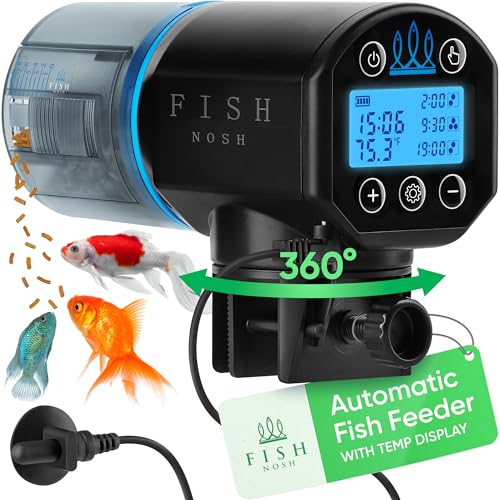
This model pairs automatic feeding with a built-in digital thermometer. It supports up to nine portions daily and allows three scheduled feedings per day. The combination of portion control and temperature monitoring helps maintain fish health, especially in varying room conditions. It is well-suited for vacation care and general monitoring without requiring constant manual intervention.
Petbank Automatic Fish Feeder (Rechargeable)

Petbank’s rechargeable model highlights USB charging and a long-lasting battery, reducing the need for frequent replacements. It supports up to four feeding times per day and allows manual feeding on demand. The device emphasizes moisture resistance and flexible mounting options, which helps accommodate a variety of aquarium configurations, including tanks with or without hoods.
Aoyar Automatic Fish Feeder

The Aoyar model emphasizes simple setup with three fixed feeding modes at 8, 12, or 24 hours, plus manual feeding. Its 200ml capacity helps cover mid-length vacations, and the moisture-proof lid reduces clumping. This option is designed for ease of use and reliability across various fish sizes and species, including small to medium tanks.
DXOPHIEX WiFi Fish Feeder

DXOPHIEX provides WiFi-enabled control, allowing remote feeding via a mobile app and the ability to schedule up to six meals per day with up to 12 portions per meal. The system supports flexible repeat patterns and provides feeding records for monitoring. It also includes dual power options (batteries and USB), ensuring operation during outages, and offers multiple mounting options to fit open tanks or hooded setups.
Buying Guide: Key Considerations For Choosing The Best Automatic Fish Feeder
When selecting an automatic fish feeder, consider the tank size, feeding frequency, and food type. A larger capacity helps with longer trips, while moisture-proof design prevents food clumping. Look for models with clear programming interfaces, either LCD displays or app-based controls, for easier setup and monitoring. Power options (battery and USB) provide resilience during outages, especially in remote locations. For mixed species or varying feeding needs, flexible schedules and portion controls help maintain water quality and reduce waste. Finally, factor in mounting options to ensure a secure fit on tanks with or without hoods, and verify compatibility with the type of aquafeed you use (pellets, flakes, or powders).
In practice, evaluate models that balance user-friendly operation and reliable dispensing, particularly for vacation use. A model with moisture resistance and an adjustable portion system helps prevent overfeeding and runoff, protecting water quality. For tech-savvy setups, WiFi-enabled feeders add convenience through remote management and feeding history tracking. Cross-check customer reviews for real-world notes on reliability, especially across different tank sizes and environmental conditions. This approach helps ensure a consistent feeding schedule while minimizing daily maintenance.