If you’re keeping a reef tank, an automatic water top-off (ATO) system is essential to maintain stable salinity and water levels. This article highlights five reliable options that help prevent salinity swings, reduce manual maintenance, and protect your corals and fish. Each pick suits different setups—from nano tanks to larger reef displays—and includes practical considerations to help you choose the right fit for your system.
| Product | Brand | Best For | Notes |
|---|---|---|---|
| Useek Auto Top Off for Saltwater Aquarium Water ATO System | Useek | Small to mid-size reef tanks; aesthetic setups | Compact 0.7 inch diameter; QST real-time protection |
| Auto Top Off System ATO Saltwater Aquarium (Blue) | ATET | Smaller displays and nano reefs | Dual anti-overflow; real-time level protection |
| ATO Auto Top Off System for Aquarium (NG ONE) | Miofis | Stable water levels with adaptive learning | Triple safety; adaptive intelligence |
| Auto Top Off System for Saltwater Reef Tank (NG11) | LAZYBONE AQUA | Reef and mixed tanks seeking integrated design | Integrated controller in probe; AI features |
| Useek Auto Top Off for Saltwater Aquarium Water ATO System (Green) | Useek | Same as blue variant; visual choice | Same core tech; compact design |
Useek Auto Top Off for Saltwater Aquarium Water ATO System – Blue

Best for small to mid-size reef displays that need a subtle, space-saving ATO. This unit uses real-time protection with QST to calculate ideal fill times and visual alerts, stopping the pump if refilling takes too long. It helps maintain stable salinity by preventing overfilling and dry running, making it suitable for nano to small-to-medium tanks. A potential limitation is that space is needed for the reservoir and line routing in rimmed or rimless setups.
Auto Top Off System ATO Saltwater Aquarium (Blue)
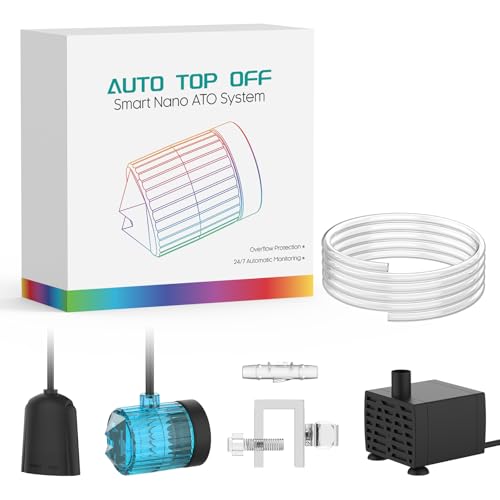
Best for reef setups that want continuous, worry-free top-offs with dual anti-overflow and real-time protection. Its QST Smart Technology maintains salinity by stabilizing water volume and supports both home and away scenarios. Choose this if you prefer a compact device with strong overflow safeguards; avoid if you need a larger reservoir or integration with a complex external controller.
ATO Auto Top Off System with Intelligent Adaptive Learning (NG ONE)

Best for reef tanks that benefit from adaptive learning and reduced pump cycles. The system analyzes evaporation patterns to cut pump activity by up to 60%, extending pump life while stabilizing water quality. It includes triple safety protection to guard against overflow, dry runs, and siphoning issues. Consider this option if you want long-term maintenance ease; be aware that more advanced functionality may require initial setup time.
Auto Top Off System for Saltwater Reef Tank (NG11)

Better for reef tanks seeking a compact, leak-proof probe integrated with the controller. Features include a seamless, dual-seal probe to reduce leak risk and AI-driven refill timing. Best for tanks where space is limited and leak protection is a priority; avoid if you require external monitoring through a separate controller interface.
Auto Top Off System for Saltwater Aquarium (Purple)

Best for owners who like to match equipment colors with their tank aesthetics while keeping salinity stable. This unit uses QST Smart Technology with dual anti-overflow, providing round-the-clock protection for reef and fish tanks. If you have a heavily populated tank or sensitive corals, this option offers robust safety features; consider its display and controller integration needs when choosing placement.
MagTool Aquarium Auto Top Off System (Duetto V2026)

Best for users seeking a compact, upgraded ATO with dual optical sensors and a built-in external controller. The Duetto system offers one-touch pause for maintenance, LED indicators, and a buzzer to alert issues. It’s well-suited to small to mid-sized reef setups that value easy access to control and explicit alerts; avoid if you prefer a fully integrated external control unit with separate sensors.
Buying Guide
Key considerations when choosing an auto water change/ATO system for a reef tank include tank size, space for installation, and desired level of automation. The following questions help identify the right fit.
- What tank size and shape will the ATO fit best? Nano tanks require nano-diameter sensors; larger displays may need higher capacity reservoirs.
- Do you prefer integrated controllers or external monitoring? Integrated units reduce clutter, while external controllers can offer broader system integration.
- Which safety features matter most? Look for dual anti-overflow, dry-run protection, and anti-siphon design to prevent accidents.
- What evaporation rate do you expect? Adaptive learning models save pump life by adjusting refill timing to your evaporation pattern.
- Is leak protection or sensor durability a priority? Probes with seamless seals and corrosion resistance reduce maintenance and failure risk.
- How important is space efficiency? Ultra-compact ATO units fit rimmed and rimless tanks without crowding the display.
FAQ
- What is an ATO system and how does it help reef tanks? An ATO maintains stable water level and salinity by automatically replenishing evaporated water, reducing manual refills.
- Can ATO systems prevent salinity swings? Yes, by keeping water volume consistent and minimizing evaporation-related fluctuations.
- Are there risks with ATO systems? Common risks include overfilling, leaks, and sensor failure; choose models with dual protections and leak-proof probes.
- Which ATO features are most important for corals? Real-time protection, anti-overflow, and adaptive refill timing help maintain stable water parameters critical for corals.
- What maintenance is required for ATO systems? Periodic sensor cleaning, checking seals, and verifying reservoir connections help sustain reliability.
- Do ATOs work with large reef tanks? Yes, but you may need higher capacity units or multiple sensors for broad coverage.