Answering your search for an effective aquarium water cooling system, these five options are well-suited for different setups. They range from compact evaporative fans to full chiller units, helping reduce water temps for axolotls, jellyfish, corals, and planted tanks. This guide highlights who each product is best for, why it was selected, and practical cautions to consider before purchase.
| Product | Best For |
|---|---|
| AQUASMITH Aquarium Chiller Fan | Best for small to mid-sized tanks needing quiet, affordable cooling with precise temperature control |
| BAOSHISHAN 1/10 HP Aquarium Chiller | Best for mid-range tanks up to about 42 gallons; you want a ready-to-install kit |
| PAIZOO Aquarium Chiller Fan | Best for budget-conscious setups needing adjustable speed and quiet operation |
| AKSDSGA 42Gal Aquarium Chiller | Best for smaller to medium planted or axolotl tanks needing stable digital control |
| VEVOR Aquarium Chiller 110 Gallon | Best for larger tanks requiring high capacity and robust cooling |
AQUASMITH Aquarium Chiller Fan

Best for: Aquariums needing steady, evaporative cooling with an independent temperature display. The dual fans and 3°F-7°F cooling range help maintain stable water temps for axolotls or mixed tanks. The independent LED display and temperature probe enable intelligent stabilization. Effective in 59°F–93°F set range, it suits environments with warm summers and mid-range tanks.
Why selected: It provides a true temperature-control system at a lower cost than traditional chillers, delivering visible cooling effects without excessive noise. The 30° adjustable airflow and 360° rotation adapt to various tank shapes.
Caution: Performance depends on ambient humidity and tank size. In very large volumes or extreme heat, you may need additional cooling support.
BAOSHISHAN 1/10 HP Aquarium Chiller

Best for: Medium-sized tanks up to roughly 42 gallons needing robust cooling with a complete kit. It lowers water by about 10°F and targets stable 68–78°F, which is helpful for axolotls and planted tanks in warm rooms.
Why selected: It includes upgraded pump, tubing, and clamps, reducing installation hassles. It emphasizes quiet operation at 45–50 dB at a meter, making it suitable for homes and offices.
Caution: Cooling effectiveness varies with ambient temperatures and tank load; for very hot rooms, confirm you’re within its cooling range and consider a backup method.
PAIZOO Aquarium Chiller Fan

Best for: Budget-conscious hobbyists seeking a compact, quiet cooling option with variable speeds. It uses dual turbo fans and a copper motor to keep noise low while improving airflow to the water surface.
Why selected: Three adjustable modes let you tailor cooling to day/night cycles or seasonal needs. It is described as sturdy with durable ABS construction, making it a practical choice for frequent use.
Caution: As a fan-based cooler, its performance may be less predictable in extremely hot environments or very large tanks; pairing with other cooling strategies can help.
AKSDSGA 42Gal Aquarium Chiller

Best for: Axolotl and planted tanks up to about 32–42 gallons requiring precise digital temperature control with a wide 32°F–122°F range. The titanium evaporator adds durability for enduring use.
Why selected: Digital temperature probe and one-touch start enable easy, real-time monitoring and simple operation. The unit is designed for reliable performance with a sturdy housing.
Caution: The set temperature might require fine-tuning to match room conditions; ensure the unit size fits your cabinet or stand space to avoid clearance issues.
VEVOR Aquarium Chiller 110 Gallon
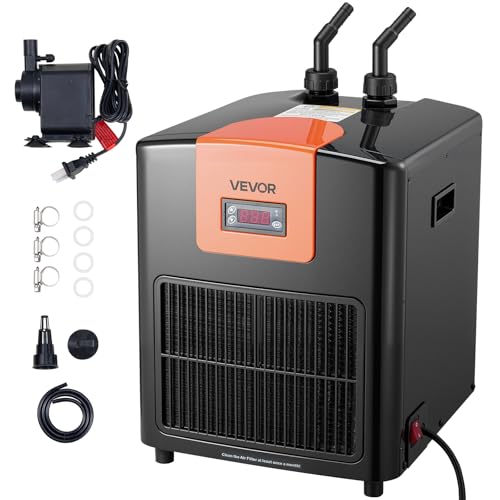
Best for: Larger tanks up to about 110 gallons needing robust cooling performance and high water flow. It features a high-capacity compressor and a large cooling capacity.
Why selected: Aimed at bigger setups, it offers a substantial 1/3 HP option with a larger water circulation rate (up to 1200 L/H), which helps stabilize temperatures in more expansive aquariums.
Caution: Higher power and size require adequate space and electrical capacity. Check the setup’s compatibility with your tank’s plumbing and lid design.
Buying Guide: Key Considerations For Aquarium Cooling Systems
What size is your tank and how much cooling do you need? Choose a unit that matches your tank volume and expected temperature drop. Smaller tanks often do well with evaporative fans, while larger or more sensitive environments may require a dedicated chiller.
Do you need a built-in temperature readout? Digital controllers and real-time probes help stabilize water temperatures precisely and reduce fluctuations that stress aquatic life.
What noise level is acceptable? If the living space is near bedrooms or offices, prioritize quiet models (lower dB) and consider the room’s ambient temperature when evaluating performance.
Is installation complexity a concern? Ready-to-install kits with pumps, hoses, and clamps reduce setup time and potential leaks. Check whether the kit includes all necessary components for your tank size.
What is your budget and long-term operating cost? Evaporative cooling fans are generally cheaper to run than full chillers, but they may require careful placement and adequate humidity. Full chillers provide powerful cooling but use more energy.
What is the tank type and occupants? Axolotls, corals, and jellyfish have specific temperature ranges. Ensure the chosen device can maintain stable temps within the species’ comfort zone and consider backup cooling if summers are extreme.
Frequently Asked Questions
- Do aquarium cooling fans work for all tank sizes? They work best for small to mid-sized tanks and are less effective for very large volumes. For larger tanks, consider a dedicated chiller or multiple cooling strategies.
- Can cooling systems harm my plants or fish? If temperatures drop too quickly or fall outside species’ ranges, there can be stress. Use gradual setpoint changes and monitor responses in the tank.
- Is an all-in-one kit better than separate components? All-in-one kits simplify installation and ensure compatible parts, but independent components may offer more customization for complex setups.
- What maintenance is required? Regular inspections for leaks, cleaning of fans, and checking temperature probes help maintain reliable cooling performance.
- When should I use a back-up cooling method? In very hot climates or oversized tanks, plan for supplemental cooling during peak heat to prevent temperature spikes.
- How do I verify cooling effectiveness? Regularly measure water temperature at multiple points in the tank and compare with the setpoint to ensure even cooling.