Yes—these aquarium LED dimmer timers automate light cycles and brightness to suit fish, plants, and reef systems. This guide highlights five top options, detailing who each product is best for and why. It’s ideal for hobbyists seeking consistent day-night rhythms, sunrise/sunset effects, and adjustable brightness without manual on/off fiddling.
Buyer snapshot table
| Product | ||||
|---|---|---|---|---|
| NICREW Aquarium Light Timer & Dimmer | Beginners and mid-range setups | 10–100% brightness | Amazon | |
| DaToo Aquarium Light Timer & Dimmer | Flexible timing with broad dimming | 10–100% brightness | Amazon | |
| Lominie Programmable WiFi Controller 2.0 | Smart/remote control lovers | WiFi-enabled, 0–100% | Amazon | |
| WAGHAVEN Aquarium Light Timer & Dimmer | Versatile duty cycles and multi-voltage | 5V/12V/24V DC, up to 48W | Amazon | |
| DIIOOMIEEU Aquarium Light Timer | Bright, nature-simulated cycles | 5V–30V | Amazon |
NICREW Aquarium Light Timer & Dimmer

The NICREW timer supports sunrise and sunset simulations and offers three default lighting modes. It provides manual brightness control from 10% to 100%, enabling straightforward fine-tuning for planted tanks or reef setups. This unit is best for beginners and intermediate hobbyists who want reliable automation without extensive configuration.
Who it’s best for: Aquarists seeking an easy-to-program timer with adjustable brightness and natural-looking transitions. Why chosen: It combines simple operation with practical sunrise/sunset effects to promote healthy daylight cycles for fish and plants.
Caution: The device’s dimming range starts at 10%, so very low-light needs may require a different controller or additional accessories.
DaToo Aquarium Light Timer & Dimmer

The DaToo timer includes both time scheduling and brightness adjustment with six levels (10%–100%). It offers four, eight, or twelve-hour timing options via quick-tap controls, making it suitable for hobbyists needing more precise day-night cycles and smoother transitions for varied tank inhabitants.
Who it’s best for: Aquarists seeking flexible daily schedules with clear brightness steps. Why chosen: It’s a strong pick for naturalistic lighting while maintaining straightforward operation for routine maintenance.
Caution: The device may require careful calibration to synchronize with plant growth cycles in densely planted tanks.
Lominie Programmable WiFi Controller 2.0
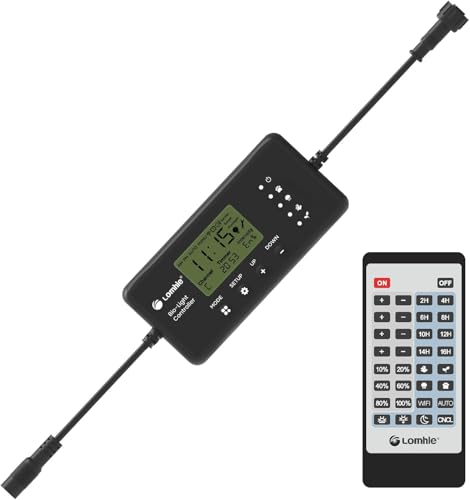
The Lominie controller adds WiFi connectivity, enabling remote programming of a ramp timer and dimmer. It’s designed for users who want to adjust lighting from a mobile device or integrate with smart-home routines. This makes it better for tech-forward aquarists with compatible lighting setups.
Who it’s best for: Remote-control enthusiasts and those integrating aquarium lighting with home automation. Why chosen: It provides convenient control beyond a physical interface, helpful for variable schedules or vacation coverage.
Caution: WiFi-based control can introduce dependency on network stability; local operation may be slower if the network experiences congestion.
WAGHAVEN Aquarium Light Timer & Dimmer

The WAGHAVEN timer supports 1–24 hour programmable cycles and multi-voltage compatibility (5V/12V/24V), up to 48W. It’s designed for LED strips and general aquarium lighting, offering reliable automation with flexible power options for mixed hardware configurations.
Who it’s best for: Tank setups using varied LED strips or pumps that require synchronized lighting across devices. Why chosen: Its wide voltage compatibility and clear programmable cycles simplify multi-device management.
Caution: Performance may vary with very high-power LED fixtures; verify total wattage aligns with the device’s ratings before use.
DIIOOMIEEU Aquarium Light Timer

The DIIOOMIEEU timer combines a 24-hour program with sunset simulation, covering 5V–30V lighting. It emphasizes a natural day-night rhythm suitable for small to medium aquariums, especially where a consistent sunset cue is valued by inhabitants.
Who it’s best for: Aquarists needing a straightforward 24-hour program with sunset simulation. Why chosen: Its calm transition and compatibility with common low- to mid-voltage LEDs support stable daily cycles.
Caution: Ensure voltage compatibility with existing fixtures to avoid dimming irregularities or device overloads.
Buying Guide: Key Considerations for Aquarium LED Dimmer Timers
- Programming granularity: Choose a device offering 24-hour cycles or multiple preset modes if you need precise day-night transitions.
- Brightness control: Look for a dimming range that covers your tank’s needs (10%–100% is typical). Some models support ramping for gradual changes.
- Power and voltage compatibility: Verify voltage (5V/12V/24V) and wattage limits align with your lighting fixtures to prevent overloading.
- Remote and automation features: WiFi-enabled controllers enable smartphone scheduling, but require network stability. Basic timers should work offline.
- Compatibility with plants and livestock: For planted tanks, consistent sunrise/sunset and gradual dimming help reduce stress and mimic natural environments.
- Ease of use and installation: Favor devices with intuitive controls or clear app interfaces if you value quick setup and ongoing adjustments.
- Reliability and durability: Durable housings and stable electronics are important for long-term aquarium use, especially in humid or salt environments.
Frequently Asked Questions
- What is the main benefit of an aquarium LED dimmer timer?
– It automates light cycles, promoting stable day-night rhythms and reducing stress for fish and plants. - Can I control these timers remotely?
– Some models offer WiFi or app-based control, while others operate offline with physical buttons. - What brightness range should I look for?
– A typical range is 10% to 100%, enough to simulate sunrise/sunset and support plant growth. - Do these timers work with all LED fixtures?
– Most support common low to mid-voltage LED strips; always confirm voltage and wattage compatibility. - Is a sunrise/sunset feature necessary?
– It helps mimic natural environments and can reduce stress for aquatic life; not strictly required but beneficial for many setups. - What if I have multiple devices?
– Choose a timer with multi-device compatibility or consider a WiFi controller to synchronize lighting across fixtures.