Looking for an aquarium heater with a clear digital display? This guide highlights five reliable options, explains who each is best for, and covers key decision points to help you pick with confidence. Ideal buyers include beginners needing simple controls, hobbyists managing mixed-species tanks, and owners seeking precise temperature monitoring for sensitive livestock.
Summary of chosen products
| Product | Best For | Wattage / Range | Tank Size Range | Display Type |
|---|---|---|---|---|
| HiTauing Aquarium Heater, 200W | Medium tanks, beginner-friendly | 200W; 20–40 gal | 20–40 gallons | LED Digital Display |
| hygger Small Aquarium Betta Heater, 10W | Very small tanks; bettas | 10W; 59–93°F | 1–5 gallons | Digital Display |
| HiTauing Aquarium Heater, 300W | Larger planted or mixed tanks | 300W; 40–75 gal | 40–75 gallons | LED Digital Display |
| hygger ECO Precise Aquarium Submersible Heater, 200W | Stable control; energy-conscious | 200W; 59–93°F | 20–40 gallons | Digital Display |
| Aquarium Heater 300W Upgraded, AIWEK | Saltwater and freshwater; versatile | 300W; 68–93°F | 20–60 gallons | Digital LED Display |
HiTauing 200W Aquarium Heater With LED Display
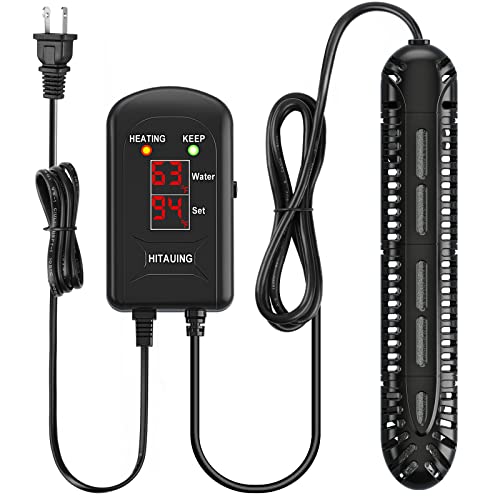
Best for: Medium tanks that require quick heating and straightforward controls. The 200W heater is designed for 20–40 gallon setups and includes a clear LED display for real-time temperature readouts. It comes with 2 suction cups and a 5.9-foot power cord, offering flexible placement. Caution: Ensure water level is maintained to prevent overheat warnings. This unit uses ABS with quartz glass and nickel-chromium heating wire for durability.
Why selected
- LED digital readout provides direct temperature visibility.
- Dual-sensor protection with automatic shutdown at 94°F (34°C) and off-water warning to prevent damage.
- Suitable for both freshwater and saltwater environments.
hygger 10W Betta Heater With Digital Display

Best for: Very small tanks and betta setups where space is at a premium. This 10W heater is designed for 1–5 gallon tanks, with a 59–93°F range and a digital display for quick checks. It uses explosion-resistant quartz glass and a protective ABS shell. Caution: It’s best used in shallow, secure setups; very small tanks are more sensitive to temperature fluctuations.
HiTauing 300W Submersible Heater With Digital Display
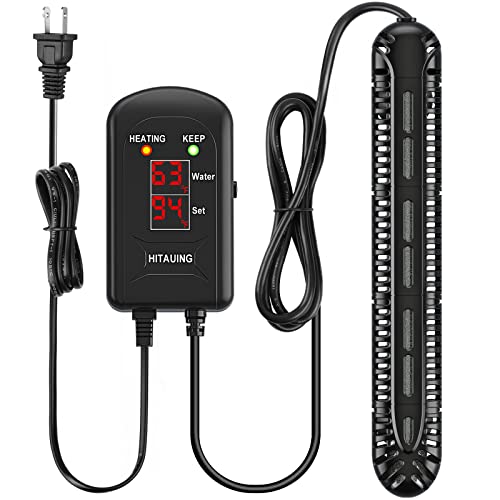
Best for: Larger 40–75 gallon tanks or mixed tropical setups. The 300W heater provides rapid heating and a long cord (8.2 ft) for flexible placement. It features an explosion-proof quartz tube, a durable ABS shell, and two safety protections: over-temp warning and off-water warning. Caution: Larger tanks may require confirmation of continuous circulation to prevent hotspots.
hygger ECO 200W Digital Submersible Heater
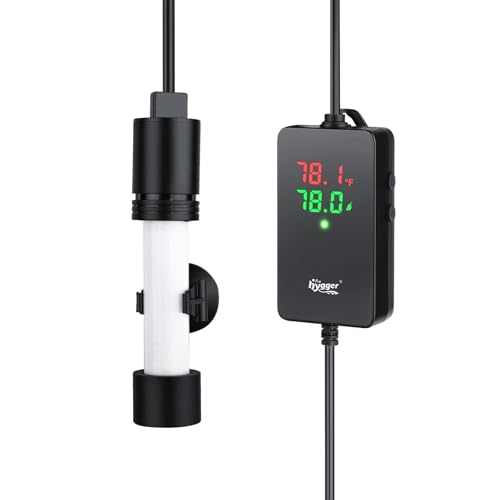
Best for: Tanks requiring precise and eco-conscious temperature control. This 200W model features smart heating with real-time temp probes and an ECO mode, plus a 0.1°F precision display. It is designed for 20–40 gallon tanks. Caution: Like other heaters, avoid strong water flow directly over the element to maintain even heating.
AIWEK 300W Upgraded Heater With Digital LED Display

Best for: Versatile saltwater or freshwater setups in the 20–60 gallon range. The AIWEK 300W heater includes a digital LED display for straightforward temp monitoring and an automatic shut-off when water is low or absent. It uses a quartz glass tube with a durable ABS shell for added safety. Caution: Ensure the heater is fully submerged before powering on to prevent false readings.
Buying Guide
- Wattage and tank size: Match the heater wattage to your tank volume. Typical ranges are 20–60 gallons per 100–300W, but always follow the manufacturer’s guidance for your specific model. For larger or heavily planted tanks, lean toward higher wattage with robust heat distribution.
- Display clarity and controls: A clear digital display helps track real-time water temperature and target settings. Look for models with intuitive external controllers and precise increments (0.5°F or 0.5°C).
- Safety features: Prioritize models with at least over-temperature protection, automatic shut-off when water level is low, and a durable, explosion-proof heating element. Double-check the warranty and material quality (quartz glass, ABS housing).
- Submersion and placement: Submersible heaters should be mounted away from water splashes and inserted fully into the water column. Suction cups should firmly anchor the unit to avoid shifting heat zones.
- Temperature control ranges: Choose a heater with a range compatible with your livestock. Sensitive species may require tighter control (e.g., 59–93°F or 17–34°C).
- Power cord length and accessibility: Longer cords improve placement flexibility but avoid cords near tangles or heat sources. Check if the unit requires a grounded outlet for safety.
- Materials and durability: Quartz glass and high-temperature-resistant shells protect against impacts and heat, particularly in community tanks with active inhabitants.
Frequently asked questions
- Do all digital-display heaters work in saltwater? Yes, most listed models are designed for both freshwater and saltwater, but always verify compatibility in the product specs.
- How precise are these digital displays? Many offer temperature readings with 0.5°F or 0.1°F precision, aiding stable environments for sensitive species.
- Is a larger wattage always better? Not necessarily. Choose wattage based on tank size, heat loss, and ambient room temperature. Overpowered heaters can cause overheating if not properly regulated.
- What safety features should I expect? Look for automatic shut-off when water is low or the heater head is exposed, plus overheating protection and a durable housing.
- Can I use multiple heaters in one tank? Yes, but ensure they are calibrated together and placed to avoid temperature gradients. Consider a controller that coordinates multiple units.
- What maintenance is required? Regularly check the suction cups, inspect the cord for wear, and verify the display accuracy during routine tank checks.