Keeping turtle habitats at the right warmth is essential for health, metabolism, and overall well-being. The following aquarium heaters are designed to deliver stable temperatures, come with safety features, and work well in both freshwater and marine environments. Below you’ll find five vetted options that balance durability, ease of use, and reliable temperature control for turtle tanks.
| Product | Tank Size Fit | Key Benefit |
|---|---|---|
| HANLESHUKA Submersible Heater (100W/200W/300W/500W) | 10–70+ gallons | Dual temperature system, durable build |
| ZazaFi 300W Aquarium Heater | 40–75 gallons | External display, quick heating |
| Orlushy 300W Submersible Heater | 40–55 gallons | Explosion-proof quartz glass |
| HiTauing 300W Submersible Heater | 40–75 gallons | Intelligent sensor, overheating protection |
| HITOP 200W PTC Heater | 25–60 gallons | PTC ceramic heating, external controller |
The following five products are highlighted for their balance of safety, compatibility with turtle habitats, and straightforward temperature control. Each product section follows with a brief overview, features, and how it supports a stable turtle environment.
HANLESHUKA Submersible Heater 100W–500W

This explosion-proof quartz glass heater is designed for durability and safety, featuring a thick high-temperature-resistant ABS shell and ultra-fast nickel-chromium wires. It supports multiple power options (100W, 200W, 300W, 500W) suitable for a range of turtle tanks from roughly 10 to 70+ gallons. Silicon carbide heat conduction provides rapid, even heating to stabilize aquarium temperature. The dual temperature controller lets you switch between Fahrenheit and Celsius, making it accessible for beginners and seasoned aquarists alike.
ZazaFi 300W Aquarium Heater

The 300W model is designed for 40–75 gallon tanks with a robust nickel-chromium heating wire and silicon carbide conduction for faster heating. It features an external digital display (two-digit LED) for temperature readout in both Fahrenheit and Celsius, and a wide temperature range (63–94°F / 17–34°C). The heater body uses explosion-proof quartz glass and a durable ABS shell to protect aquatic inhabitants, including turtles, from rapid temperature changes and scalding.
Orlushy Submersible Heater 300W
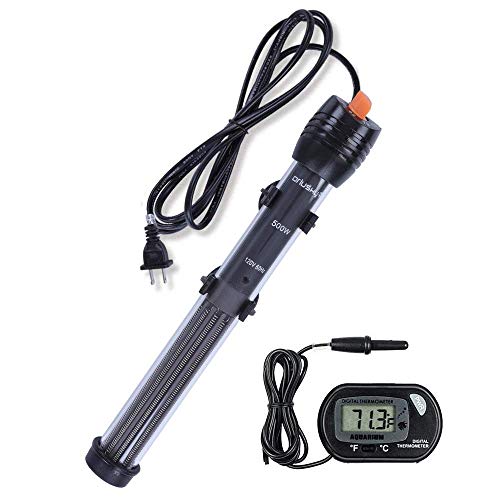
The Orlushy 300W heater is suitable for 40–55 gallon tanks and includes two suction cups for secure mounting. It uses a 2mm-thick quartz glass tube and a high-temperature resistant nickel-chromium heating wire, with silicon carbide conduction for efficient heating. The device is designed to work in both freshwater and saltwater environments, and the additional protective shell helps guard against accidental contact with hot surfaces, making it a practical choice for turtle habitats.
HiTauing 300W Submersible Heater
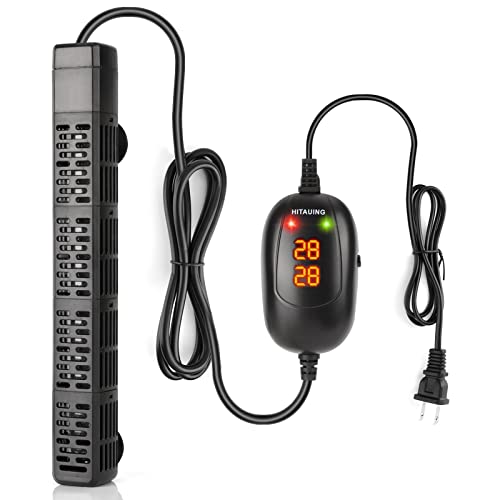
The HiTauing 300W heater features a rapid heating capability with a Fahrenheit/Celsius dual display and a temperature range of 63–94°F (17–34°C). It includes an intelligent water sensor that automatically stops heating if the heater is out of water or if the temperature exceeds the set limit, providing an important safety layer for turtle tanks. An explosion-proof quartz glass body and a robust ABS shell reduce the risk of injury to aquatic life and to tank residents during adjustments or maintenance.
HITOP 200W PTC Heater

The HITOP 200W PTC heater uses ceramic PTC heating elements for safety and longevity, with a digital external controller that displays both set and live temperatures. Suitable for turtle tanks in the 25–60 gallon range, it supports both freshwater and saltwater setups. The external controller simplifies temperature adjustments and conversion between Celsius and Fahrenheit, helping ensure turtles stay in their optimal comfort zone without frequent monitoring.
Buying Guide: Key Considerations For Turtle Tanks
- Tank size compatibility: Select a heater with the appropriate wattage for your tank capacity. Larger tanks require higher wattage for stable temperatures, while smaller tanks risk overheating if underpowered.
- Stable temperature range: Look for heaters with tight temperature control and a clear digital display. A typical safe range for many turtles is around 75–85°F (24–29°C), though species-specific needs vary.
- Safety features: Prioritize models with automatic shut-off when water levels are low or when temperatures exceed the set point. Explosion-proof quartz glass and protective housings help prevent injuries to inhabitants.
- Water compatibility: Ensure the heater is suitable for both freshwater and saltwater if you keep diverse species. Some models emphasize quick heating, while others focus on long-term durability.
- External vs. internal controllers: External controllers are convenient for visibility and adjustment without opening the tank. Internal controllers can be more compact but may require direct access for tuning.
- Maintenance and durability: A robust shell, quality glass, and reliable heating elements extend heater life in turtle habitats, where warm water is critical to health and digestion.
- Placement and visibility: Submersible heaters should be mounted according to the manufacturer’s guidelines to ensure even heating and avoid dead spots in the tank.
- Temperature stability strategies: Combine a heater with a reliable thermostat and, if possible, a separate thermometer placed away from the heater to verify actual water temperature.
In selecting the best aquarium heater for turtles, prioritize models that offer stable control, safety shutoffs, and durable construction suited to both freshwater and semi-aquatic habitats. The options above provide a spectrum of wattages, from compact 50–100W units for small tanks to high-capacity 300W models for larger turtle enclosures, all designed to minimize sudden temperature swings.