Searching for the right heater for your aquarium? This guide highlights reliable submersible options that fit diverse tank sizes and climates. Each product is chosen for ease of use, consistent temperatures, and clear indicators. Best for beginners who want plug-and-play reliability, betta keepers needing compact units, and hobbyists upgrading to steadier control.
Summary table of selected products
| Product | Best For | Wattage | Notes |
|---|---|---|---|
| AQUANEAT 50W | Medium tanks (5–15 gallons) | 50W | Top-access dial, easy temp range 65–89°F |
| AQUANEAT 25W Small Betta | Small tanks (3–5.5 gallons) | 25W | Preset 78°F, compact, quick checks |
| Orlushy 25W Small | Very small tanks (1–6 gallons) | 25W | Compact, easy concealment |
| hygger 10–50–100–…W | Small to mid tanks (up to 5–26 gallons) | 10/25/50/100 | Quartz glass, overheating protection |
| HiTauing 50–500W | Larger setups (40–75 gallons) | 300W option shown | Intelligent temp control, safety features |
AQUANEAT Aquarium Heater, 50W for 5–15 Gallon Tanks

The 50W AQUANEAT heater is designed for medium-small aquariums, with a 6.75-inch body and a 3.6-foot power cord. It supports a temperature range from 65°F to 89°F and features a top-access adjustable dial for quick changes. A red indicator light confirms when the target temperature is reached, and the heater maintains a steady temperature thereafter.
Best for: hobbyists with 5–15 gallon tanks who want a compact, straightforward heater with visible status. Better for freshwater setups, though it works in marine environments as well. Choose this if space is limited and you need a simple dial control.
Caution: Ensure the heater is fully submerged and sized appropriately for the tank to avoid underheating or overheating. The unit is not designed to heat large volumes beyond its 50W rating.
AQUANEAT 25W Small Betta Tank Heater

Designed for compact tanks, this 25W unit fits 3–5.5 gallon setups. It ships preset to 78°F, a temperature suitable for Bettas and many tropical fish. A simple plug-and-play design means minimal setup, and an indicator light shifts from red (heating) to green (holding).
Best for: Betta owners or small community tanks where space is at a premium. Better for those who prefer a preset temperature with quick daily checks. Avoid if your tank requires higher heat or larger volume than 5 gallons.
Limitation: The preset 78°F may not match every species’ preferred range; you may need to monitor and adjust if your fish require different temps.
Orlushy Submersible 25W Heater With Thermometer
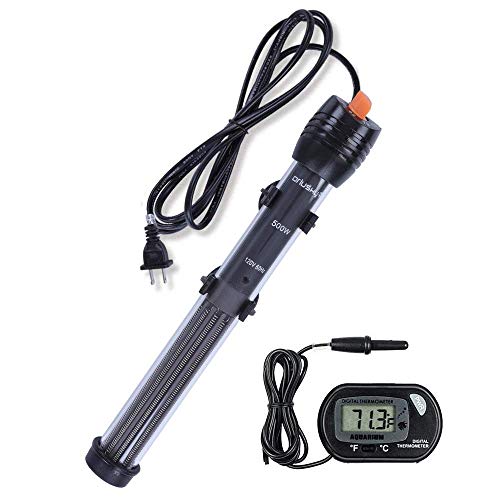
Orlushy’s 25W model covers 1–6 gallons, with a separate thermometer for real-time monitoring. It uses a stair-step heating approach, turning red while heating and green once the set temperature is reached. Built with heat-resistant ABS and a nickel-chromium heating wire, it aims to be durable and quick to respond.
Best for: Small tanks where constant monitoring is preferred and space is tight. Better for users who want a visible thermometer and straightforward operation. Limitations include a smaller heater head that may require precise placement for even heating.
Orlushy 25W Small Submersible Heater

This 25W unit targets 1–6 gallon tanks and has a compact 4.7-inch form factor. It emphasizes automatic constant temperature with preset 78°F, with red-green indicators to show heating and holding states. The outer shell is heat-resistant ABS, and the heating rod uses nickel-chromium wire for faster warming.
Best for: Small, unobtrusive setups where a constant 78°F is sufficient for the inhabitants. Better for those who value a discreet heater that blends into the tank. Caution: for tanks at the very low end of capacity, ensure the placement allows even heat distribution.
HiTauing 300W Submersible Heater for 40–75 Gallons

This 300W model is designed for larger tanks, covering 40–75 gallons. It features a robust quartz glass tube and a high-temperature ABS shell for safety and concealment. Temperature range spans 63–94°F, with a dual-control system and an intelligent water sensor that stops heating if the heater is out of the water or exceeds the set temperature.
Best for: Large freshwater or saltwater setups needing rapid heating and strong temperature control. Better for confident hobbyists who want safety features like automatic power-off if water is low. Limitation: higher wattage may be more than needed for smaller tanks and could require careful placement to avoid overheating in a mixed-species environment.
Orlushy 25W Small Submersible Heater (Alternative)
Note: This alternative Orlushy model also targets small tanks with the same 25W rating and a 78°F preset. It emphasizes durability and straightforward operation, with similar color indicators and ABS housing. Choose this if you prefer the Orlushy brand consistency in a compact heater.
Buying Guide: Key Purchase Considerations
- Tank size and wattage: Match heater wattage to your tank volume. Underpowered heaters struggle to maintain stable temperatures, while overpowered units may cause abrupt changes.
- Temperature range and controls: Consider if you want preset temperatures, dial adjustments, or digital displays. Easy visibility of current temp helps with daily checks.
- Submersion and placement: Ensure the heater is fully submerged according to its design. Placement affects heat distribution and safety for sensitive species.
- Safety features: Look for automatic shutoff if water level drops, and out-of-water sensors to prevent overheating. Explosion-proof or quartz glass builds add durability for long-term use.
- Monitoring aids: Extra thermometers or built-in displays improve monitoring consistency, especially in mixed-species tanks.
- Material quality: ABS housings and nickel-chromium heating elements are common for durability and efficient heat transfer.
FAQ
- What size heater do I need for a 10-gallon tank? A medium wattage heater, around 50W, is commonly suitable for 10 gallons, but verify species requirements and ambient room temperature.
- Can I use a 25W heater in a 5-gallon tank? Yes, but ensure the chosen model matches the species’ temperature needs and monitor regularly for stability.
- Are preset temperature heaters less flexible? Preset heaters are convenient, but you may need to adjust if your fish require a different range.
- Is an external thermometer necessary? An additional thermometer is helpful to confirm real-time water temps and to catch any drift from the heater’s display.
- Do these heaters work for saltwater tanks? Most submersible heaters are suitable for both freshwater and saltwater; always follow manufacturer guidelines and monitor salinity impact on heat transfer.
- What safety features matter most? Look for auto shutoff when out of water, overheating protection, and a robust outer shell to prevent heat exposure and injuries.