Answering the question for layout-minded aquarium hobbyists and home automation fans: a digital programmable timer designed for outlets is ideal for automating aquarium lights, pumps, and heaters. These five selections cover a range of outlet counts, daily schedules, and backup options to fit small tanks through larger setups. Best for beginners are single-outlet timers with simple controls; best for multi-device setups are timers with multiple timed outlets and memory; best for silent operation are models with quiet electronics and night-friendly displays.
| Product | Best For | Key Benefit |
|---|---|---|
| DEWENWILS 24 Hour Programmable Digital Timer Outlet (Single Outlet) | Small aquarium setups | Compact, memory backup, silent operation |
| BN-LINK 8 Outlet Surge Protector with 7-Day Digital Timer | Multi-device control | Eight outlets with four on timed control and four always on |
| DEWENWILS 24 Hour Programmable Digital Timer Outlet (Two Pack) | Two-device automation | Two timers in one pack for two devices or two tanks |
| Fosmon 24 Hour Programmable Digital Timer Outlet (Two Pack) | User-friendly setup | Large LCD, backup battery, simple 24-hour schedule |
| DEWENWILS 24 Hour Programmable Digital Timer Outlet (Two Pack, Dual Outlets) | Dual outlet automation | Two grounded outlets, daily programs, random security mode |
DEWENWILS 24 Hour Programmable Digital Timer Outlet

Best for: small aquariums with a single device such as a lighting fixture or small pump. This timer offers 3 daily repeat programs and a memory backup to keep settings after a power outage. The compact design avoids blocking other outlets, and a quiet operation is suitable for bedrooms or living spaces near the tank. A potential limitation is that only one outlet is controlled, so you’ll need additional timers for other devices.
BN-LINK 8 Outlet Surge Protector with 7-Day Digital Timer

Best for: larger or multi-device tank setups where there are several lights, heaters, or small fans. This surge protector includes four timed outlets and four always-on outlets with a shared timer control, plus short on/off cycles as brief as one minute. A caveat is that all timed outlets switch together, which may require planning if you need independent schedules for each device.
DEWENWILS 24 Hour Programmable Digital Timer Outlet (Two Pack)

Best for: households needing two separate timers for two devices or two tanks. The two-pack provides 3 daily repeat programs per timer, a large display, and a memory function to preserve settings during outages. Consider that the on/off times should be aligned with your aquarium’s photoperiod and feeding schedule to maintain stability.
Fosmon 24 Hour Programmable Digital Timer Outlet (Two Pack)
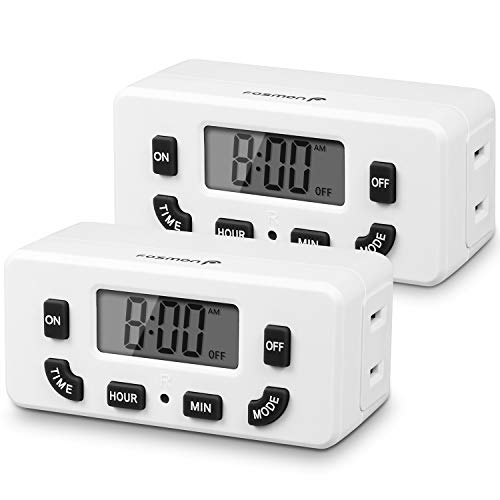
Best for: users who want a user-friendly interface with a clear LCD readout and a backup battery. The timer supports a range of devices from lighting to small heaters and aquarium equipment. A limitation is that the timer uses a 125V/15A rating and may be less suitable for high-draw devices beyond typical aquarium equipment.
DEWENWILS 24 Hour Programmable Digital Timer Outlet (Two Pack, Dual Outlets)

Best for: two-outlet control with daily programs and advanced features like random occupancy mode to mimic presence when away. This model provides two grounded outlets and a large display for precise timing. A potential limitation is that it may require careful planning to avoid simultaneous ON events for devices that shouldn’t run together.
Buying Guide: Key Purchase Considerations
- Outlet count and layout: Choose a timer that matches how many devices you need to control. Single-outlet models are compact; multi-outlet timers simplify wiring for several aquarium devices.
- Program settings: Look for daily repeat schedules, the minimum on/off interval, and the number of programmable events per day. More events offer finer control of light cycles and filtration.
- Memory and backup power: A backup battery preserves programs during outages. Check how long the memory lasts and whether power interruptions reset schedules.
- Display and interface: A large, easy-to-read display reduces setup errors. Side switches or quick-access modes help select ON/AUTO/OFF quickly.
- Safety and certification: ETL, FCC, or RoHS certifications indicate compliance and safety for home use. For aquarium setups, ensure the timer’s rated current matches your loads.
- Durability and noise: Quiet timers are preferable for bedrooms or living spaces near the tank. A compact, low-profile design reduces clutter on power strips.
- Random/occupancy modes: If you travel or want a “lived-in” look to deter theft, some timers offer randomization modes that mimic normal day/night activity.
Frequently Asked Questions
- How many devices should I control with a timer for an average freshwater tank?
– For most setups, two to four devices (lighting and filtration) can be managed with a single multi-outlet timer or two separate timers, depending on blow-by needs. - Can I use these timers with LED aquarium lights?
– Yes, most timers are compatible with LEDs as long as the total current stays within the timer’s rated load. - What is the purpose of a memory backup?
– It preserves programmed on/off times during power outages so you don’t need to reprogram after restoration. - Is a mechanical timer better than a digital timer for aquariums?
– Digital timers offer more precise schedules and multiple daily events; mechanical timers are simple but less flexible. - Should I choose a timer with a random mode?
– Random modes help homeowners simulate occupancy when away, which can be beneficial for security and consistent lighting patterns nearby.