Answering the common question, this guide highlights the best aquarium CO2 regulators with solenoids designed for planted tanks. These units balance precision, safety, and ease of use for hobbyists who want steady CO2 delivery without leaks. They’re ideal for beginners seeking a reliable starter kit and experienced hobbyists upgrading from basic setups. The top five options below are chosen for stable pressure, clear readouts, and practical features like bubble counters and check valves.
Buyer-friendly overview table
| Product | Best For | Notable Feature | Potential Limitation |
|---|---|---|---|
| FZONE DC Solenoid Regulator (CG A320) | Small to mid-size tanks | Split-type 12V DC solenoid; bubble counter | Single-stage design |
| FZONE Pro Series Dual Stage Regulator | Larger tanks or multi-tank setups | Dual stage; independent manifolds | More complex installation |
| FZONE Mini Series V3.0 Dual Stage | Front-of-tank placement, compact setups | Triple stage feel; 12V DC solenoid | Smaller footprint may limit outlets |
| FZONE CO2 Regulator Kit with Diffuser | Compact planted tanks | Integrated diffuser; 12V DC solenoid | All-in-one unit may limit customization |
| Hygger Dual Gauge with Motorized Valve | Two-tank or expandable systems | Motorized valve; expandable manifold | Timer-dependent operation required for automation |
FZONE Aquarium Co2 Regulator DC Solenoid with Bubble Counter

Best for small to mid-size aquariums, this regulator features a 12V DC solenoid and a bubble counter with a check valve. It provides precise flow control suitable for hobbyists who want predictable CO2 delivery, with an emphasis on safety and leak prevention. The unit is designed for CGA320 cylinders and includes tools for setup. The main caveat is that it is a single-stage regulator, which can be less forgiving on very large tanks or high CO2 demand compared with dual-stage models.
- Best for: compact planted tanks and hobbyists who prioritize a simple, reliable solenoid setup.
- Why selected: stable, easy-to-read bubble counter; safety-focused design with a check valve.
- Limitation: single-stage design may show larger fluctuations in high-demand systems.
FZONE Pro Series Dual Stage CO2 Regulator
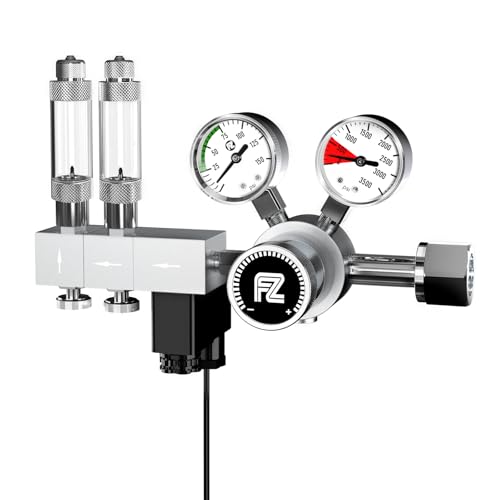
The Pro Series upgrades to dual-stage regulation for more consistent output, especially as tank pressure changes. It includes two independent manifold blocks, each with its own needle valve. This makes it well-suited for users who run two tanks or want precise, per-tank control. A built-in safety valve relieves pressure if it climbs too high. The downside is a more intricate installation and setup process, which may require careful wiring and plumbing for first-timers.
- Best for: multi-tank setups or larger aquariums needing stable CO2 pressure.
- Why selected: independent control blocks reduce cross-tank interference; automatic relief improves safety.
- Limitation: more complex to install and tune.
FZONE Aquarium CO2 Regulator Mini Series V3.0 Dual Stage
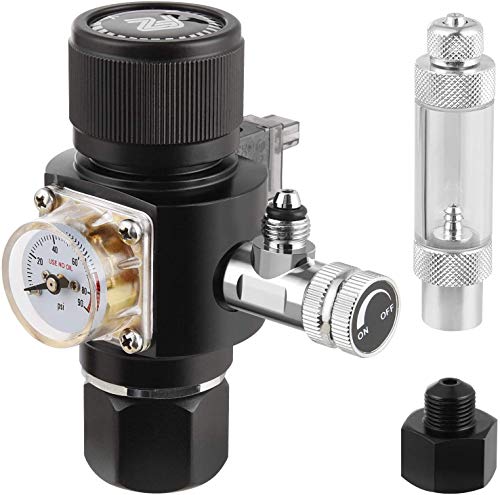
Designed for compact installations, the Mini Series V3.0 operats at 0-60 psi with a 12V DC solenoid and an integrated bubble counter. The triple-stage feel mentioned in features suggests enhanced stability of output, making it suitable for hobbyists who want a compact footprint without sacrificing control quality. Best for smaller tanks or wall-mounted setups. A potential limitation is the reduced number of outlets in the compact design, limiting expansion without adding a separate manifold.
- Best for: small planted tanks or space-constrained setups.
- Why selected: high-precision needle valve with compact form factor.
- Limitation: limited expansion options compared to larger manifolds.
FZONE CO2 Regulator Kit With Diffuser
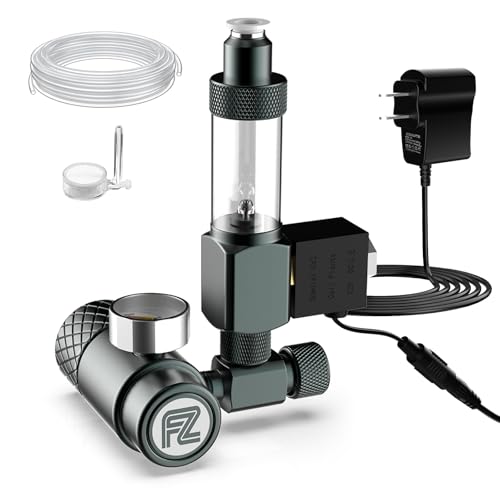
This kit emphasizes a compact aesthetic by integrating the regulator, solenoid, and bubble counter into one unit. It’s ideal for small to mid-size planted tanks where a tidy appearance matters. The 12V DC solenoid supports safer operation with stable CO2 delivery. The main caveat is that all components are integrated; users who want to customize individual parts may prefer separate regulators and diffusers.
- Best for: clean setups in small to mid-size tanks.
- Why selected: integrated unit saves space and reduces clutter.
- Limitation: limited customization of individual components.
Hygger CO2 Aquarium Regulator with 12V DC Solenoid

The Hygger unit uses durable aluminum and includes a dual gauge display for working pressure and tank pressure. It features a 12V DC solenoid and an upgraded bubble counter with a check valve to prevent backflow. This model is well-suited for hobbyists who want a robust, expandable setup that can support more than one tank with careful flow control. A limitation is that expansion or automation often depends on optional timers or additional components.
- Best for: durable, expandable CO2 systems in multi-tank arrangements.
- Why selected: dual gauge display with precise flow control and safe operation.
- Limitation: may require extra components for full automation.
JARDLI Dual Stage CO2 Regulator

JARDLI’s regulator features a dual-stage design with an integrated relief valve and a red LED indicator for the 12V DC solenoid. It provides adjustable output from 0-60 psi to suit a wide range of aquarium sizes. The dual stainless steel gauges give a clear read on both working and tank pressures. It’s a solid choice for serious hobbyists who want reliable, constant CO2 delivery and a straightforward setup. The LED indicator helps in quick on/off status checks but may be unnecessary for fully automated systems.
- Best for: serious hobbyists needing constant CO2 and clear pressure readouts.
- Why selected: dual-stage protection and easy-to-read gauges.
- Limitation: requires careful tuning to avoid over-pressurizing.
Hygger CO2 Upgraded Regulator With Motorized Valve

This Hygger kit is designed for expandable, multi-tank CO2 systems. It includes two bubble counters and a motorized valve with a timer for automation. The quick-connect fittings make setup straightforward, and the motorized valve reduces heat generation compared with traditional continuous-operation solenoids. It’s best for users who want a scalable, timer-controlled CO2 solution. The main caveat is that automation depends on matching the timer to your schedule, which may require some configuration.
- Best for: multi-tank setups with automated CO2 delivery.
- Why selected: motorized valve with timer improves energy efficiency and control.
- Limitation: automation requires proper timer setup with scheduling.
Aquarium CO2 Regulator Mini Kit with Detachable Design
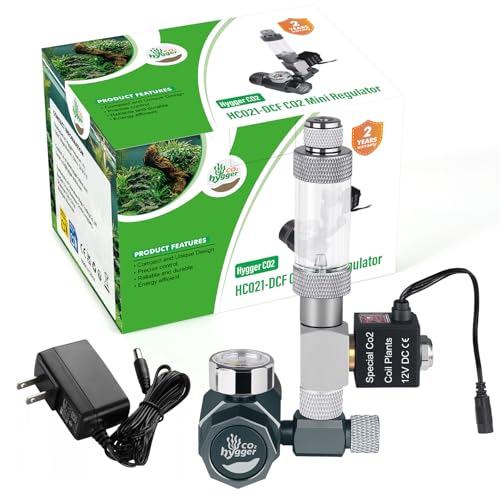
This Hygger model emphasizes a detachable design and compatibility with CGA320 tanks, making it flexible for various setups. It delivers 1 bubble per 3 seconds through a precise needle valve and includes a 12V DC solenoid for quieter operation and improved safety. The detachable feature facilitates maintenance and customization for users who like to customize their CO2 path. A note: ensure compatibility with your specific diffuser and atomizer brand before purchase.
- Best for: detachable design enthusiasts and CGA320-compatible systems.
- Why selected: high-precision tuning and safe, quiet operation.
- Limitation: detachable design may complicate assembly for beginners.
Buying Guide: Key Considerations for CO2 Regulators With Solenoids
What should you evaluate when choosing a regulator?
- Tank size and number of tanks: If you run more than one aquarium, consider dual-stage regulators with multiple outlets or expandable manifolds.
- Regulation stage: Dual-stage regulators offer more stable pressure, especially as tank pressure drops.
- Solenoid type: 12V DC solenoids tend to run cooler and more quietly than AC models, with improved safety.
- Bubble counter and gauge readability: Clear readouts help you maintain precise dosing and diagnose issues quickly.
- Leak prevention: Bubble counters with check valves and quality seals reduce backflow risks and water intrusion.
- Automation options: Timers or motorized valves can automate dosing but require proper setup to avoid over- or under-delivery.
- Footprint and aesthetics: Compact, integrated units help keep tanks clean and accessible, especially in tight spaces.
- Compatibility: Confirm CGA320 compatibility with your CO2 cylinder and your tank’s diffuser.
Frequently Asked Questions
- What is the difference between single-stage and dual-stage regulators?
Single-stage regulators regulate CO2 pressure through a single valve, which can lead to more fluctuation as tank pressure changes. Dual-stage regulators use two valves to maintain steadier pressure and flow, reducing end-of-tank dumps.
- Why choose a 12V DC solenoid over an AC solenoid?
12V DC solenoids generally run cooler, use less power, and produce less heat, which is beneficial for exposed installations near aquariums.
- How important is a bubble counter?
A bubble counter provides a direct visual readout of CO2 flow rate, helping you maintain precise dosing and quickly identify anomalies in the system.
- Can I run CO2 regulators on two tanks from a single regulator?
Yes, many dual-stage regulators come with multiple outlets or expandable manifolds, but ensure your regulator’s maximum flow rate matches the total demand.
- What should I check for leaks?
Inspect seals and joints; ensure bubble counters and valves are tight, and confirm the safety relief valve is unobstructed and functioning following the manufacturer’s instructions.
- Is automation necessary for CO2 dosing?
Automation helps maintain consistent dosing on a schedule, especially in multi-tank systems, but it requires correct setup and monitoring to prevent over-dosing.