Answering the need for accurate, practical alkalinity testing in saltwater setups, this guide highlights the best-tested options for hobbyists and professionals. These kits help monitor alkalinity, calcium, and magnesium, ensuring stable reef health and coral growth. Choose based on accuracy, test count, and ease of use. This selection focuses on 5 reliable options ideal for reef tanks, mixed reefs, and serious hobbyists who want consistent water chemistry. The following table summarizes each product’s suitability for quick reference.
| Product | Best For |
|---|---|
| Salifert Alkalinity Calcium Magnesium Combo Test Kit | All-in-one accuracy for reef tanks needing precise Ca, Mg, and KH |
| Monitor Alkalinity Test KIT for Coral & Reef | High-volume testing; 120 tests for large systems |
| Hanna Instruments HI755 Checker HC | Simple, quick readings with a colorimeter |
| Salifert Carbonate Hardness & Alkalinity (Kh/Alk) | KH/Alk specific tests; high-volume refills |
| API Saltwater Master Test Kit 550-Test | Comprehensive monitoring of key parameters |
Salifert Alkalinity Calcium Magnesium Combo Test Kit

Designed to measure alkalinity, calcium, and magnesium, this Salifert kit uses drop titration to yield precise results. It is best for reef keepers who want a single kit covering multiple essential minerals. The kit’s user-friendly approach suits hobbyists who prefer a straightforward procedure with clear end results. A potential limitation is that results depend on careful droplet timing and color interpretation, which may require a small learning curve for beginners.
Best for: Reef tanks requiring accurate multi-mineral readings; experienced hobbyists who value reliability and integrated testing in one kit.
Monitor Alkalinity Test KIT for Coral & Reef (120 Tests)

This kit targets alkalinity (KH) in saltwater reef aquariums with a broad 0–15.7 dKH range and 0.16 dKH resolution per 0.01 ml syringe. With 120 tests included, it’s well-suited for large systems or frequent testing schedules. The method provides repeatable results suitable for tracking long-term stability. A caveat is that color-based readings may require careful comparison to the provided color chart and consistent technique.
Best for: Large or heavily stocked reef systems needing frequent, economical KH monitoring with many tests per kit.
Hanna Instruments HI755 Checker HC Low Range

The HI755 Checker HC offers a compact, colorimeter-based approach with single-button operation and a large LCD. It is more convenient and often faster than chemical test kits, making it ideal for hobbyists who want quick, repeatable results with minimal handling. The main trade-off is that colorimeter-based devices may require routine maintenance and calibration checks to maintain accuracy over time.
Best for: Small to medium tanks and quick daily checks; users who value speed and ease over multi-parameter testing in one kit.
Salifert Carbonate Hardness & Alkalinity Kit
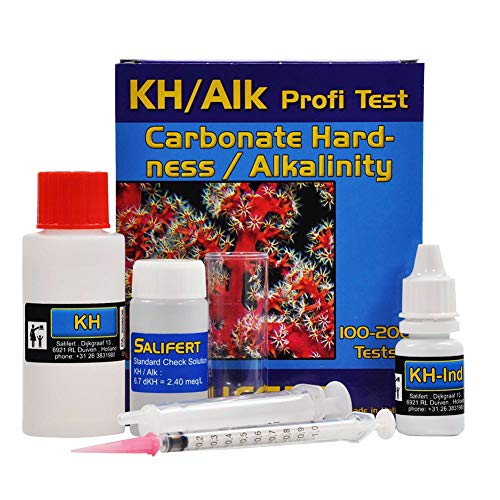
This Salifert KH/Alk kit focuses specifically on carbonate hardness and alkalinity, offering a targeted approach for maintaining stable reef conditions. It is best for users who want a deeper KH/Alk assessment without the broader calcium and magnesium readings. A limitation is that it may require separate kits for a full mineral profile, increasing overall cost and handling steps.
Best for: Reef keepers prioritizing KH and alkalinity stability; those who already track calcium and magnesium separately.
API Saltwater Master Test Kit
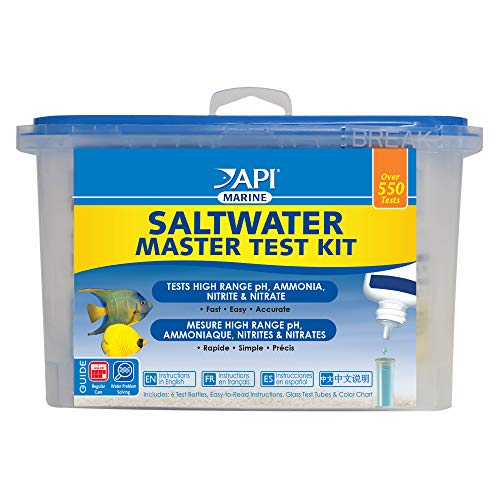
API’s Saltwater Master Test Kit covers four key parameters: high range pH, ammonia, nitrite, and nitrate. While not exclusively an alkalinity kit, it provides a broad baseline for saltwater tanks and helps detect issues that can indirectly impact alkalinity management. It’s best for hobbyists seeking a comprehensive starter kit or households with multiple tanks. A limitation is that it doesn’t include a dedicated alkalinity test in the same cup-and-drop format as KH-focused kits.
Best for: New or mixed reef environments needing a broad monitoring tool; users who prefer a single kit for multiple water parameters.
Buying Guide: Key Considerations For Saltwater Alkalinity Testing
- Test method: Choose between titration-based chemical kits and colorimetric handheld readers. Titration kits tend to be precise for KH/ALK and Ca/Mg, while colorimeters offer quick results with less manual interpretation.
- Test count: Large systems benefit from kits with many tests per bottle. For busy schedules, 120+ tests can reduce replacement frequency.
- Comprehensiveness: If you need a full mineral profile, consider multi-parameter kits or mixtures of KH/ALK and Ca/Mg tests. Some kits focus on KH/ALK only, while others cover additional minerals.
- Ease of use: Look for straightforward instructions, fewer steps, and clear color charts or digital readouts to minimize operator error.
- Accuracy and calibration: Regular calibration checks and clear documentation help ensure consistent results across tests and time.
- Tank size and livestock: Larger, more demanding systems require more frequent testing and higher test counts to maintain stable parameters.
FAQ
- What is the best test kit for KH in a reef tank?
Salifert KH/Alk or the Monitor KH test kits are common choices for precise alkalinity and carbonate hardness in reef setups.
- How often should I test alkalinity in a WS reef tank?
Test frequency depends on stability; daily to weekly checks are common during adjustments or new setups, then weekly to biweekly for established systems.
- Are colorimeter kits more accurate than chemical drop tests?
Colorimeters can be quicker and easier, but accuracy relies on calibration and proper sample handling, similar to chemical kits.
- Can I use an API kit to monitor KH?
API’s kit is a broader master test set; it may not include KH with the same specificity as KH-focused kits, so use it as part of a broader testing plan.
- Should I test calcium and magnesium together with alkalinity?
For reef tanks, a combined approach helps maintain balanced mineral levels; many hobbyists use dedicated KH/Alk tests alongside Ca/Mg tests.
- What should I do if alkalinity drops suddenly?
Identify possible causes such as dosing adjustments, water changes, or biological uptake, then recheck KH and adjust dosing or water changes accordingly.